


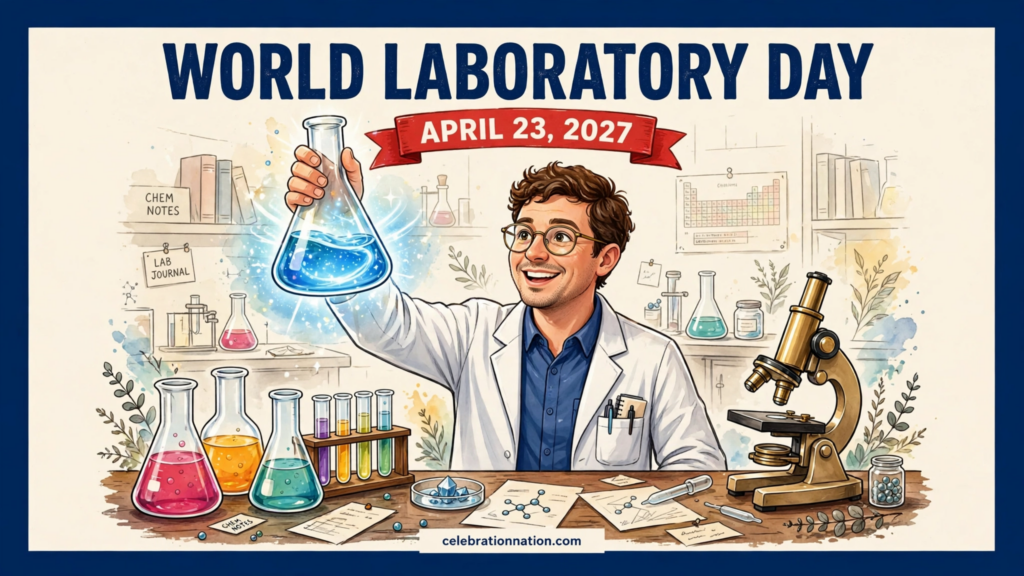
World Laboratory Day
Every year on April 23, we raise a beaker to the rooms where discovery happens. World Laboratory Day celebrates laboratories themselves, the unique workspaces that provide controlled conditions for scientific research, experiments, and measurement, along with the scientists, technicians, and researchers who fill them.
- Also on Apr 23
- International Pixel-Stained Technopeasant · English Language Day · Spanish Language Day
- Hashtag
- #WorldLaboratoryDay
WORLD LABORATORY DAY
Every year on April 23, we raise a beaker to the rooms where discovery happens. World Laboratory Day celebrates laboratories themselves, the unique workspaces that provide controlled conditions for scientific research, experiments, and measurement, along with the scientists, technicians, and researchers who fill them.
Think about the last great scientific breakthrough you heard about: a new vaccine, a cleaner battery, a safer food supply, a clearer picture of a distant galaxy. Every one of them began in a laboratory. Labs are the workshops of human curiosity, places designed so that careful questions can be asked and answered without the noise of the outside world getting in. On April 23, 2027, the world pauses to appreciate these temples of discovery and the people who keep their burners lit.
The laboratory has a longer history than most people realize. The earliest known laboratory is often attributed to Pythagoras of Samos, the Greek philosopher who conducted experiments with sound. In the Middle Ages, alchemists and apothecaries developed many of the basic techniques of laboratory work, distillation, crystallization, and careful measurement, even as they chased goals that now seem fanciful. Their painstaking methods, passed down through generations, became the foundation of modern experimental science.
The modern laboratory as we know it emerged in the late 19th century, during the Second Industrial Revolution, when applied science began to move from the workshops of lone inventors into organized teams. All sorts of new laboratory equipment appeared in those decades, and research became a collaborative enterprise. Then came the era of big science during and after World War II, when breakthroughs increasingly depended on large-scale projects funded at a national level. Facilities like the Radiation Laboratory at MIT, the laboratories at Berkeley and the University of Chicago, and the secret research sites at Los Alamos, Hanford, and Oak Ridge showed what organized laboratory science could achieve, producing everything from radar and the computer to advances that reshaped the century.
Today, laboratories exist in more forms and places than ever before. They hum inside schools and universities, hospitals and clinics, corporate research centers, government and military facilities, forensic centers, and even aboard spacecraft orbiting the Earth. Some are vast national facilities with particle accelerators; others are a single bench in a high school classroom. What unites them is the same disciplined curiosity: control the conditions, measure carefully, and let the evidence speak.
The day also honors the people behind the benches. Laboratory professionals, scientists, researchers, technologists, and technicians, do work that demands precision, patience, and integrity. They follow strict safety standards and quality practices, they document everything, and they repeat experiments until the results hold. Much of their work is quiet and methodical, far from the spotlight, but it underpins nearly every aspect of modern life, from the medicines in our cabinets to the materials in our phones.
World Laboratory Day is also a day for opening doors. Around the world, institutions mark the occasion with open houses, guided lab tours, public lectures, student competitions, and social media campaigns that pull back the curtain on scientific work. It is a chance for students to picture themselves in a lab coat, for neighbors to meet the researchers down the street, and for everyone to remember that science is not some distant abstraction. It happens in rooms full of beakers and instruments, worked by real people, and it is always looking for the next curious mind.
Louis Pasteur, whose own laboratory work transformed medicine, once pleaded for the world to take interest in laboratories, calling them the places where humanity would grow, strengthen, and improve. He was right in ways he could hardly have imagined: the discoveries made under lab lights have doubled human life expectancy, connected the planet, and carried instruments to other worlds. On April 23, 2027, whether you visit a lab, run an experiment at the kitchen table, or simply thank a scientist, you are joining a global celebration of the most productive rooms ever built.
THE STORY BEHIND WORLD LABORATORY DAY
🏺 Ancient Roots
The story of the laboratory stretches back to antiquity. The Greek philosopher Pythagoras is credited with one of the earliest known laboratories, where he experimented with sound. Centuries later, medieval alchemists and apothecaries developed the basic techniques of distillation, crystallization, and careful measurement that experimental science still relies on today.
⚡️ The Industrial Lab Is Born
During the Second Industrial Revolution in the late 19th century, research moved from lone inventors into organized teams. New laboratory equipment flourished, applied science took center stage, and the modern research laboratory began to take the shape we recognize today, with specialized instruments, shared methods, and teams working side by side.
💥 The Age of Big Science
World War II and its aftermath ushered in big science: large-scale, nationally funded laboratory projects. From the Radiation Laboratory at MIT to Los Alamos, Hanford, and Oak Ridge, these facilities produced radar, the computer, and advances in physics and chemistry that reshaped the modern world and defined what laboratories could achieve.
🔬 One Date, Two Meanings
World Laboratory Day on April 23 celebrates laboratories and the people who work in them. It is distinct from the World Day for Laboratory Animals on April 24, established in 1979 by the National Anti-Vivisection Society on the birthday of Lord Hugh Dowding, which commemorates animals used in research. Same week, very different observances, so mark your calendar carefully.
WAYS TO CELEBRATE
🧪 Run a Kitchen Laboratory
Set up your own home lab with safe, simple experiments: grow crystals in a jar, test pH with red cabbage juice, or build a volcano that erupts on command. Grab a notebook, record your observations like a real researcher, and remember that every great scientist started out curious at home. Safety goggles optional but encouraged.
🏫️ Tour a Real Lab or Science Museum
Many institutions open their doors for World Laboratory Day with tours, demonstrations, and hands-on exhibits. Bring friends or family, meet working scientists, ask them what they are excited about, and see the instruments behind the discoveries you read about in the news.
🗣 Thank a Scientist
Reach out to a teacher, researcher, lab tech, or healthcare worker and tell them their work matters. Share a favorite discovery on social media and tag the people behind it. Recognition fuels curiosity, and curiosity fuels the next breakthrough. A little gratitude goes a long way in a lab coat.
Celebrate World Laboratory Day
On April 23, 2027, take a moment to appreciate the laboratories where human knowledge grows. Discovery has an address, and today we celebrate it.
Plan ahead
World Laboratory Day is observed on April 23 every year. Here is where it lands for the next ten years, handy for planners, marketers and party people.
Keep the party going
See the calendar
Celebrate every day, all year
Official gear from the people who track 1,700+ celebrations.
Browse the shop 2027 National Day Wall CalendarGet the 2026 edition free. 1,700+ observances.
Never miss a reason to celebrate.
One quick morning email with today's celebrations, ideas and posters. Free, unsubscribe anytime.
🎉 You're on the list! Watch your inbox for The Daily Confetti.