Health Literacy Month
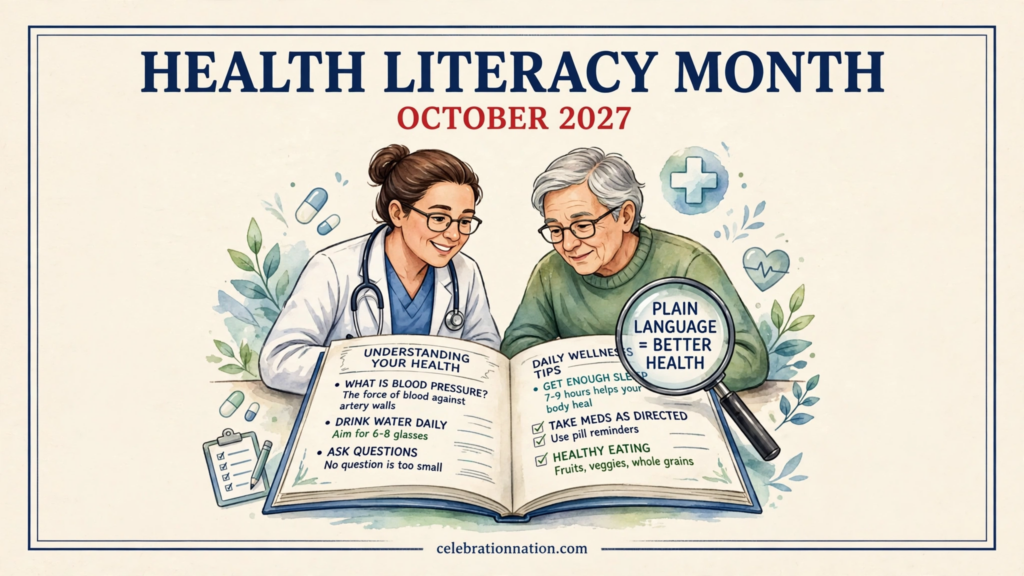
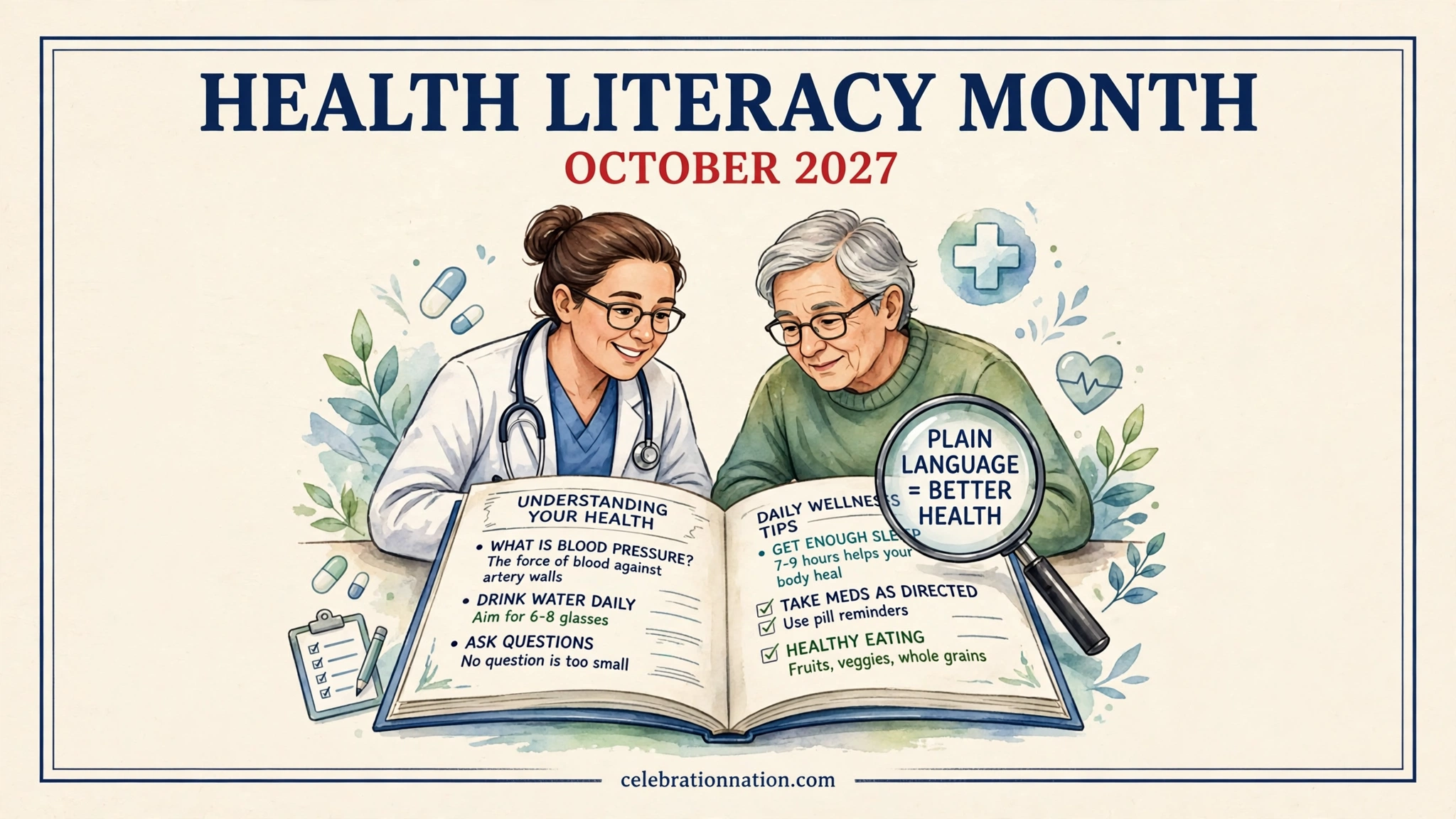
Every October, Health Literacy Month shines a light on something that quietly shapes every doctor visit, every prescription label, and every health decision: clear, understandable health information. Founded in 1999 by health literacy consultant Helen Osborne, the worldwide observance asks a simple question. Can you find, understand, and use the health information you need? It is a cause that touches every family, because everyone, at some point, must make sense of medical words that seem written for someone else. In 2027, it runs October 1 through October 31.
- Hashtag
- #HealthLiteracyMonth
HEALTH LITERACY MONTH
Every October, Health Literacy Month shines a light on something that quietly shapes every doctor visit, every prescription label, and every health decision: clear, understandable health information. Founded in 1999 by health literacy consultant Helen Osborne, the worldwide observance asks a simple question. Can you find, understand, and use the health information you need? It is a cause that touches every family, because everyone, at some point, must make sense of medical words that seem written for someone else. In 2027, it runs October 1 through October 31.
Health literacy is the ability to find, understand, and use information and services to make health-related decisions, a definition refined by Healthy People 2030 into two parts: personal health literacy, what individuals are able to do, and organizational health literacy, how well organizations make information and services accessible and understandable. In daily life it covers reading a medicine label correctly, knowing when a symptom needs prompt care, communicating clearly with a provider, navigating insurance forms and patient portals, and managing a chronic condition between visits. When health information is written in plain language and delivered with patience, people make safer choices, follow treatment plans more reliably, and get better results from the care they receive. Clarity, in other words, is a form of care.
The need for clearer communication is enormous. More than 90 million adults in the United States have low health literacy, according to the National Institutes of Health, and the National Assessment of Adult Literacy found that nine out of ten adults lack the skills needed to maintain their health and prevent disease. Adults with low health literacy are more likely to report poor health, less likely to have health insurance, more likely to struggle with chronic disease management, and more likely to end up hospitalized. Researchers have estimated that low levels of health literacy cost the United States economy up to 236 billion dollars each year, a burden felt personally in households, broadly in communities, and nationally in the health system. Behind every one of those statistics is a person who deserved information they could actually use.
Momentum behind the cause has been building for decades. In 2004, the Institute of Medicine’s landmark report, Health Literacy: A Prescription to End Confusion, brought the issue into the medical mainstream and gave the young field serious credibility with clinicians and policymakers alike. It was followed by support from the American Medical Association Foundation and pharmaceutical partners for health literacy research, tools, and training initiatives, and then by milestones including the Plain Writing Act and the National Action Plan to Improve Health Literacy. By around 2010, federal health officials were describing health literacy as having reached a genuine tipping point. Today the Institute for Healthcare Advancement coordinates the observance’s planning and promotion, and the annual theme, Be a Health Literacy Hero, honors the people and teams who spot communication problems and act to fix them.
Anyone can be part of the solution, starting at their very next appointment. Bring a short written list of questions and keep asking until the answers make sense in everyday words. Bring an up-to-date list of every medication, vitamin, and supplement you take, and ask the pharmacist to walk through anything unfamiliar. If an explanation still sounds like jargon, try saying, “Could you explain that another way?” Most clinicians welcome the chance to be clearer. Reliable, plain-language resources like MedlinePlus can help you prepare before a visit and review what you heard afterward. Health Literacy Month is a reminder that understanding your care is not a luxury or a favor. It is your right, and asking for clarity is one of the healthiest habits there is.
THE STORY BEHIND HEALTH LITERACY MONTH
💬 The 1999 Listserv Post
Health Literacy Month began with a single email. Soon after starting her own health literacy consulting business, founder Helen Osborne joined the New England chapter of the National Speakers Association, where she heard a fellow speaker describe how she had started her own themed holiday. Osborne thought health literacy deserved one too, so without really knowing what she was getting into, she posted a message to a health literacy listserv asking, “Health Literacy Month. How does that sound to you?” Nearly 50 people replied within days, many answering with some version of, “Great idea. What are YOU going to do?” And so began Health Literacy Month. That was in 1999, and it has been going strong ever since, growing from one brave post into a worldwide observance.
📅 Why October
Osborne gave the choice of month real thought. She envisioned Health Literacy Month as open to everyone worldwide, so she chose October for its generally good weather and its lack of competing holidays, a practical decision meant to make the observance easy to adopt anywhere on the calendar. In the United States, she also noted that October falls just before elections, when politicians are happy to be photographed doing good deeds alongside people advocating for clear health communication. October also happens to host a great many health-related observances, so the month fits right in among friends.
📖 A Prescription to End Confusion
In 2004, the Institute of Medicine released Health Literacy: A Prescription to End Confusion, a landmark report that brought the issue considerably more mainstream medical attention and gave the field real momentum. The American Medical Association Foundation and pharmaceutical company Pfizer followed with support for health literacy research, tools, and training initiatives. By around 2010, then-Assistant Secretary of Health Howard Koh described health literacy as having reached a genuine tipping point, citing milestones like the Plain Writing Act and the National Action Plan to Improve Health Literacy. A field that started with a listserv post was now shaping national policy.
🦸 Be a Health Literacy Hero
The observance’s theme, Be a Health Literacy Hero, turns the spotlight on individuals, teams, and organizations who not only identify health literacy problems but take action to solve them. A hero might be a pharmacist who rewrites confusing labels in plain words, a clinic that redesigns its intake forms so patients actually understand them, a librarian who guides neighbors through a patient portal, or a family member who sits in on appointments and asks the follow-up questions. Anyone can take part by recognizing and cheering on the clear communicators in their own community.
🌍 A Worldwide Effort
What began with one listserv post is now marked with local and national awareness efforts across the United States, Canada, and overseas, as well as online. Organizations in healthcare, education, and social services use October to host workshops, share resources, publish plain language materials, and teach the public why health literacy matters for every age and every background. The Institute for Healthcare Advancement now coordinates the observance’s ongoing planning and promotion, a role founder Helen Osborne originally held herself, carrying one woman’s good idea into its third decade and beyond.
WAYS TO CELEBRATE
📝 Ask One Plain-Language Question
Bring a short written list of questions to every appointment and keep asking until the answers make sense in everyday words. No question is too small when it concerns your health, and most clinicians welcome the chance to be clearer.
🦸 Name Your Health Literacy Hero
Think of a nurse, pharmacist, librarian, or neighbor who explains health information clearly, thank them, and tell friends why clear communication matters. Recognition encourages more of the plain speaking everyone deserves.
📚 Host a Clear-Communication Workshop
Partner with a library, clinic, or community center to run an October session on reading prescription labels, using patient portals, or preparing for doctor visits. Practical skills, taught kindly, change health outcomes.
Celebrate Health Literacy Month
Clear words lead to healthier lives. This October, be the reason someone finally understands.
Coming up next
See the calendar
Celebrate every day, all year
Official gear from the people who track 1,700+ celebrations.
Browse the shop 2027 Wall + Desk Calendar BundleCelebrate every day at home and at work.
Never miss a reason to celebrate.
One quick morning email with today's celebrations, ideas and posters. Free, unsubscribe anytime.
🎉 You're on the list! Watch your inbox for The Daily Confetti.