
National Ergonomics Month
Every October, National Ergonomics Month asks a simple but powerful question: does your workspace fit you, or do you bend to fit it? Designated by the Human Factors and Ergonomics Society in 2003, the month promotes the science of designing work around human bodies and minds. Your body is the most precise instrument you will ever own, and this month is about treating it that way. In 2027, it runs October 1 through October 31.
- Hashtag
- #NationalErgonomicsMonth
NATIONAL ERGONOMICS MONTH
Every October, National Ergonomics Month asks a simple but powerful question: does your workspace fit you, or do you bend to fit it? Designated by the Human Factors and Ergonomics Society in 2003, the month promotes the science of designing work around human bodies and minds. Your body is the most precise instrument you will ever own, and this month is about treating it that way. In 2027, it runs October 1 through October 31.
Ergonomics comes from the Greek words ergon, meaning work, and nomos, meaning laws: quite literally, the science of work. Also called human factors, the field studies how people interact with tools, equipment, workstations, and processes, drawing on psychology, engineering, physiology, biomechanics, kinesiology, and design. Its goal is to minimize or eliminate exposure to injury risk factors by shaping the job to fit the person, not the other way around. If something in your day feels easier, safer, or more comfortable than it used to be, from a split keyboard to a car seat that tilts just right to a cockpit laid out so pilots cannot mix up the controls, there is a good chance ergonomics had a hand in it. Good design is invisible, and that is the point.
The stakes are real and measurable. According to the 2016 Liberty Mutual Workplace Safety Index, overexertion injuries account for about 25 percent of all nonfatal occupational injuries and illnesses, costing employers more than 15 billion dollars. Overexertion covers lifting, pushing, pulling, holding, carrying, and throwing, and that figure does not even include the repetitive motion injuries common among office workers hunched over keyboards. The risk is not limited to warehouses and construction sites: laboratories, food service, custodial work, maintenance, and home offices all carry ergonomic hazards. Simple changes, like raising a monitor to eye level, keeping wrists neutral, or alternating between sitting and standing, can prevent genuine pain and genuine costs.
The observance itself began in Denver. The Human Factors and Ergonomics Society launched the first National Ergonomics Month in October 2003 at its 47th annual meeting, with Denver’s mayor declaring October 13 through 17, 2003, Denver Human Factors and Ergonomics Week. The society set an ambitious goal: to introduce more than 10 million adults and over a million students to human factors concepts by the end of the decade, targeting students, businesses, consumers, and government alike. Standards bodies support the mission too: the American National Standards Institute and the Business and Institutional Furniture Manufacturers Association develop tested safety standards so workplace furniture truly supports the people who use it, boosting comfort and productivity while reducing injuries.
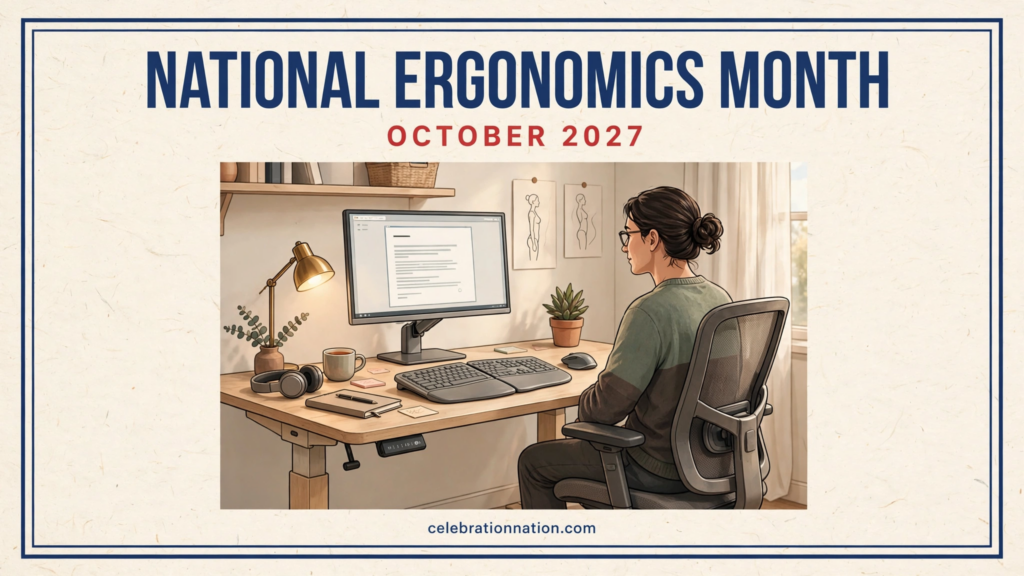
You do not need a consultant to start. Give your own setup a five-minute check this October. Position the top of your monitor at or just below eye level, about an arm’s length away, and keep your feet flat on the floor with elbows resting near 90 degrees. Keep wrists straight and floating over the keyboard rather than bent upward, and place the mouse close enough that your shoulder stays relaxed. Then build movement into the day: stand, stretch, and walk briefly every half hour or so, and give your eyes a break with the commonly recommended 20-20-20 habit, looking at something 20 feet away for 20 seconds every 20 minutes. Small, mindful adjustments compound into a workday that leaves you feeling better at 5 p.m. than you did at 9 a.m., and that is a gift worth giving yourself this October.
THE STORY BEHIND NATIONAL ERGONOMICS MONTH
🇬🇷 Ergon plus Nomos
The word itself is the story. In 1857, Polish professor Wojciech Jastrzebowski used the term ergonomics for the first time, combining the Greek words for work and laws into a single idea: that labor should follow principles, not just habits. Nearly a century later, in 1949, British psychologist Hywell Murrell helped make it the official name of a new scientific discipline devoted to fitting work to people. From a coined word in a Polish paper to a global science with its own societies, journals, and annual meetings, ergonomics has always been about respecting the human body and designing the world to suit it. The next time a door handle just feels right in your grip or a tool sits comfortably in your hand for hours, you are holding a small victory of this science.
✈️ The Cockpit Fix
In 1943, U.S. Army Lieutenant Alphonse Chapanis studied airplane crashes that had been blamed on pilot error and reached a different conclusion: the real problem was confusing cockpit design, with critical controls placed where tired pilots could easily grab the wrong one. His push for clearer, more logical controls showed the world that designing for humans saves lives, and his work became one of the founding stories of the field. It remains the classic lesson of ergonomics: when people err, the design often deserves the blame, and better design is the fix.
🏛️ A Society Is Born
The Human Factors and Ergonomics Society was founded in 1957 to promote the discovery and exchange of knowledge about designing systems and devices for human beings. The society remains the professional home of ergonomists and human factors specialists, publishing research, hosting annual meetings, and carrying the message to students, businesses, consumers, and government year after year. It is the organization behind National Ergonomics Month, and its members include the researchers and practitioners who quietly make everyday objects safer and easier to use.
📅 October 2003
The first National Ergonomics Month launched at the society’s 47th annual meeting in Denver, Colorado, in October 2003. To honor the occasion, Denver Mayor John Hickenlooper declared October 13 through 17, 2003, Denver Human Factors and Ergonomics Week, and the society set out to build awareness of what ergonomics adds to almost every facet of society. Local chapters, student groups, and individual members were invited to host events and enter action plan contests, turning a new observance into a grassroots movement from its very first year.
💪 The Cost of a Bad Fit
Overexertion injuries make up about a quarter of all nonfatal workplace injuries and illnesses, costing more than 15 billion dollars, according to the 2016 Liberty Mutual Workplace Safety Index. Those numbers cover only overexertion, not the repetitive motion injuries office workers know too well, from aching wrists to stiff necks. National Ergonomics Month is a reminder that a workstation assessment today, a monitor raised an inch, a chair adjusted properly, can prevent a workers’ compensation claim tomorrow. Comfort is not a perk. It is prevention, and October is the month to practice it.
WAYS TO CELEBRATE
🖥️ Audit Your Workstation
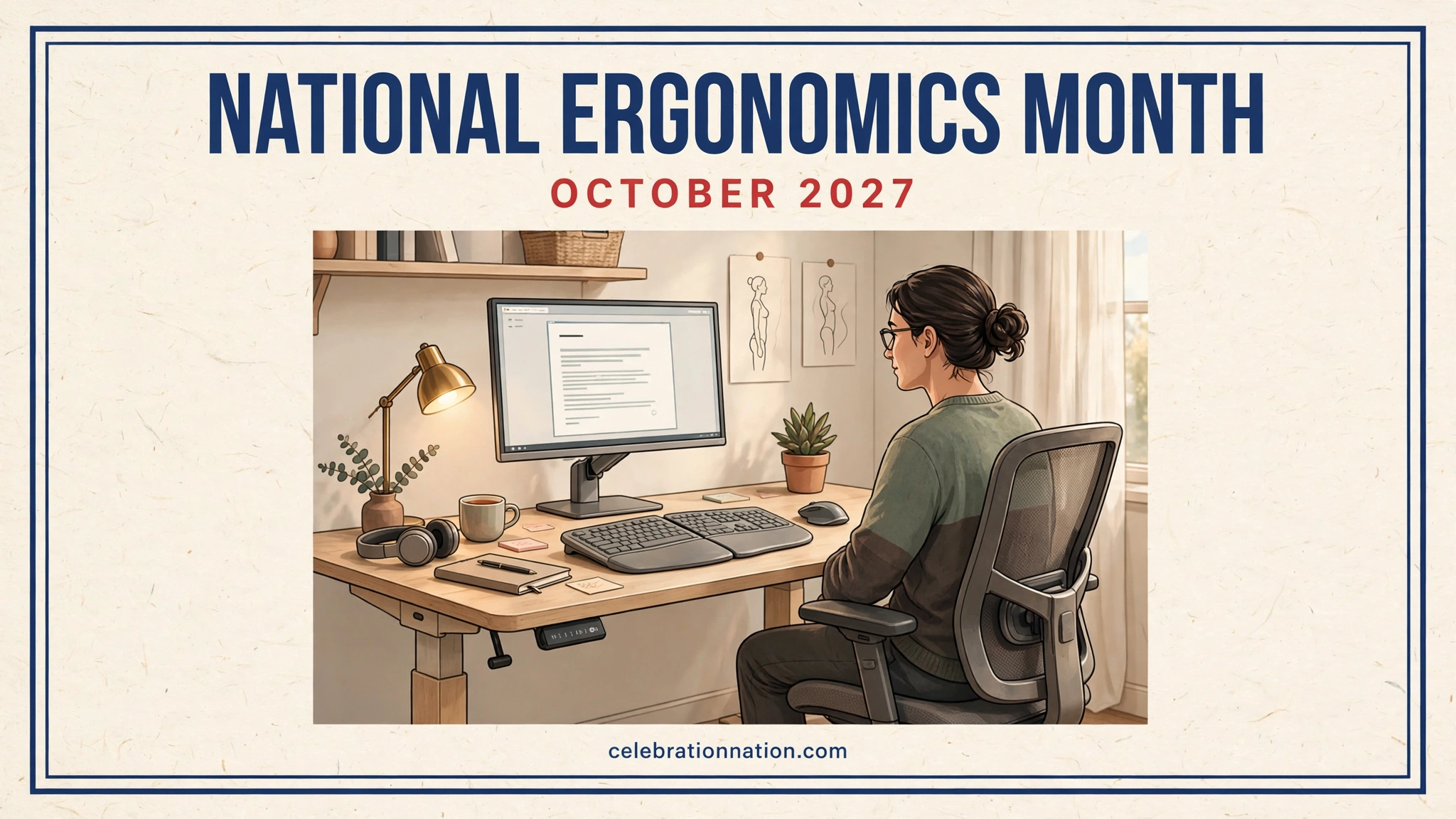
Set your monitor at eye level about an arm’s length away, keep feet flat and wrists neutral, and raise your chair so elbows rest near 90 degrees. Then add movement: stand, stretch, and walk briefly every half hour. Small adjustments add up fast.
🤸 Start a Stretch-Break Pact
Agree with coworkers, classmates, or housemates to stand, stretch, and move every 30 to 60 minutes. A shared reminder makes the habit stick, and a quick group stretch is a surprisingly good mood reset in the middle of a long day.
🏢 Request an Ergonomic Evaluation
Many employers and universities offer free workstation assessments through their safety or facilities teams. Ask your HR department or safety office for one and let a trained eye spot the risks you cannot see from your own chair. If your workplace lacks a program, suggest starting one this October.
Celebrate National Ergonomics Month
Work should not hurt. This October, make your workspace truly fit the most important tool in it: you. Your back, neck, wrists, and eyes will all thank you for years to come.
Coming up next
See the calendar

Celebrate every day, all year
Official gear from the people who track 1,700+ celebrations.
Browse the shop 2027 Wall + Desk Calendar BundleCelebrate every day at home and at work.
Never miss a reason to celebrate.
One quick morning email with today's celebrations, ideas and posters. Free, unsubscribe anytime.
🎉 You're on the list! Watch your inbox for The Daily Confetti.