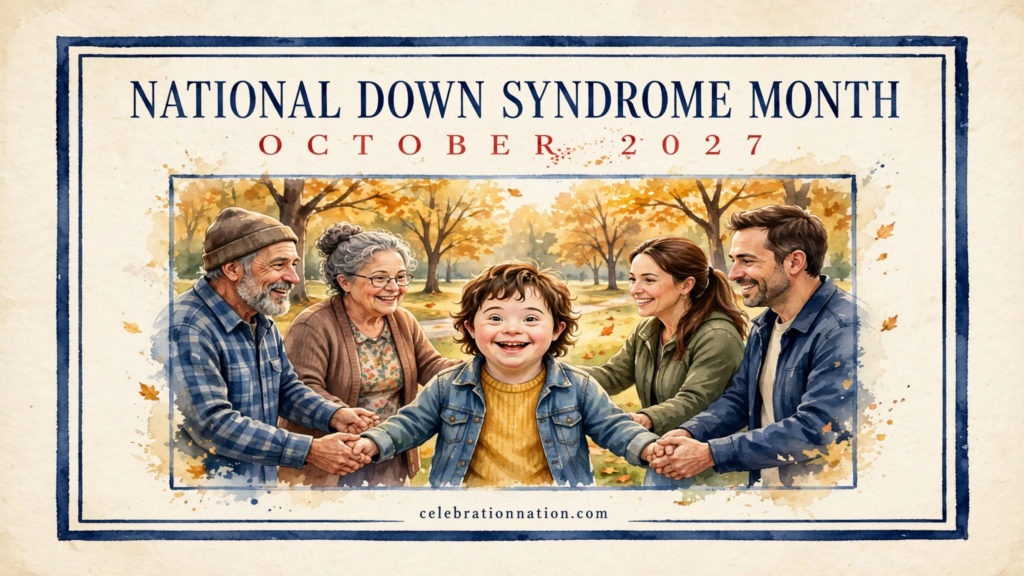
National Down Syndrome Month
Every October, the nation observes National Down Syndrome Month, honoring the abilities, achievements, and everyday joy of people with Down syndrome. Congress first designated the month in 1984, and President Ronald Reagan proclaimed it again in 1987, calling all Americans to celebrate the dignity of every life. This month reminds us that every person is more than a diagnosis.
- Hashtag
- #NationalDownSyndromeMonth
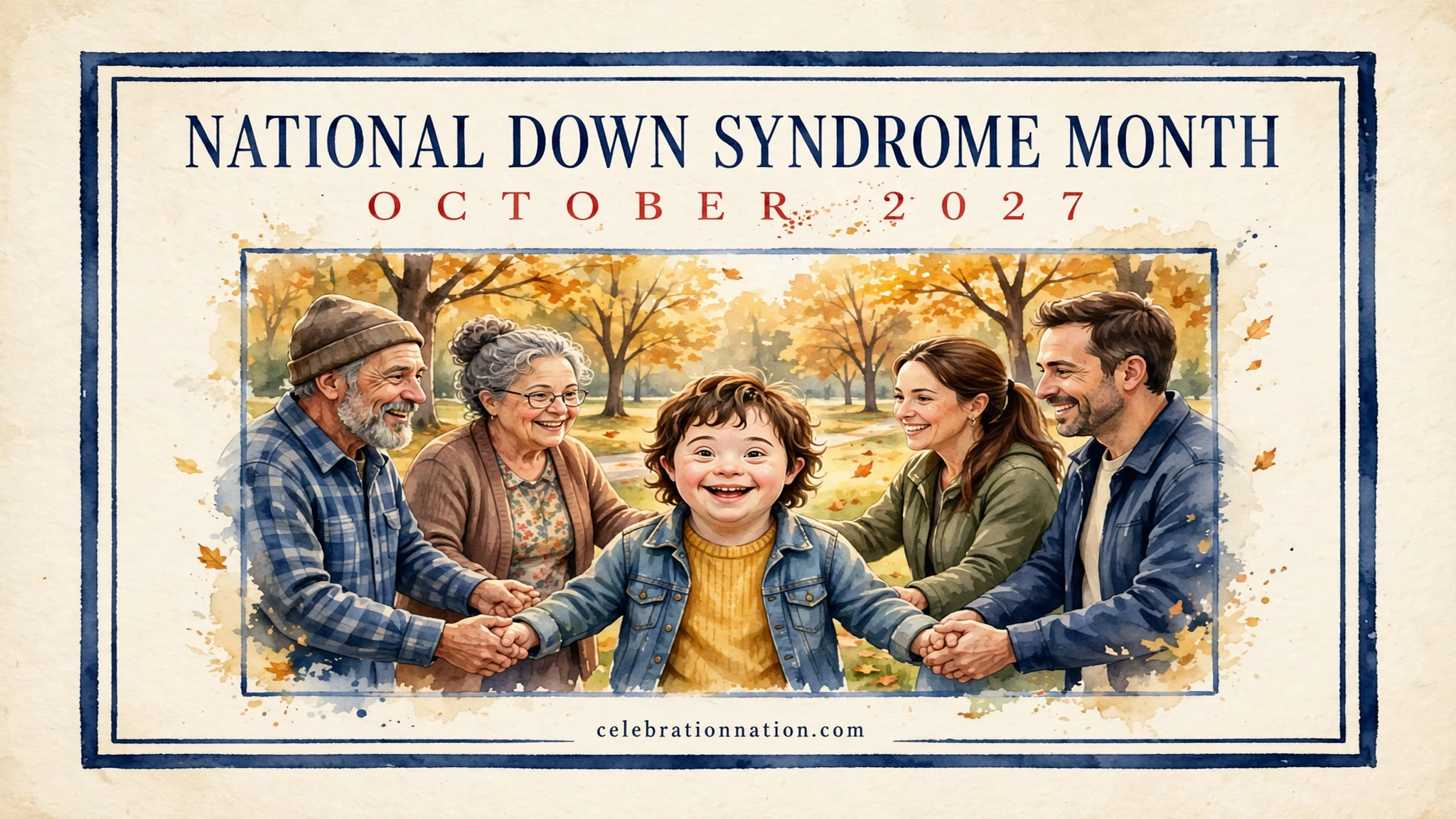
NATIONAL DOWN SYNDROME MONTH
Every October, the nation observes National Down Syndrome Month, honoring the abilities, achievements, and everyday joy of people with Down syndrome. Congress first designated the month in 1984, and President Ronald Reagan proclaimed it again in 1987, calling all Americans to celebrate the dignity of every life. This month reminds us that every person is more than a diagnosis.
National Down Syndrome Month is observed every October, honoring the abilities, achievements, and everyday joy of people with Down syndrome. Congress first designated the month in 1984, and President Ronald Reagan proclaimed October 1987 as National Down Syndrome Month, inviting all citizens, agencies, and organizations to unite in observances directed toward helping affected individuals and their families enjoy life to the fullest. The National Down Syndrome Congress and the National Down Syndrome Society worked in concert with the Public Health Service, the President’s Committee on Mental Retardation, and other government agencies to raise public awareness of the condition and of the capabilities of those who have it. Each October, the organization celebrates in a different way and invites everyone to get involved, share the message, and spread the word that people with Down syndrome are valued, capable members of their communities.
The congressional path to the month began with Public Law 98-437, approved September 28, 1984, which designated October 1984 as National Down’s Syndrome Month. Three years later, by Senate Joint Resolution 84, Congress asked the President to proclaim October 1987 as National Down Syndrome Month, and President Reagan did so on October 8, 1987. These were not empty honors. They were the product of years of advocacy by parent groups, physicians, teachers, and organizations determined to move public understanding from pity to respect. The proclamations invited all concerned citizens, agencies, and organizations to unite during October with appropriate observances and activities directed toward assisting affected individuals and their families.
Down syndrome is the most common chromosomal condition. It occurs when a person is born with a full or partial extra copy of the 21st chromosome, which changes how the body grows and learns. The condition is named for Dr. John Langdon Down, who identified it in 1862. About 6,000 babies, or one in every 700, are born with Down syndrome each year in the United States, and more than 400,000 people are living with the condition nationwide. It can happen to any family, regardless of race or economic status, and there is no known way to prevent it.
Public attitudes have traveled a long road. As recently as the 1950s and early 1960s, the birth of a child with Down syndrome was widely viewed as a tragedy, and doctors often discouraged parents from raising such children at home. Many children were placed in large state institutions, often in deplorable conditions, hidden from public view. The climate began to change when parents who refused that advice organized themselves, forming groups such as the National Association for Down Syndrome in 1960 and insisting, always, on the great value of individuals with Down syndrome. Medical advances, early intervention, and inclusive education have brightened the outlook ever since. The past decade has brought a greater and more enlightened attitude in the care and training of people with developmental disabilities, and the cost of services that help individuals with Down syndrome take their rightful place in society is but a tiny fraction of the cost of institutionalization.
What the month celebrates most is ability. People with Down syndrome attend school, hold jobs, vote, drive, go to college, form meaningful relationships, and take part in the decisions that affect their lives. They participate in sports at every level, including the Special Olympics, whose athletes with Down syndrome have competed from swimming and gymnastics to the triathlon. Self-advocates have been clear about what they want the world to hear: they have the same wants and dreams as everyone else, and they ask to be judged by their abilities rather than by assumptions. As one self-advocate has expressed, people with Down syndrome want the same chance as anyone else: to work, to form relationships, and to be seen as capable of anything they set their minds to.
October offers many ways to take part. Hundreds of Buddy Walks take place in communities across the country each fall, raising awareness and funds while bringing families, friends, classmates, and coworkers together in celebration. Sharing accurate facts on social media with #NationalDownSyndromeMonth helps replace outdated myths with truth, and classrooms can feature books by authors with Down syndrome. Employers can review hiring practices with inclusion in mind. The global movement adds its voice too: in 2008, the United Nations declared March 21 as World Down Syndrome Day, giving the cause a worldwide stage each spring. The National Down Syndrome Society also offers 31 customizable fact cards, one for each day of October, that can be shared on social media, and encourages people to tag the organization so the posts can be shared more widely.
National Down Syndrome Month endures because its work is not finished. People with Down syndrome still face outdated barriers, and advocates continue to push for the reforms that let them live full, self-directed lives. Awareness matters because it puts a spotlight on those barriers while celebrating how far inclusion has come. When a classroom welcomes, an employer hires for ability, and a community walks together in October, the message is the same one the proclamations carried decades ago: every life has value, every dream is valid, and every person belongs. When awareness grows, so does acceptance, and when acceptance grows, inclusion follows. That is the arc of this month, from proclamation to practice.
THE STORY BEHIND NATIONAL DOWN SYNDROME MONTH
📅 October 1984
Public Law 98-437 designates October 1984 as National Down’s Syndrome Month, the first federal recognition of the month. The law called on the people of the United States to observe the month with appropriate programs, ceremonies, and activities.
📆 October 1987
By Senate Joint Resolution 84, Congress asks President Reagan to proclaim October 1987 as National Down Syndrome Month. He signs the proclamation on October 8.
👥 Partners in Progress
The National Down Syndrome Congress and the National Down Syndrome Society worked with government agencies to raise public awareness.
💬 Named in 1862
Dr. John Langdon Down identified the condition in 1862, giving a name to what would later be linked to an extra copy of chromosome 21.
❤️ One in 700
About one in every 700 babies born in the United States each year has Down syndrome, the most common chromosomal condition. It is a condition that makes learning harder, but with patience and persistence, people with Down syndrome contribute to their communities in countless ways.
WAYS TO CELEBRATE
👥 Join a Buddy Walk
Find one of the hundreds of Buddy Walks held each October and walk for awareness, inclusion, and fundraising.
📢 Share Accurate Facts
Post one verified fact about Down syndrome on social media with #NationalDownSyndromeMonth and tag someone you admire.
❤️ Welcome Inclusion
Look at how your classroom, workplace, or family welcomes people with Down syndrome, and take one step toward greater inclusion.
Celebrate National Down Syndrome Month
All through October 2027, honor the abilities and achievements of people with Down syndrome. Walk in a Buddy Walk, share an accurate fact, and take one step toward greater inclusion in your school, workplace, or family. Awareness is only the beginning. Belonging is the goal, and it starts with each of us this October.
Coming up next
See the calendar
Celebrate every day, all year
Official gear from the people who track 1,700+ celebrations.
Browse the shop National Day Celebration Card GameA party in a box, any day of the year.
Never miss a reason to celebrate.
One quick morning email with today's celebrations, ideas and posters. Free, unsubscribe anytime.
🎉 You're on the list! Watch your inbox for The Daily Confetti.