

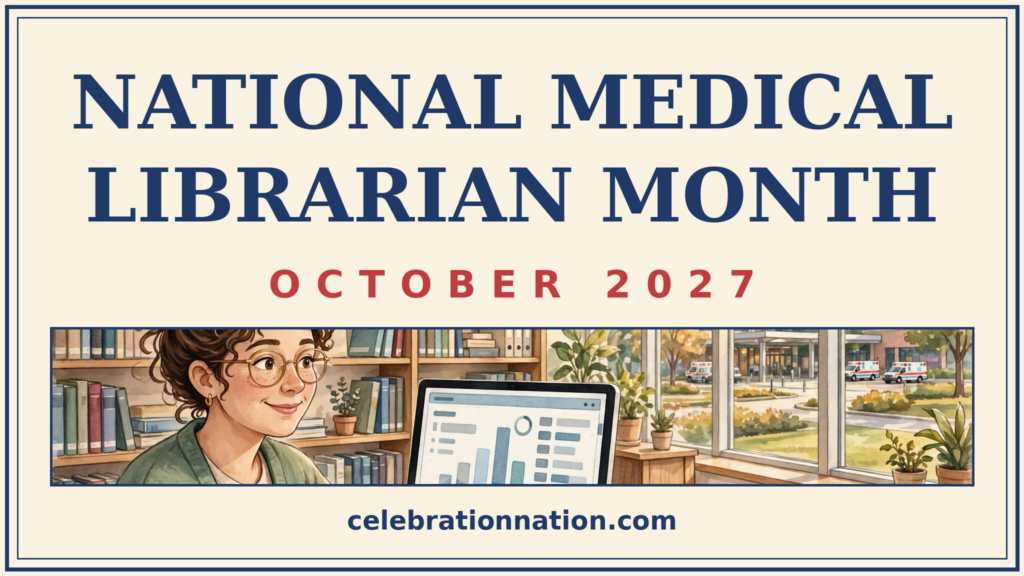
National Medical Librarian Month
Every October, hospitals, universities, and research centers pause to honor the experts behind the evidence during National Medical Librarian Month. Created in 2004 by the Medical Library Association, this month recognizes the health information professionals whose searches shape patient care and power medical research. Behind every sound medical decision is someone who found the proof.
- Hashtag
- #NationalMedicalLibrarianMonth
National Medical Librarian Month
Every October, hospitals, universities, and research centers pause to honor the experts behind the evidence during National Medical Librarian Month. Created in 2004 by the Medical Library Association, this month recognizes the health information professionals whose searches shape patient care and power medical research. Behind every sound medical decision is someone who found the proof.
The Medical Library Association created National Medical Librarians Month to raise awareness of the important role of the health information professional. Medical librarians sit at the intersection of medicine and information science, helping clinicians, researchers, students, and patients find reliable answers in a field where knowledge grows more complex every year. When a doctor needs the latest evidence on a treatment or a patient needs trustworthy information about a diagnosis, a medical librarian is often the one who finds it. These are highly trained professionals: at one major academic health sciences library, the staff includes two dozen faculty librarians, each holding at least a master’s degree, with several holding second master’s degrees or doctorates. Many health sciences libraries mark the month with meet-the-librarian displays in their reading rooms and lobbies, putting faces to the names behind the searches and inviting clinicians to stop by with questions.
The profession has deep roots. In 1898, four physicians and librarians formed the Association of Medical Librarians to encourage the improvement of public medical libraries. The National Library of Medicine, the world’s largest biomedical library, was first established under Armed Forces rule and began circulating bibliographies of national medical books and works relating to public health as early as 1871. Ownership of the library was transferred from the Defense Department to the Health Department in 1956. These institutions gave medical librarianship its foundation and its enduring mission: getting the right information to the right person at the right time. The early association circulated printed bibliographies to help physicians find the medical literature they needed, a mission that continues today in digital form through expertly crafted database searches.
One of the profession’s greatest tools is MEDLINE, the database of life sciences and biomedical literature developed by the National Library of Medicine. Medical librarians are expert searchers of MEDLINE and dozens of other resources, crafting searches that are faster, more precise, and more complete than a quick web query, and they teach clinicians to do the same. They also train users on citation management tools such as EndNote, guide researchers through bioinformatics resources many never knew existed, and help teams stay current on advances in their specialty areas. Pressed for time, a clinician can ask a librarian to perform the search directly and deliver a curated set of results instead of a mountain of links, a service that saves hours during a busy clinical week.
Today’s medical librarians do far more than shelve journals. Clinical informationists round with care teams, bringing evidence directly to the bedside and helping with decisions in real time. Systematic review specialists partner with researchers from the first research question to final publication. Consumer health librarians help patients understand their diagnoses in plain language. Others specialize in collection development, cataloging, web management, and computer services. Across these roles, they support evidence-based practice, analyze research impact, and help teams meet requirements such as NIH public access mandates, often at no charge to the clinicians and students they serve. Subject specialists on a medical library staff may focus on areas as specific as molecular biology, the history of medicine, animal research, or consumer health services, bringing deep expertise to every consultation.
Each October, the Medical Library Association highlights the profession with an annual theme that captures the moment. Past themes have included “The information you need when you need it!”, “Medical Librarians: Your Partners to Advance Health Equity”, and “Avoid Misinformation! Take the Right Path: Partner with your Medical Librarian.” The themes reflect a field that keeps evolving with medicine itself, from print indexes to electronic journals to artificial intelligence, while its core mission never changes: connecting people with information they can trust. Libraries often pair the annual theme with workshops on spotting misinformation, a skill every patient and provider needs in an age when bad health advice travels faster than good science.
In an era when a search engine is often the first consultant, medical librarians provide what algorithms cannot: judgment. They evaluate sources for quality, distinguish strong evidence from weak, separate trustworthy guidance from misinformation, and deliver concise, reliable answers when the stakes are highest. For clinicians pressed for time, a librarian’s expert search can save hours; for patients facing frightening diagnoses, a librarian’s guidance can bring clarity and calm. They teach students and healthcare providers not just where to look, but how to think about what they find. For students, a librarian’s guidance on searching well is a professional skill that pays off across an entire career, shaping how they will find and judge evidence for decades.
During October 2027, thank the medical librarians in your world. Visit your hospital or university library, ask a librarian to demonstrate a database, request a consultation for a tough search, or invite one to speak to a class or community group. Many libraries host meet-the-librarian displays during the month, putting faces to the names behind the searches. The people who keep medicine honest deserve a month of recognition, and your gratitude is the best place to start. A short visit to say thanks, or an invitation to collaborate on a research project, can start a partnership between a department and its library that improves care all year long.
THE STORY BEHIND NATIONAL MEDICAL LIBRARIAN MONTH
📆 Established in 2004
The Medical Library Association created National Medical Librarians Month to raise awareness of the health information professional’s vital role in patient care and research.
🏫 Roots in 1898
Four physicians and librarians formed the Association of Medical Librarians to improve public medical libraries across the country.
💻 MEDLINE
The National Library of Medicine developed MEDLINE, the premier database of biomedical literature that medical librarians search every day.
🩹 Beyond the Stacks
Modern medical librarians round with clinical teams, co-author systematic reviews, teach evidence-based practice, and guide patients to trustworthy health information.
🎯 Annual Themes
Each October carries a theme, from health equity to fighting misinformation, reflecting the profession’s evolving mission.
WAYS TO CELEBRATE
🙏 Thank Your Medical Librarian
Send a note or a small gift to the health sciences librarians at your hospital or university this October.
🔍 Ask for a Search Demo
Invite a medical librarian to show your team how an expert literature search works and what it can uncover.
💬 Share a Trusted Resource
Pass along a reliable consumer health resource from your medical library to friends and family with health questions.
Celebrate National Medical Librarian Month
All through October 2027, take a moment to thank the experts behind the evidence. Whether you are a clinician, a student, or a patient, a medical librarian can help you find answers you can trust. Behind every breakthrough is a search, and behind every great search is a librarian.
Coming up next
See the calendar

Celebrate every day, all year
Official gear from the people who track 1,700+ celebrations.
Browse the shop 2027 Wall Calendar, signed by Marlo AndersonSigned by the founder of National Day Calendar.
Never miss a reason to celebrate.
One quick morning email with today's celebrations, ideas and posters. Free, unsubscribe anytime.
🎉 You're on the list! Watch your inbox for The Daily Confetti.