
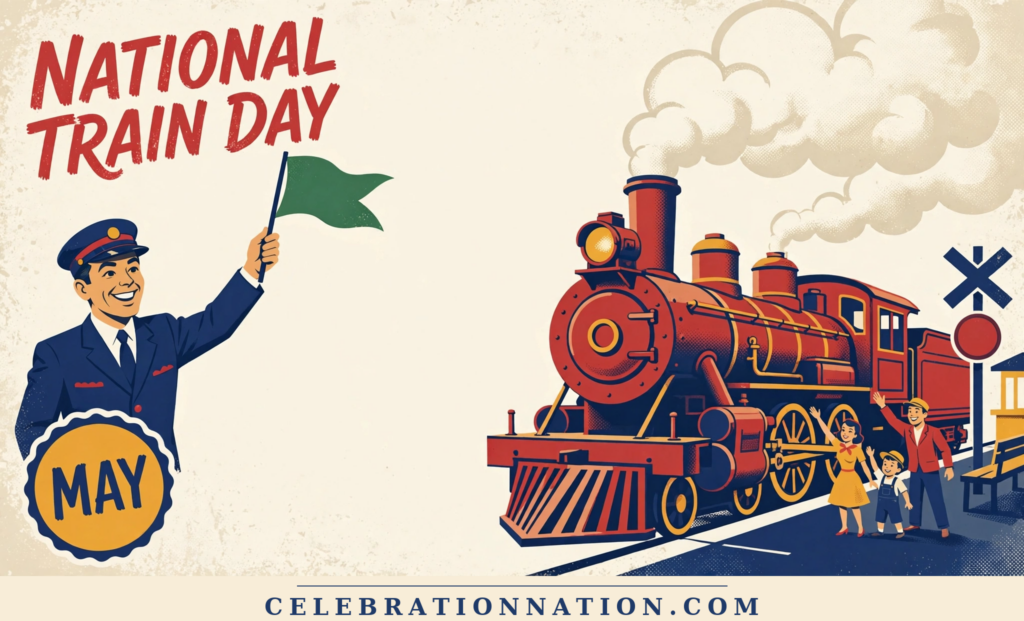
National Train Day
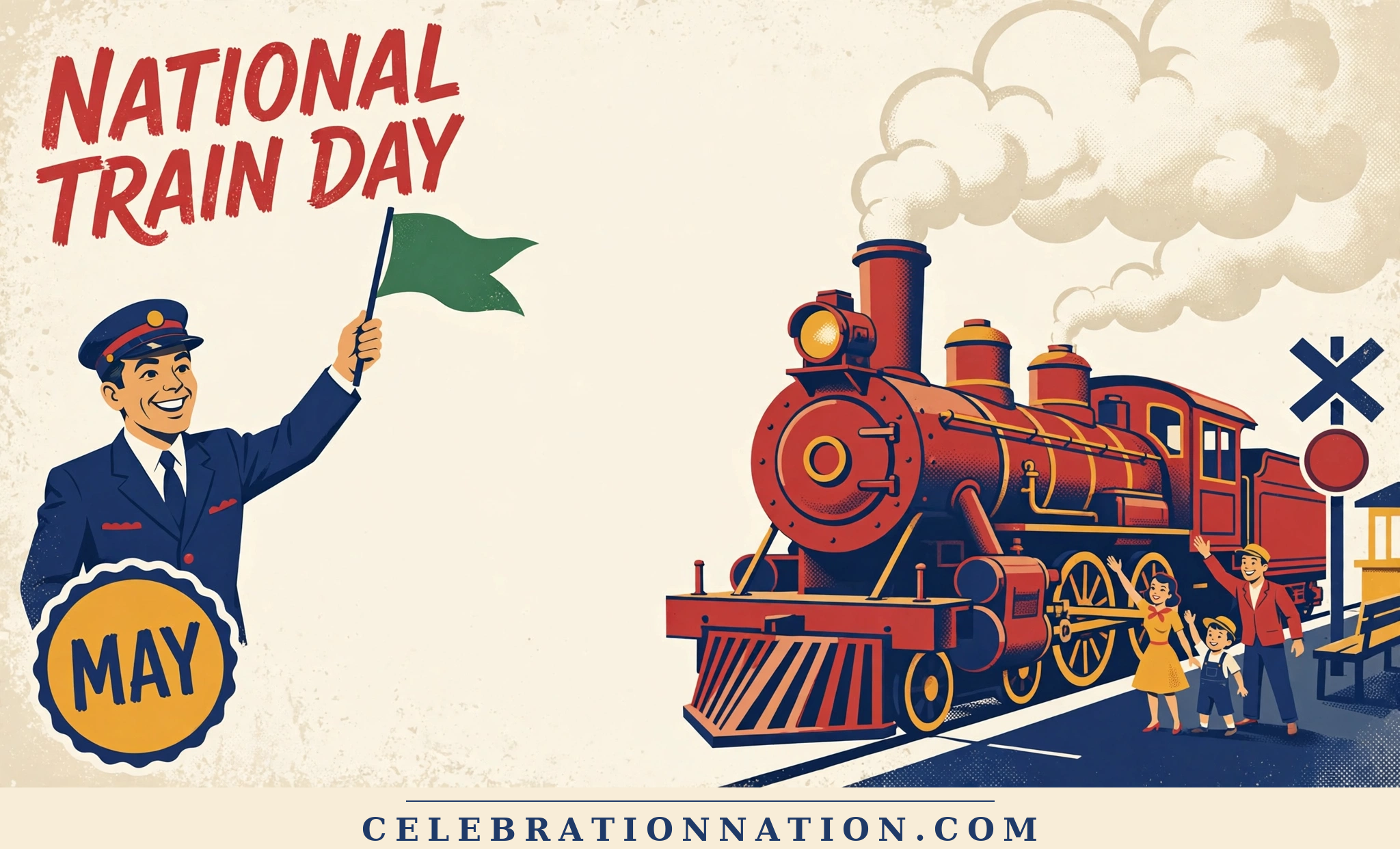
National Train Day on the second Saturday of May (May 9, 2026) celebrates America's railroad heritage — the 1869 Transcontinental Railroad completion that unified the continent, the Pullman sleeping car that created American rail travel, Amtrak's preservation of long-distance trains, and the future of high-speed rail. The day was created by Amtrak in 2008 to honor the 139th anniversary of the Golden Spike driven at Promontory Summit, Utah — May 10, 1869.
- Vibe
- Heritage & Adventure
- Hashtag
- #NationalTrainDay
Ways to celebrate
Ride, watch, remember:
- 🚂 Take a train trip. Even a short Amtrak ride — Northeast Corridor, Amtrak Cascades (Seattle to Portland), California Zephyr — is a celebration. Long-haul sleeper trains are a bucket-list experience.
- 🎨 Visit a train museum. Smithsonian (DC), California State Railroad Museum (Sacramento), B&O Railroad Museum (Baltimore). Iconic American history.
- 🎬 Watch 'Grand Hotel' (1932) or 'North by Northwest' (1959). Train travel's golden-age cinema.
- 🎵 Listen to train music. Johnny Cash's 'Folsom Prison Blues,' Bob Dylan's 'Slow Train Coming.' American train music is a genre.
- 📖 Read a railroad history. Stephen Ambrose's 'Nothing Like It in the World' (2000) covers the Transcontinental Railroad construction.
Fast facts
The story
The Transcontinental Railroad, 1,900 miles linking Omaha, Nebraska to Sacramento, California, was built between 1863 and 1869 by two companies: the Union Pacific (building westward) and the Central Pacific (building eastward). The Central Pacific's workforce was overwhelmingly Chinese immigrants (around 15,000 at the peak), who did the most dangerous work in extreme conditions. The Union Pacific relied on Irish immigrants, Civil War veterans, and freedmen. At 12:47 PM on May 10, 1869, the 'Golden Spike' was driven at Promontory Summit, Utah, completing the railroad. The moment was announced by telegraph, 'DONE', to cities across the country.
Read the full story
American railroads transformed the country. Before the Transcontinental Railroad, crossing from New York to California took 4-6 months by ship or wagon. After the railroad, it took 6 days. This collapsed distance enabled American industrial capitalism, agricultural expansion, and the settler migration that displaced indigenous peoples across the West. Railroads were central to the 19th-century American economy. George Pullman's invention of the sleeping car (1865) made long-distance passenger rail comfortable; his company built entire 'Pullman towns' for workers.
The 20th century brought decline. Interstate highways (1956 onward), commercial aviation (1950s onward), and cars ended the passenger-rail age. By 1970, American passenger rail was near collapse. Congress created Amtrak in 1971 as a government-subsidized entity to preserve long-distance passenger service. Amtrak absorbed most US passenger routes; it operated through federal subsidy. The freight industry was deregulated in 1980 and is now enormously profitable, but the passenger experience remains limited compared to Europe and Asia.
Modern US rail has bright spots and dark spots. The Northeast Corridor (Boston-NYC-Washington) is the nation's busiest passenger rail corridor, with the Acela high-speed line. California is building a high-speed rail line (scheduled completion 2030s) that will be the first US true high-speed rail. Meanwhile, long-distance sleeper trains, the Empire Builder, California Zephyr, Southwest Chief, still run, providing a genuine slow-travel experience. National Train Day on the second Saturday of May celebrates all of it: heritage, possibility, and the American romance with the rail.
America's most scenic rail experiences:
Where the tracks have shaped the nation:
Did you know?
Chinese laborers built most of the Central Pacific.
Approximately 15,000 Chinese immigrants worked on the Central Pacific's Sierra Nevada crossings, the most dangerous section. Estimates suggest 1,000-2,000 died. Their contribution was largely erased from history until recent decades. The 'Chinese Railroad Workers Memorial' at Promontory was dedicated in 2019.
Standard Time was invented for railroads.
Before 1883, every American city had its own local time. Railroads couldn't make schedules work. On November 18, 1883, US railroads adopted 4 time zones (Eastern, Central, Mountain, Pacific). The US government adopted them nationally in 1918.
The Pullman Porter union fought for civil rights.
The Brotherhood of Sleeping Car Porters (founded 1925 by A. Philip Randolph) was the first African-American union. It won recognition in 1937. The Porters became crucial to the civil-rights movement, training organizers who later led the 1963 March on Washington.
US freight rail is enormously profitable.
US freight rail companies (Union Pacific, BNSF, CSX, Norfolk Southern) are among the most profitable businesses in America. Freight rail carries 40% of all US ton-miles (more than trucks or ships). Passenger rail is the political child; freight rail is the economic giant.
Coming up next
See the calendar
Celebrate every day, all year
Official gear from the people who track 1,700+ celebrations.
Browse the shop 2027 Wall + Desk Calendar BundleCelebrate every day at home and at work.Shop now
Never miss a reason to celebrate.
One quick morning email with today's celebrations, ideas and posters. Free, unsubscribe anytime.
🎉 You're on the list! Watch your inbox for The Daily Confetti.