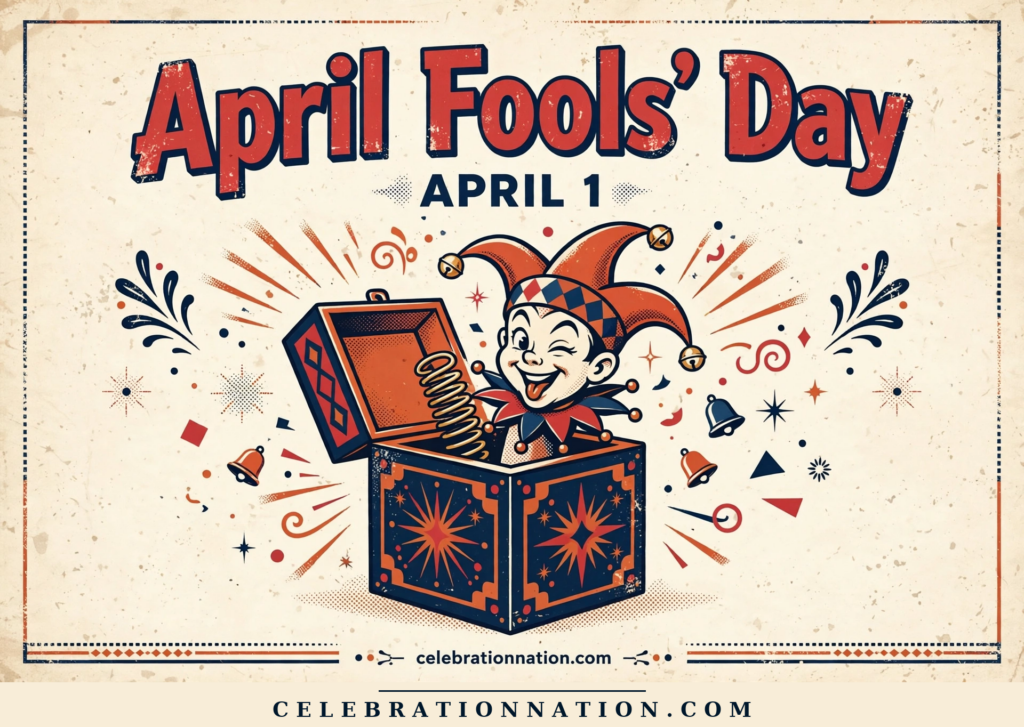
April Fools’ Day
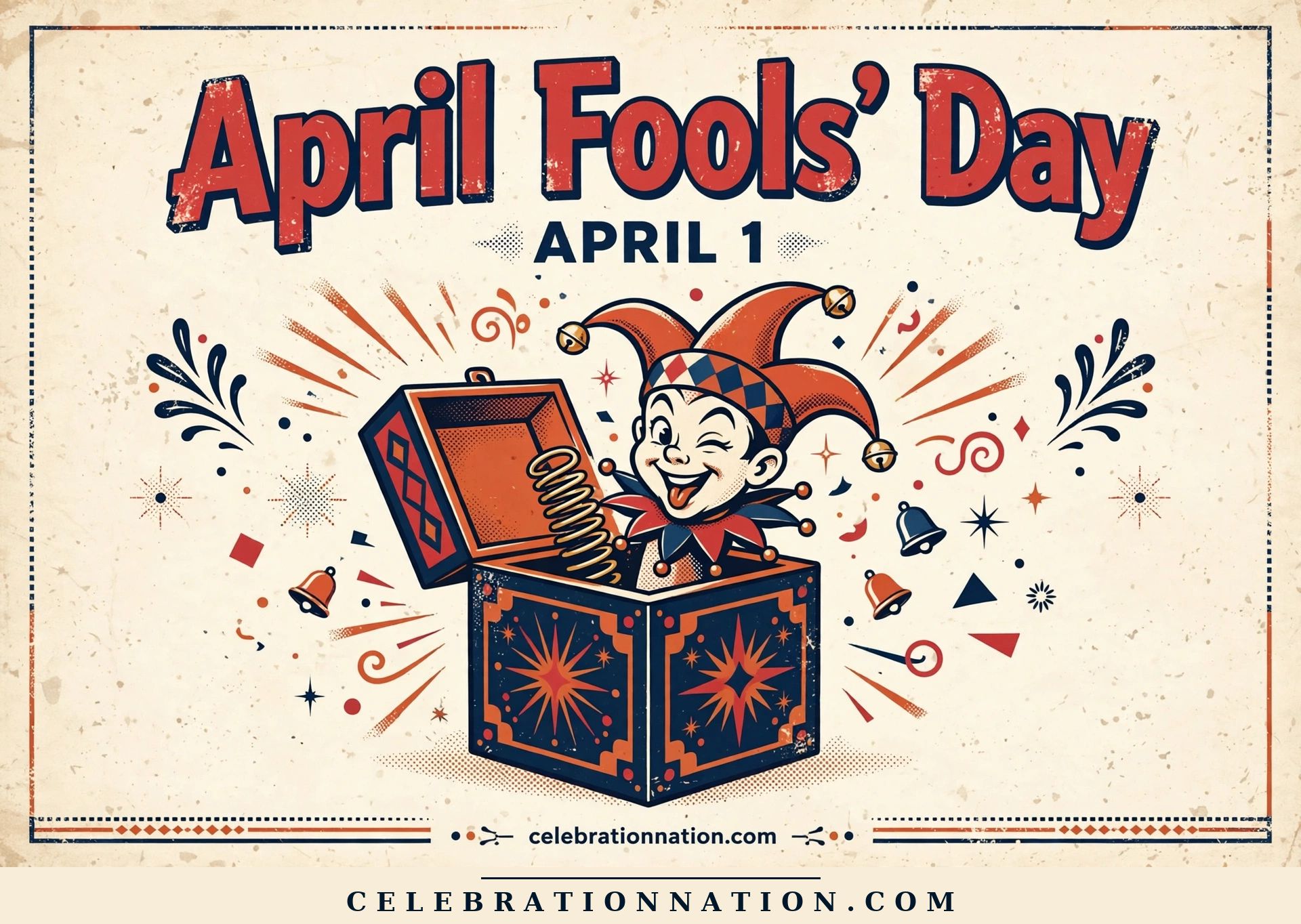
April Fools' Day on April 1 is one of the oldest surviving folk observances in the Western calendar — a 500-year-old license to prank, hoax, and mischief-make, practiced by newspaper editorialists, corporate marketers, school children, and serious academics alike. The origin is debated (possibly the 1582 Gregorian calendar shift), but the result is one day a year when even the New York Times might run a gag headline.
- Vibe
- Playful & Mischievous
- Also on Apr 1
- Take Down Tobacco National Day of Action · ChildHelp National Day of Hope · One Cent Day
- Hashtag
- #AprilFools8217Day
Ways to celebrate
Prank, play, laugh:
- 🃏 Pull a kind prank. Keep it light; no targeting of the anxious or humorless. Classic prank: swap the sugar and salt at breakfast.
- 📰 Read the April 1 newspaper. Many major American newspapers — and websites, product releases, and company press — run one April Fool's joke. Hunt for them; it's a tradition.
- 📺 Watch 'Spaghetti Tree' on YouTube. The 1957 BBC Panorama hoax is 3 minutes long, extraordinarily well-made, and the gold standard of April Fool's comedy.
- 🎬 Watch 'Groundhog Day' (1993) or 'The Truman Show' (1998). Both explore the absurdist-prank philosophy of April Fool's.
- 😂 Share a good joke. A real one. The day that permissions jokes is also a day that permissions telling them.
Make it your kind of celebration
Family
Family prank night. Classic: fake spider in the bathroom, swapped breakfast cereals, fake news headlines. Keep it gentle; big laughs, no tears.
Kids
Kids LOVE April Fool's. Help them plan a simple prank on a parent or sibling. Age-appropriate joke books exist.
Couples
Good prank ideas for couples: fake bill or fake email that looks official (but is obvious enough to not panic). Keep it warm, not cruel.
Office
Careful with office pranks — know your audience. The Big Laughs prankster could be Human Resources's next appointment. Low-stakes pranks only.
School
Teachers often enjoy a single classroom prank — fake-pop-quiz-that's-actually-joke-questions, for example. Students have been pranking teachers since the 1800s.
Community
Local newspapers often run one April Fool's joke. Find it; appreciate it; share it on social.
Just me
Read 'Hoax: The Greatest Pranks in History' by Alex Boese. One of the most entertaining books ever published on the subject.
Plan ahead
April Fools’ Day is observed on April 1 every year. Here is where it lands for the next ten years, handy for planners, marketers and party people.
Fast facts
The story
April Fools' Day's origin is genuinely unknown. The most popular theory: when France switched from the Julian to the Gregorian calendar in 1582, New Year's Day moved from April 1 to January 1. Those who hadn't gotten the message continued celebrating on April 1, and were mocked as 'April fools.' The theory is plausible and widely repeated, but earliest documented evidence of April 1 pranking actually predates 1582, a Flemish poem from 1561 already references 'sending fools on errands' on April 1.
Read the full story
By the 1700s, April Fools' Day was well-established across Europe. In Scotland, it became 'Gowkie Day', where victims were sent on 'fool's errands' carrying sealed letters instructing the recipient to 'send the idiot further on.' In France, children would stick paper fish ('poisson d'avril,' April fish) on friends' backs. In England, the tradition of pranking before noon, but not after, became formalized in the 1800s. Every Western culture developed its own April Fools' customs, all revolving around sanctioned trickery.
The modern era of April Fools' is defined by media hoaxes. The BBC's 1957 "Spaghetti Tree" segment on the news program Panorama, showing Swiss farmers harvesting spaghetti from trees, narrated by distinguished broadcaster Richard Dimbleby, became the gold standard. It worked because Italian food was still exotic in post-war Britain; thousands of viewers wrote in asking how to grow spaghetti trees. The BBC reportedly told them: "Place a sprig of spaghetti in a tin of tomato sauce and hope for the best." The segment is still considered the greatest media hoax ever executed.
The internet era brought corporate April Fools' to a new scale. Google ran annual pranks from 1999 to 2019, launching 'Gmail Motion' (email controlled by body movements), 'Google Nose' (smell search), 'PAC-MAN on Google Maps,' 'Google Gnome' for lawns. Burger King's 2001 'Left-Handed Whopper' generated real complaints from customers. In 2020, Google officially ended its April Fools' program, citing social unease during the pandemic. But the tradition continues, the Washington Post, National Geographic, IKEA, and many others still run one deliberate gag per April 1. A rare day when the media permits itself to lie for laughs.
Cultural hoaxes that earned their place in history:
Six cultural variations on the same day:
Did you know?
Mark Twain was an April Fool's genius.
Mark Twain's 1884 April 1 'essay' in the Boston Daily Globe announced he was running for President of the United States. The joke was extremely well-sustained; some readers believed it. Twain frequently wrote April Fool's content for decades of his career.
The New York Times tried a prank in 1857.
The Times published an April 1, 1857 front-page story claiming a herd of mastodons had been discovered in New Jersey. The paper ran a correction the next day. Readers were reportedly disappointed. The Times has largely avoided April Fool's since.
Google launched Gmail on April 1, 2004.
Google launched Gmail on April 1, 2004, with a genuine 1-gigabyte-per-user inbox, then a preposterously large amount. Many people assumed it was an April Fool's prank. It wasn't. Gmail became the world's largest email service.
Pranks can be illegal.
Some April Fool's pranks have crossed into legal territory, fake 911 calls, fake emergency broadcasts, hoax bomb threats. US federal law prohibits false emergency communications regardless of April 1 context. Pranksters have served jail time.
Keep the party going
See the calendar
Celebrate every day, all year
Official gear from the people who track 1,700+ celebrations.
Browse the shop 2027 National Day Wall CalendarGet the 2026 edition free. 1,700+ observances.
Never miss a reason to celebrate.
One quick morning email with today's celebrations, ideas and posters. Free, unsubscribe anytime.
🎉 You're on the list! Watch your inbox for The Daily Confetti.