





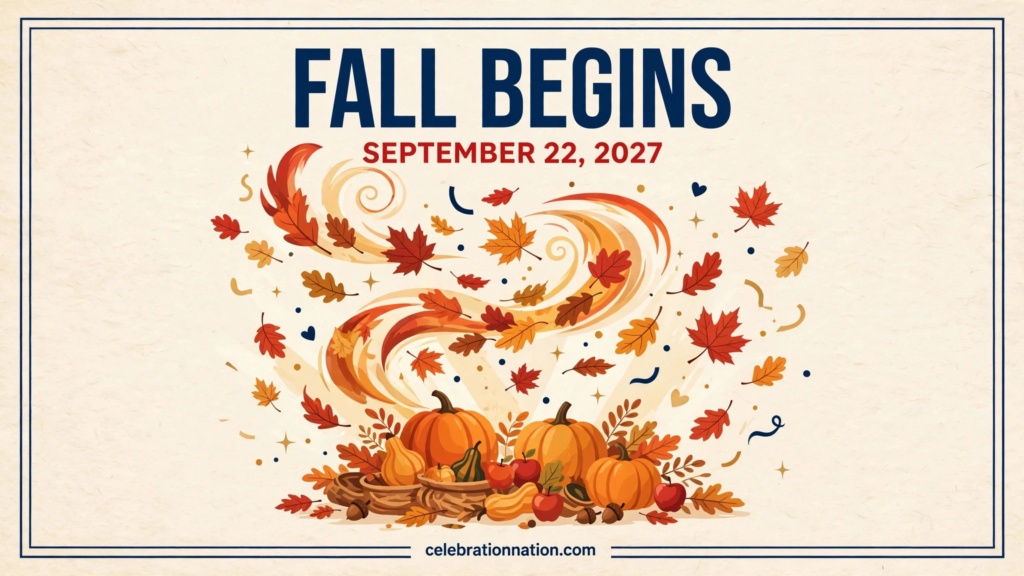
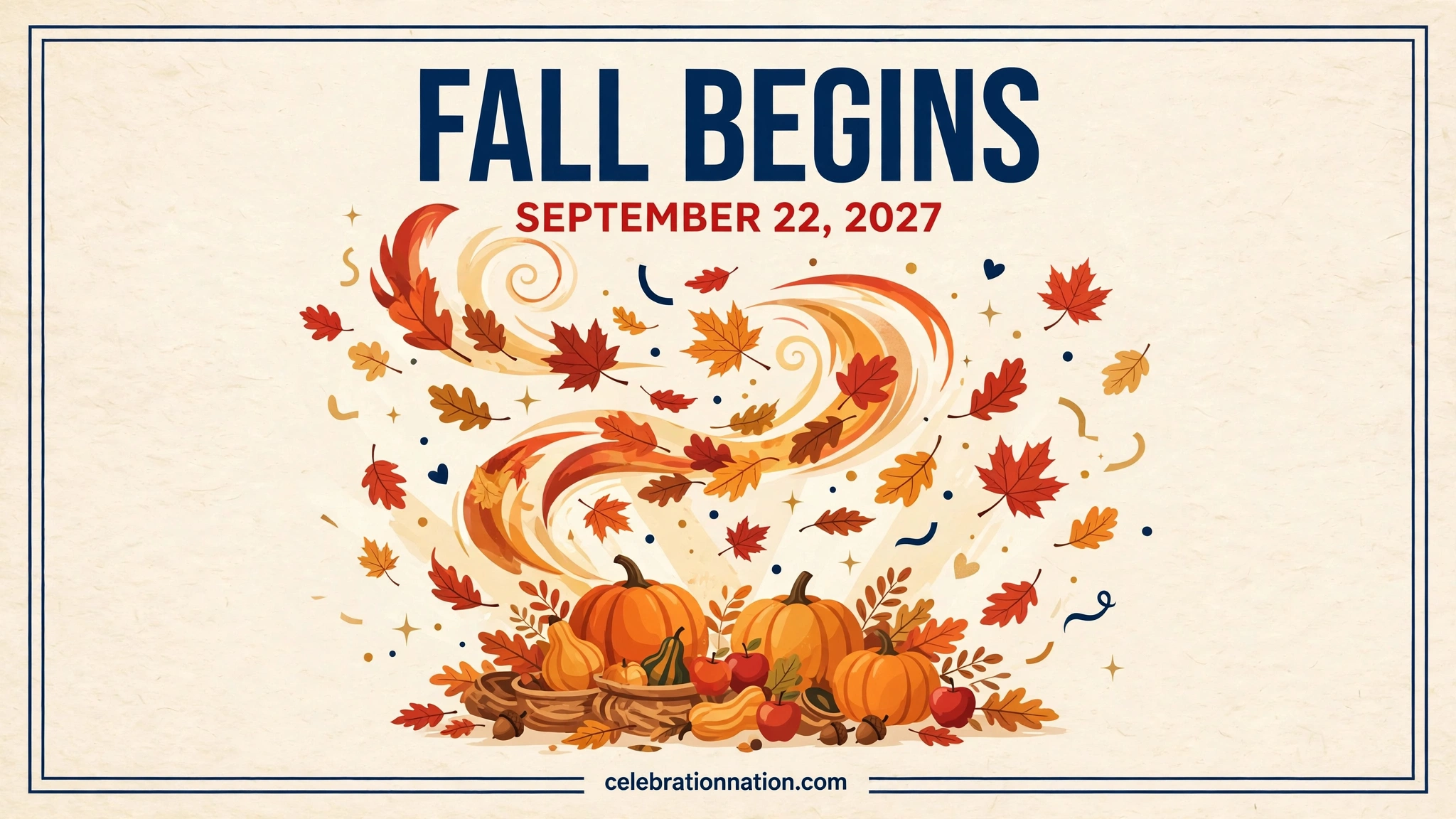
Fall Begins/Autumnal Equinox
Every year in late September, the planet performs its most perfectly balanced trick: day and night split almost evenly across the globe. The autumnal equinox marks the first day of fall in the Northern Hemisphere, the moment summer officially hands the season over to sweaters, harvests, and golden light. In 2027 the day falls on a Wednesday, September 22. Grab a warm drink and step outside: fall has begun.
- Also on Sep 22
- World Rhino Day · Legwear Day · World Narcolepsy Day
- Hashtag
- #FallBeginsAutumnalEquinox
FALL BEGINS
Every year in late September, the planet performs its most perfectly balanced trick: day and night split almost evenly across the globe. The autumnal equinox marks the first day of fall in the Northern Hemisphere, the moment summer officially hands the season over to sweaters, harvests, and golden light. In 2027 the day falls on a Wednesday, September 22. Grab a warm drink and step outside: fall has begun.
An equinox is not a daylong event. It is a single precise moment, the instant the sun crosses the celestial equator, an imaginary line projecting Earth’s equator into the sky. In 2027 that moment arrives at 06:02 UTC on September 23, which means the western United States experiences it late on the evening of September 22, while the eastern half of the country greets it just past midnight on the 23rd. Time zones are why the equinox can land on either September 22 or 23 depending on where you stand.
At that moment, something lovely happens. The Sun shines directly over the equator, and both hemispheres receive nearly equal amounts of daylight. Day and night last almost the same length everywhere on Earth, which is exactly what the word equinox means: it comes from the Latin aequus, meaning equal, and nox, meaning night. The sun rises almost exactly due east and sets almost exactly due west, something that happens only twice a year.
The reason we have seasons at all is Earth’s tilt. Our planet spins on an axis tilted about 23.5 degrees, and that tilt always points the same direction in space as Earth orbits the Sun. During the autumnal equinox, the tilt is aimed neither toward nor away from the Sun, so sunlight falls evenly on both halves of the planet. From here on, the Sun will rise a little later and set a little earlier each day in the Northern Hemisphere, making the days shorter and the nights longer all the way to the winter solstice.
Everything is mirrored below the equator. While the Northern Hemisphere settles into fall, the Southern Hemisphere celebrates the same moment as the spring equinox, with days growing longer toward the December start of summer in places like Australia and South America. One planet, one moment, two seasons beginning at once.
The date of the equinox is not fixed to a single calendar day. Depending on the year, the autumnal equinox can land anywhere between September 21 and 24, because the Gregorian calendar is only an approximation of Earth’s orbit around the Sun. The 2027 equinox lands on September 22 for most of the United States, but the calendar keeps the celebration simple: fall begins on the 22nd.
Here is a delightful quirk: day and night are not exactly equal on the equinox. Each side of the planet may get a few extra minutes of one or the other, depending on where you stand, because the Sun’s disk has width and the atmosphere bends its light. And the equinox brings one more gift for sky watchers: the weeks around the equinoxes see increased geomagnetic activity, making them a prime season for spotting the Northern Lights.
The autumnal equinox also has a twin. Twice a year the sun stands over the equator: in September, and again around March 21 for the vernal equinox, which marks the beginning of spring in the Northern Hemisphere. The two equinoxes bookend the year’s light, one opening the door to longer days, the other closing it. September’s equinox is the closing door, and fall is what waits on the other side.
However you mark it, the equinox rewards attention. Many cultures celebrate combinations of the solstices, the equinoxes, and the midpoints between them, giving rise to holidays and harvest festivals around the world. Your own version can be simpler: a walk at golden hour, a seasonal meal with people you love, or a quiet moment noticing that the light has changed. Fall has begun, and it is worth greeting properly.
There is one more equinox wonder worth knowing. On the equator, the sun will be directly overhead at noon, and the equinoxes are the only times when both the North and South Poles are lit by sunshine at the same time. It is a brief, beautiful symmetry: for one moment, the entire planet shares the light equally, pole to pole.
Then comes the best part: living it. The equinox is the starting line for everything fall does best. Crisp morning walks, orchards heavy with apples, pumpkins stacking up on porches, and that particular golden light that makes even an ordinary street look cinematic. Summer was for sprawling out; fall is for gathering in. The equinox simply makes it official, and September 22, 2027, is the day to answer.
Mark it now: Wednesday, September 22, 2027. Late that evening, the sun crosses the celestial equator, day and night balance, and fall officially begins across the Northern Hemisphere. However you celebrate, do it outside if you can. The first day of fall only comes once a year, and it deserves a proper hello.
The autumnal equinox arrives at harvest time, and cultures have marked it for centuries. The equinoxes fall when crops are ready to be harvested, and many people observe them with feasting and celebrations of the harvest. Japan marks public holidays around the equinoxes, and at the Mayan site of Chichen Itza in Mexico, crowds gather to watch the sun throw a shadow shaped like a serpent descending the pyramid called El Castillo. It is one of humanity’s oldest shared appointments with the sky.
So how should a modern celebrant mark the first day of fall? Notice things. The light turns honey-colored. The air smells different. Leaves begin their slow, spectacular exit. Fall is the season of gathering in, of slowing down, of trading long evenings for long sleeves. The equinox is simply the official starting gun, and on September 22, 2027, it fires right on schedule.
THE STORY BEHIND FALL BEGINS
☀️ A Moment, Not a Day
The equinox is defined by a single instant: the moment the sun crosses the celestial equator. In 2027 that instant is 06:02 UTC on September 23, landing on the evening of the 22nd in the western United States and just past midnight on the 23rd farther east.
⚖️ Equal Night
Equinox comes from the Latin aequus (equal) and nox (night). At the equinox, the sun shines directly over the equator, the sun rises almost exactly due east and sets almost exactly due west, and day and night are nearly equal worldwide.
🌎 The Tilt That Makes Seasons
Earth spins on an axis tilted about 23.5 degrees. At the equinox the tilt aims neither toward nor away from the sun, so both hemispheres get equal sunlight. Afterward, northern days shorten toward the winter solstice while southern days lengthen toward summer.
🌾 Harvest Time
The autumnal equinox falls when crops are ready to be harvested, and many cultures observe it with feasting and celebrations of the harvest. It has been one of humanity’s shared seasonal markers for centuries.
🎃 Celebrated Around the World
Japan marks public holidays around the equinoxes, and at Chichen Itza in Mexico, crowds gather to watch sunlight cast a serpent-shaped shadow down the pyramid of El Castillo. The equinox is a global appointment with the sky.
WAYS TO CELEBRATE
🍂 Take a First-of-Fall Walk
Step outside on the equinox and notice the season turning: the lower light, the cooler air, the first leaves letting go. A walk at sunset, when the sun sets due west, is the perfect equinox ritual.
🎃 Visit the Harvest
Head to a pumpkin patch, apple orchard, or farmers market to celebrate the season the way cultures have for centuries: with the harvest. Bring home something in season and cook it that night.
🍵 Toast the Shorter Days
Gather friends for a cozy evening with a warm drink and something baked. Fall is for gathering in, so start the season the way you mean to continue it.
Celebrate Fall Begins
On September 22, 2027, step into the season. Watch the sun set due west, taste the harvest, and welcome the golden days of fall.
Plan ahead
Fall Begins/Autumnal Equinox moves each year (Changes Annually). This year it is Tuesday, September 22, 2026. Check back for future years.
Keep the party going
See the calendar



Celebrate every day, all year
Official gear from the people who track 1,700+ celebrations.
Browse the shop 2027 National Day Wall CalendarGet the 2026 edition free. 1,700+ observances.
Never miss a reason to celebrate.
One quick morning email with today's celebrations, ideas and posters. Free, unsubscribe anytime.
🎉 You're on the list! Watch your inbox for The Daily Confetti.