

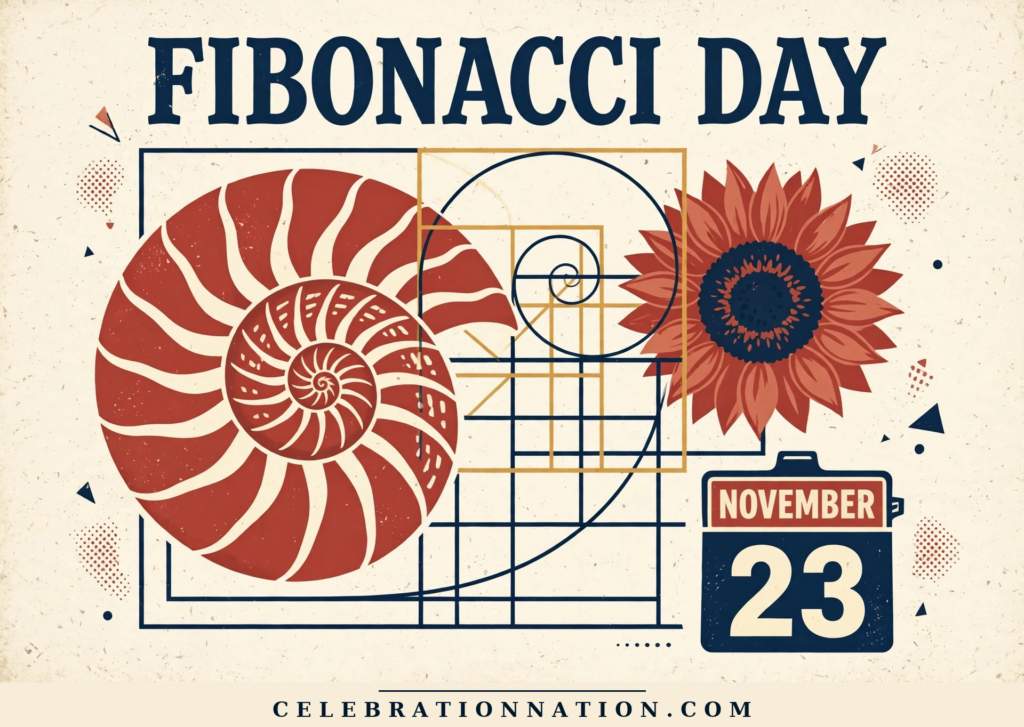
Fibonacci Day
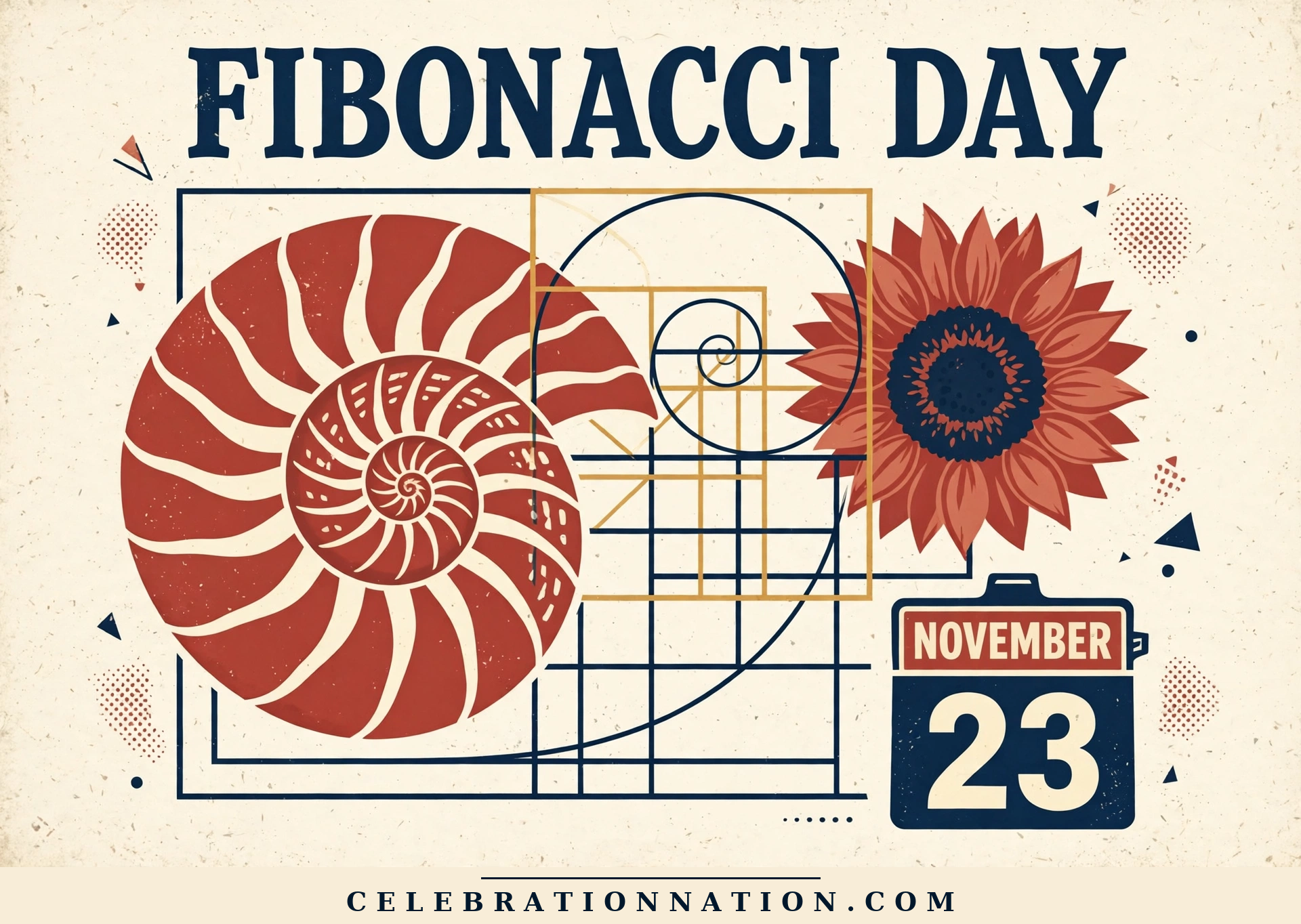
Join us on November 23 to explore the mathematical wonders that Fibonacci introduced to the world.
- Roots
- The date 11/23 matches the sequence's start: 1, 1, 2, 3
- Vibe
- A blend of mathematics, art, and nature appreciation
- Also on Nov 23
- Cashew Day · Eat a Cranberry Day · Espresso Day
- Hashtag
- #FibonacciDay
3 ways to celebrate
Draw the spiral
Sketch the famous spiral using squares, then spot it in pinecones and shells.
Hunt numbers outside
Walk the park and photograph spirals, petals and patterns in nature.
Share sequence puzzles
Challenge classmates with 1, 1, 2, 3, 5 and see who continues it.
Plan ahead
Fibonacci Day is observed on November 23 every year. Here is where it lands for the next ten years, handy for planners, marketers and party people.
Fast facts
The story
Fibonacci Day, observed annually on November 23, pays tribute to the influential mathematician Leonardo of Pisa, known as Fibonacci. Born around 1170 in Italy, he is best known for introducing the Fibonacci sequence to Western mathematics through his 1202 book, "Liber Abaci." This sequence, where each number is the sum of the two preceding ones, has fascinated mathematicians, artists, and nature enthusiasts alike.
Read the full story
The Fibonacci sequence is not just a mathematical concept; it resonates throughout nature. From the arrangement of leaves and the branching of trees to the spirals of shells and galaxies, this sequence reveals a hidden order. Artists, too, have employed Fibonacci numbers to create aesthetically pleasing compositions, drawing on the golden ratio, which is closely tied to Fibonacci numbers.
One of the most engaging aspects of Fibonacci Day is the opportunity for hands-on exploration. Students and families can embark on nature walks to discover Fibonacci patterns, such as the spiral arrangement of sunflower seeds or the fractal patterns found in Romanesco broccoli. This interactive approach helps to bridge the gap between math and the natural world, sparking curiosity and creativity.
As we celebrate Fibonacci Day, we invite everyone, students, educators, families, and math enthusiasts, to engage with this mathematical marvel. Whether through art projects, nature exploration, or simply learning more about Fibonacci's impact, this day serves as a reminder of the beauty that mathematics can unveil in our world.
Did you know?
Fibonacci's Birth
Leonardo of Pisa was born in 1170, making significant contributions to mathematics.
The Sequence Defined
The Fibonacci sequence starts with 0 and 1, followed by each number being the sum of the two preceding ones.
Real-World Applications
Fibonacci numbers are used in computer algorithms, financial markets, and even in analyzing stock prices.
Mathematical Beauty
The golden ratio, approximately 1.618, is closely related to Fibonacci numbers and is often found in art and architecture.
Fibonacci in Nature
Many plants, such as pine trees and sunflowers, display Fibonacci patterns in their growth.
Cultural Influence
Fibonacci's work has inspired artists and architects for centuries, influencing styles and design.
Fibonacci's Legacy
Fibonacci's influence extends beyond mathematics, impacting fields such as biology, art, and music.
Around the world
Every culture celebrates a little differently.
- USUnited StatesFibonacci Day is celebrated across the country, inspiring students and math enthusiasts to explore the beauty of mathematics.
- ITItalyFibonacci's homeland, Italy, pays homage to his contributions in various educational initiatives and cultural events.
- FRFranceIn France, schools often incorporate Fibonacci's concepts into their curriculum, celebrating his legacy on this day.
- DEGermanyGerman mathematicians and educators utilize Fibonacci Day to engage students in the beauty of mathematics through various activities.
- GBUnited KingdomIn the UK, Fibonacci Day is marked by workshops and discussions on the intersection of math and art.
- BRBrazilBrazilian educators highlight Fibonacci's influence in nature during lessons, celebrating this mathematical day with enthusiasm.
Keep the party going
See the calendar

Celebrate every day, all year
Official gear from the people who track 1,700+ celebrations.
Browse the shop National Day Celebration Card GameA party in a box, any day of the year.
Never miss a reason to celebrate.
One quick morning email with today's celebrations, ideas and posters. Free, unsubscribe anytime.
🎉 You're on the list! Watch your inbox for The Daily Confetti.