



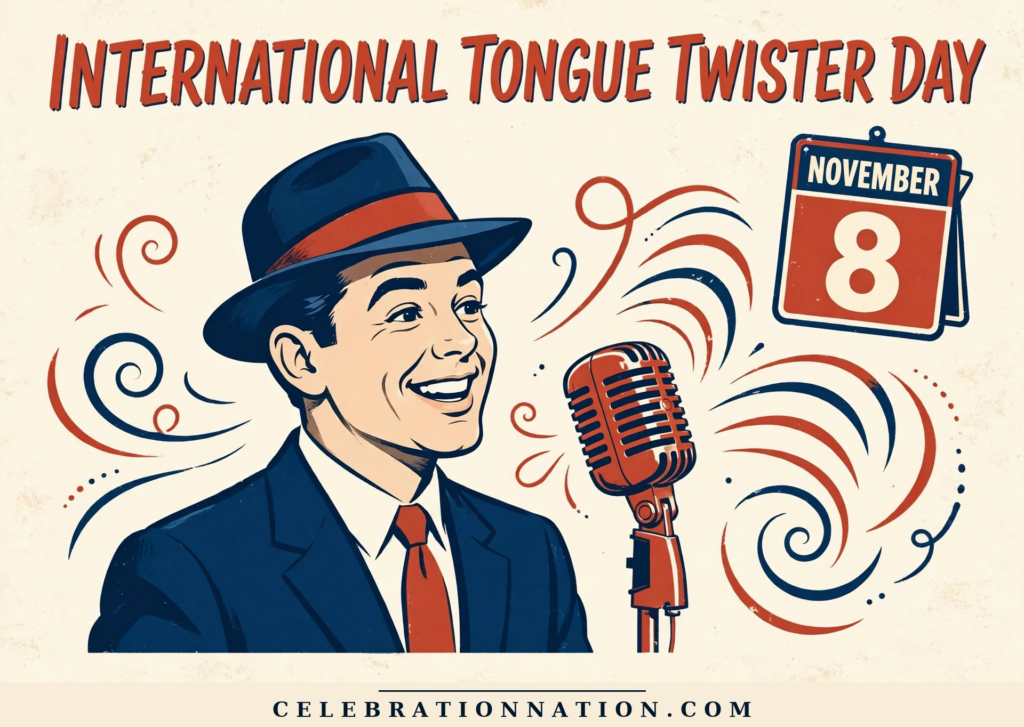
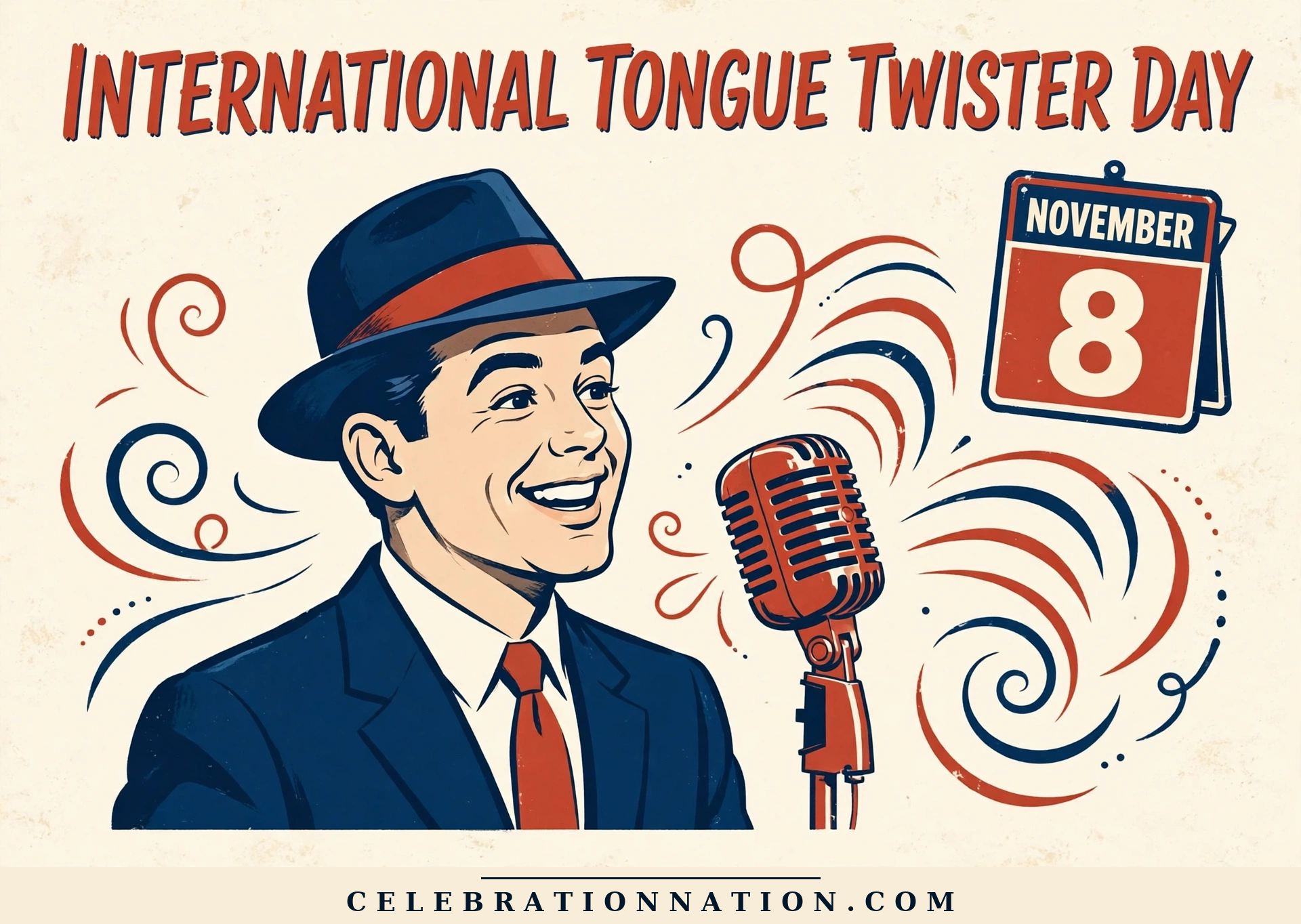
International Tongue Twister Day
Get ready to twist your tongue and have fun with language, it’s a delightful way to celebrate communication!
- Roots
- Celebrated since 2011
- Vibe
- Light-hearted and playful
- Also on Nov 8
- Diwali · STEM/STEAM Day · World Radiography Day
- Hashtag
- #InternationalTongueTwisterDay
3 ways to celebrate
Master a classic twister
Pick one tricky phrase and repeat it faster each round.
Hold a twister battle
Take turns reciting tongue twisters; the stumbler loses the round.
Open with a warm-up
Start the meeting by having everyone tackle one silly phrase.
Plan ahead
International Tongue Twister Day is observed on the second Sunday in November. Here is where it lands for the next ten years, handy for planners, marketers and party people.
Fast facts
The story
International Tongue Twister Day is a celebration of linguistic creativity that takes place on the second Sunday of November. This day encourages participants around the world to engage in the playful art of twisting their tongues with complex phrases. It is an opportunity to appreciate the nuances of language while having fun with friends and family.
Read the full story
The day has been celebrated since 2011, inspired by the International Tongue Twister contest once held at the Logic Puzzle Museum in Burlington, Wisconsin. These playful phrases, often humorous and challenging, serve not only as entertainment but also as effective tools for improving pronunciation and fluency in various languages.
A tongue twister consists of a sequence of words that are difficult to articulate quickly. Classic examples include 'She sells seashells by the seashore' and 'Peter Piper picked a peck of pickled peppers.' These phrases are not just amusing; they have cultural significance, showcasing the richness of language across different regions.
As you participate in International Tongue Twister Day, consider how language connects us. From children giggling over silly sounds to adults honing their eloquence, this celebration bridges generations and cultures, reminding us that language is a living, breathing art form meant to be enjoyed.
Did you know?
Fast Facts About Tongue Twisters
Tongue twisters have been used for centuries, originating in oral traditions.
Famous Tongue Twisters
The classic 'Peter Piper' has been a favorite since the early 19th century.
Global Phenomenon
Many cultures have their own unique tongue twisters, reflecting local languages and humor.
Linguistic Benefits
Practicing tongue twisters can improve clarity and speed in speech.
Early Twisters
The earliest published version of 'Peter Piper' appeared in London in 1813.
Children's Development
Tongue twisters can aid in speech development for young children.
Cultural Significance
Tongue twisters reflect the playfulness and creativity inherent in language.
Around the world
Every culture celebrates a little differently.
- USUnited StatesIn the U.S., tongue twisters have become a popular form of entertainment, especially among children.
- GBUnited KingdomBritish culture has produced many classic tongue twisters, showcasing the playful nature of the English language.
- JPJapanJapanese tongue twisters, or 'hayakuchi kotoba,' often contain sounds that are challenging for non-native speakers.
- FRFranceFrench tongue twisters, like 'Un chasseur sachant chasser,' play with the sounds and rhythm of the language.
- ESSpainSpanish speakers enjoy tongue twisters such as 'Tres tristes tigres' to enhance their pronunciation and fluency.
- DEGermanyGerman tongue twisters often feature intricate sounds, making them a fun challenge for learners of the language.
Keep the party going
See the calendar
Celebrate every day, all year
Official gear from the people who track 1,700+ celebrations.
Browse the shop 2027 Wall + Desk Calendar BundleCelebrate every day at home and at work.
Never miss a reason to celebrate.
One quick morning email with today's celebrations, ideas and posters. Free, unsubscribe anytime.
🎉 You're on the list! Watch your inbox for The Daily Confetti.