
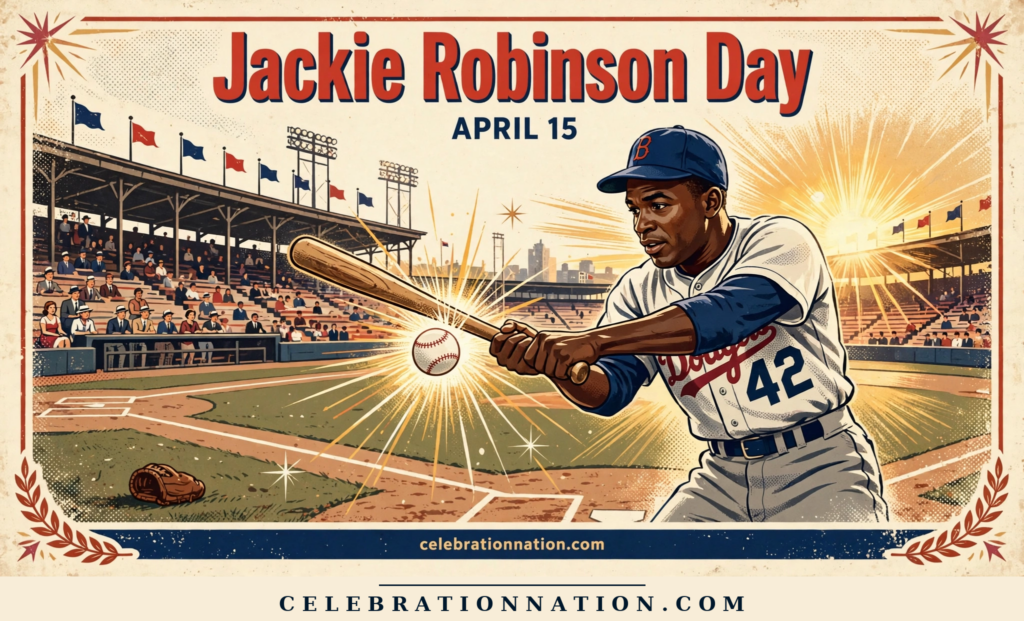
Jackie Robinson Day
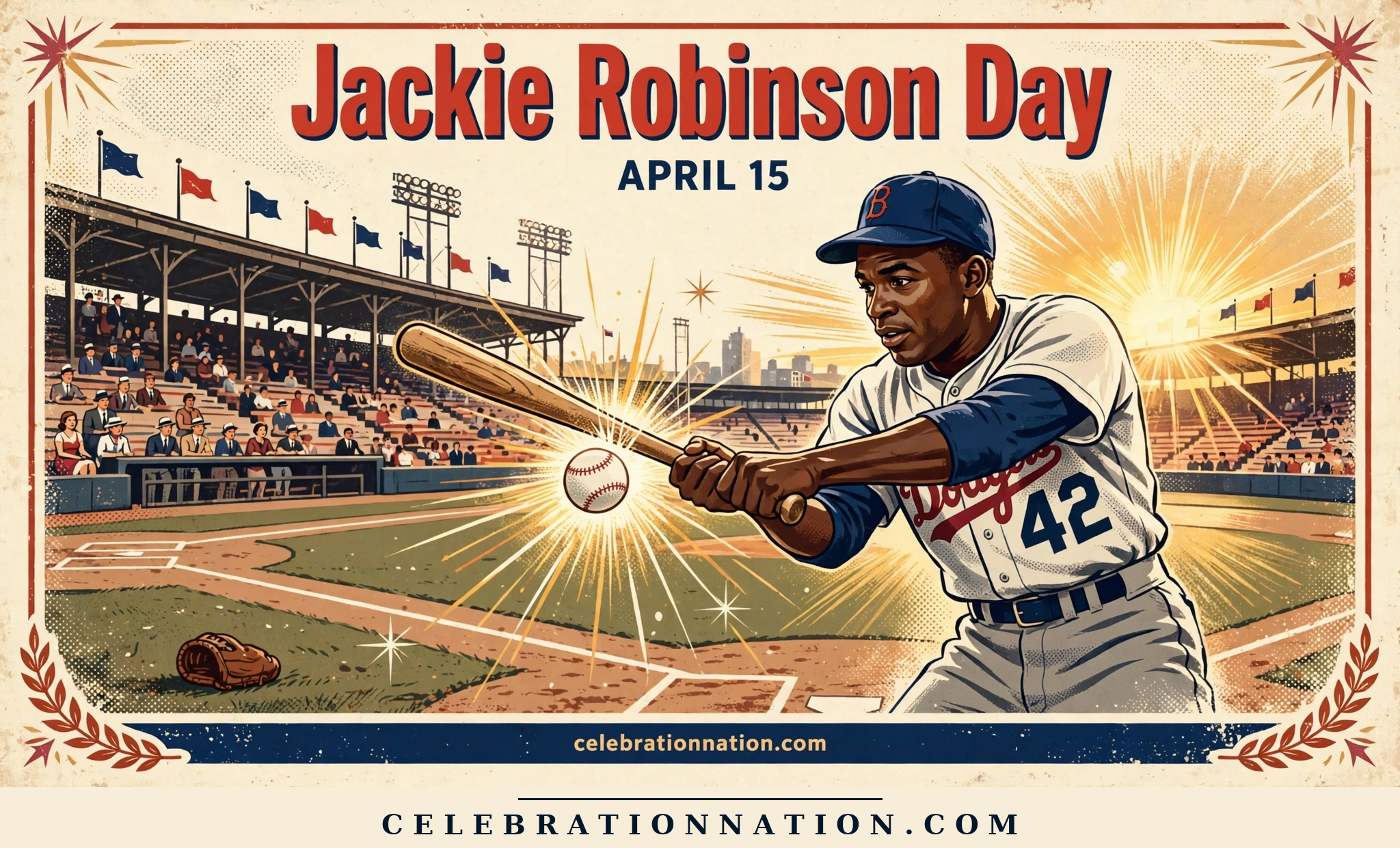
Number 42. The day the color line broke. Jackie Robinson Day on April 15 honors the single most important moment in American sports history — and one of the most important in American civil rights.
- Vibe
- Historic Courage
- Also on Apr 15
- Glazed Spiral Ham Day · Laundry Day · Rubber Eraser Day
- Hashtag
- #JackieRobinsonDay
Ways to celebrate
Honor both the man and the moment:
- ⚾ Watch a baseball game. Every MLB game today features players in #42. Local minor league games often have their own ceremonies.
- 📖 Read about Robinson. His autobiography I Never Had It Made or Jonathan Eig's Opening Day. You'll come away understanding what it cost.
- 🎬 Watch 42 (2013). Chadwick Boseman's Oscar-considered performance. The film is good; the historical moment is extraordinary.
- 💰 Support the Jackie Robinson Foundation. Provides scholarships to minority students. Direct civil-rights economic impact.
- 🧑🏫 Teach it. Kids understand courage. Robinson's story is civics at its most accessible.
Make it your kind of celebration
Family
Watch 42 together tonight. Age 10+. Great conversation after. Robinson's story is foundational American history.
Kids
Kids grasp the moment immediately — "they wouldn't let him play because he was Black? And one team said yes?" Clear, powerful, memorable.
Couples
A baseball game tonight. Any level. Most stadiums will have a Robinson tribute before first pitch.
Office
Acknowledge the day in the morning meeting. Not a long lecture — a moment. It matters that leaders notice these days.
School
History + civics + literature. Robinson's story is assignable across every K-12 level. Too important to skip.
Community
Local youth baseball leagues often honor Robinson on April 15. Good day to volunteer, sponsor, attend.
Just me
Read Ken Burns's Baseball transcript, or watch one inning. The April 15, 1947 moment is well-documented and worth 30 quiet minutes.
Plan ahead
Jackie Robinson Day is observed on April 15 every year. Here is where it lands for the next ten years, handy for planners, marketers and party people.
Fast facts
The story
On April 15, 1947, Jackie Robinson walked onto Ebbets Field in a Brooklyn Dodgers uniform. For the first time in six decades, a Black player was in Major League Baseball. It changed America.
Read the full story
Major League Baseball had been segregated since the 1880s. Black players played in the separate Negro Leagues, a parallel baseball universe that produced some of the greatest players in the sport's history (Satchel Paige, Josh Gibson, Cool Papa Bell). Meanwhile, the white Major Leagues refused them entry. The "gentleman's agreement" excluding Black players held for 60 years.
Branch Rickey, general manager of the Brooklyn Dodgers, decided to break it. In 1945 he signed Jackie Robinson a former UCLA four-sport athlete and Army lieutenant, to play for the minor-league Montreal Royals. Rickey famously asked Robinson during their first meeting whether he had the courage NOT to fight back against the insults, beanballs, and death threats that would inevitably come. Robinson said he did. He signed a commitment to three years of non-retaliation.
Robinson's 1947 Major League debut on April 15 was unremarkable statistically (0 for 3, scored a run). The significance was that he played. Over the next three seasons, he endured spit, slurs, thrown bottles, pitchers deliberately aiming at his head, opposing teams threatening to strike, hotels that wouldn't house him, restaurants that wouldn't feed him and he didn't fight back. He was Rookie of the Year in 1947, National League MVP in 1949, won a World Series in 1955, and retired in 1957.
MLB retired #42 across all teams in 1997, the 50th anniversary of Robinson's debut. It's the only number retired league-wide; no player in any MLB uniform will wear #42 again (Mariano Rivera was the last active player grandfathered in, retiring in 2013). Every April 15, every player, coach, and umpire in baseball wears #42. The tradition is the country's most visible civil-rights commemoration. Robinson died in 1972 at 53, having spent his post-baseball life working on civil rights and Black economic development. The weight he carried shortened his life. It also changed the country.
Four dimensions of what happened on April 15, 1947:
Six key moments in the life that changed baseball:
Did you know?
Robinson stole home 19 times.
Still one of the most in baseball history. The most famous: Game 1 of the 1955 World Series against the Yankees. Yogi Berra has insisted Robinson was out ever since.
Robinson's #42 is retired league-wide.
The only number retired across all 30 MLB teams. No active player has worn #42 since 2013 (Mariano Rivera, grandfathered in).
Robinson was a four-sport UCLA athlete.
Baseball, football, basketball, and track. He actually thought he was best at football. UCLA may be the only university where Robinson's athletic career was overshadowed by... UCLA's athletic department.
Martin Luther King called Robinson "a freedom rider before freedom rides."
In a 1962 speech. King saw Robinson's integration of MLB as a direct precursor to the civil rights movement that was about to break open.
Keep the party going
See the calendar

Celebrate every day, all year
Official gear from the people who track 1,700+ celebrations.
Browse the shop 2027 Wall Calendar, signed by Marlo AndersonSigned by the founder of National Day Calendar.
Never miss a reason to celebrate.
One quick morning email with today's celebrations, ideas and posters. Free, unsubscribe anytime.
🎉 You're on the list! Watch your inbox for The Daily Confetti.