
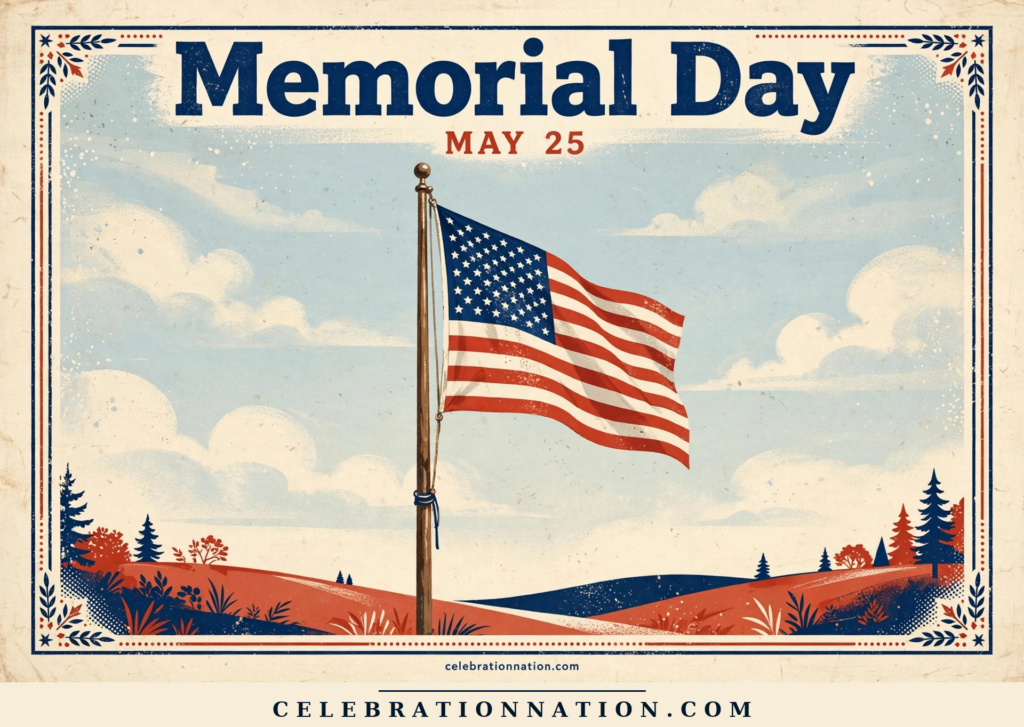
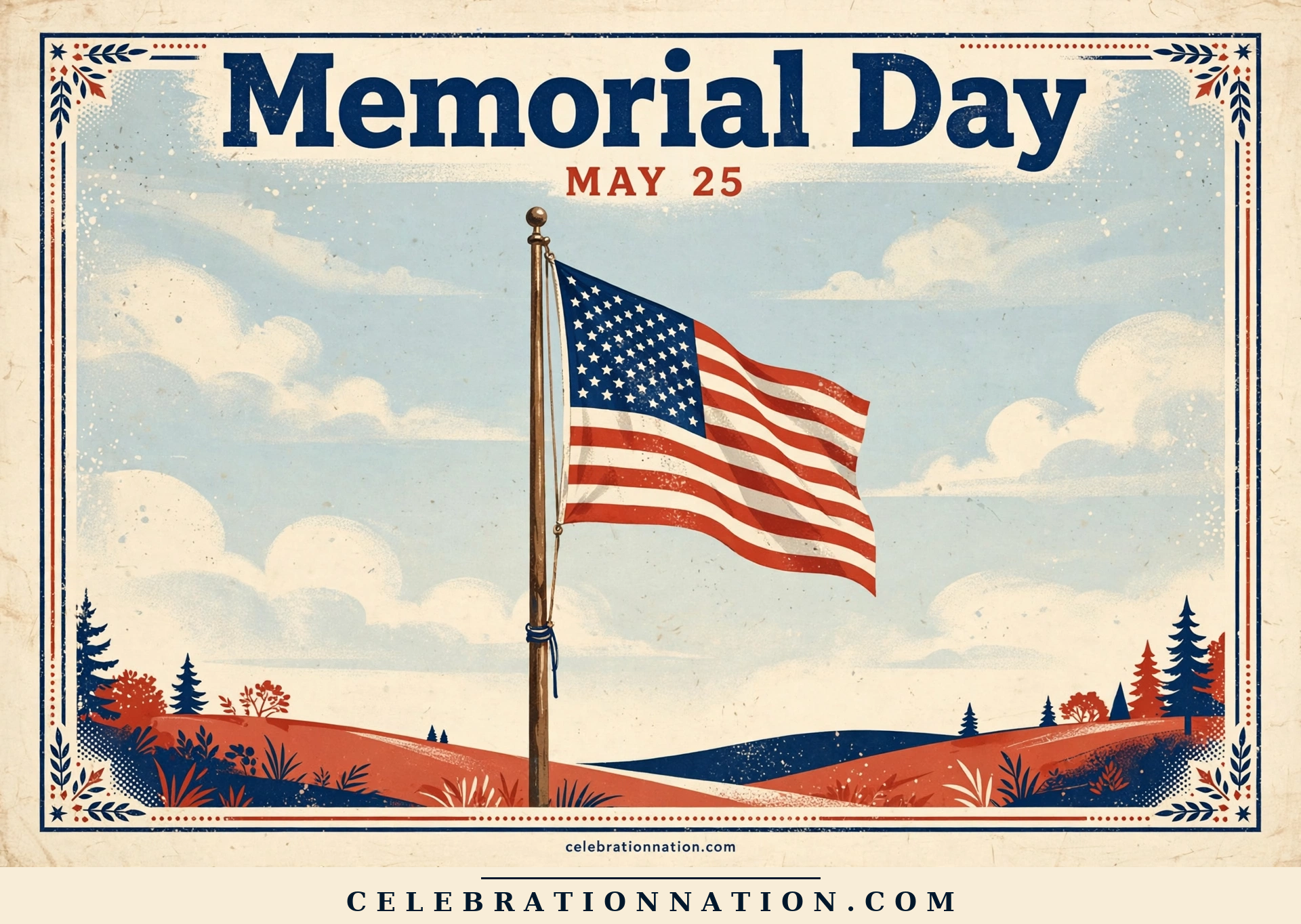
Memorial Day
Memorial Day — the last Monday of May — is the day America remembers the people who died in its service. It is not Veterans Day. It is not a car-sale occasion. It is, at its heart, one of the most solemn holidays on the calendar.
- Vibe
- Solemn & Grateful
- Also on May 25
- World Thyroid Day · Geek Pride Day · International Plastic Free Day
- Hashtag
- #MemorialDay
Ways to celebrate
Honor first; celebrate second:
- 🎖️ Pause at 3:00 PM local time. The National Moment of Remembrance. One minute. Silent. Wherever you are.
- 🌹 Visit a cemetery or memorial. Bring flowers. The flowers aren't for anyone in particular; they're for the fact of remembering.
- 🏳️ Half-staff until noon. Flags should be flown at half-staff from sunrise until noon, then raised to full for the rest of the day — symbolic of the nation rising in resolve to honor the fallen.
- 📖 Read one story. One soldier's biography. One letter home. One speech. Make the memory specific.
- 🎁 Donate to a veteran's charity. Tragedy Assistance Program for Survivors (TAPS), Fisher House, Wounded Warrior Project. Money does work today that grief cannot.
Make it your kind of celebration
Family
Talk to kids about what the day actually is. Not scary, just real. "Today we remember people who died protecting others." That's enough.
Kids
If there's a local parade or cemetery ceremony, bring them. Kids notice solemnity, even if they don't fully understand it yet.
Couples
Attend a ceremony together. A simple act; it anchors the day in meaning, not marketing.
Office
If your office is open, acknowledge the day at morning standup or in a team note. Not sentimental — just acknowledgment. Skip the Memorial Day sales email.
School
Not a school day in most districts — but if kids are at camp or daycare, a moment of silence at 3pm ties the day to the country.
Community
Local ceremonies happen in every town. Parade, cemetery service, community picnic — all three are traditions. Show up.
Just me
Read one account of a fallen soldier. One name. Then the cookout. The grief honors the joy.
Plan ahead
Memorial Day is observed on the last Monday in May. Here is where it lands for the next ten years, handy for planners, marketers and party people.
Fast facts
The story
Memorial Day grew out of the American Civil War, the deadliest conflict the country has ever fought, and the need to honor more than 620,000 dead.
Read the full story
The origins are contested, at least 25 American towns claim to have held the first Memorial Day ceremony. The official federal recognition traces to May 5, 1868, when General John A. Logan, head of the Grand Army of the Republic (a Union veterans' organization), proclaimed May 30 as a day to decorate the graves of fallen soldiers with flowers. It was called Decoration Day. The first large-scale observance took place on May 30, 1868, at Arlington National Cemetery, where over 5,000 people gathered to place flowers on the 20,000 Union and Confederate graves.
Notably, one of the earliest documented Memorial Day ceremonies was held on May 1, 1865, in Charleston, South Carolina, by newly-freed Black Americans who exhumed, reburied, and honored Union soldiers who had died as prisoners of war. Two hundred and fifty Black schoolchildren led the procession carrying flowers. This ceremony, organized entirely by the African American community, significantly predated Logan's 1868 proclamation.
After World War I, Decoration Day expanded to honor all American military dead, not just Civil War veterans. In 1967, Congress officially renamed it Memorial Day. In 1971, the Uniform Monday Holiday Act moved the observance from May 30 to the last Monday in May, creating the three-day weekend that now bookends summer. That scheduling change is controversial veterans' groups have argued it helped turn a solemn holiday into a barbecue weekend.
The National Moment of Remembrance, observed at 3:00 PM local time on Memorial Day, was established by Congress in 2000 as a corrective. One minute of silence, wherever you are. It's the small ritual that reminds us what the day is actually for. And every year, soldiers place an American flag at each of Arlington's 260,000+ graves. The tradition holds.
Four meaningful ways to mark the day beyond the weekend party:
Six meaningful rituals, from the federal to the local:
Did you know?
The first federal Memorial Day: 5,000 people at Arlington.
May 30, 1868. General James Garfield (future president) spoke. 20,000 Union and Confederate graves were decorated with flowers. Children of both North and South laid wreaths together.
Arlington National Cemetery was Robert E. Lee's estate.
The U.S. government seized the land during the Civil War and began burying Union soldiers there explicitly to ensure Lee could never return to live on his own property.
The "Red Poppy" tradition comes from a WWI poem.
John McCrae's 1915 poem "In Flanders Fields" inspired the red paper poppy, sold by veterans' organizations every Memorial Day weekend. All proceeds support disabled veterans.
A flag is placed at each of Arlington's 260,000+ graves.
Between the 260,000 graves at Arlington, the Vietnam Veterans Memorial, the Tomb of the Unknown Soldier, and multiple state memorials in the D.C. area, hundreds of thousands of flags are placed each Memorial Day.
Keep the party going
See the calendar
Celebrate every day, all year
Official gear from the people who track 1,700+ celebrations.
Browse the shop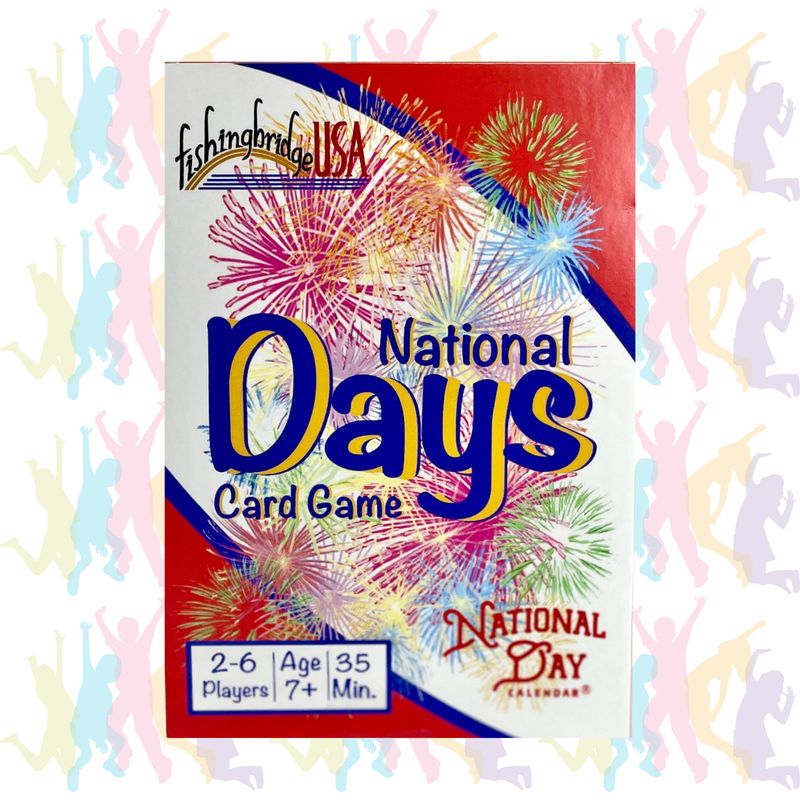 National Day Celebration Card GameA party in a box, any day of the year.
Never miss a reason to celebrate.
One quick morning email with today's celebrations, ideas and posters. Free, unsubscribe anytime.
🎉 You're on the list! Watch your inbox for The Daily Confetti.