


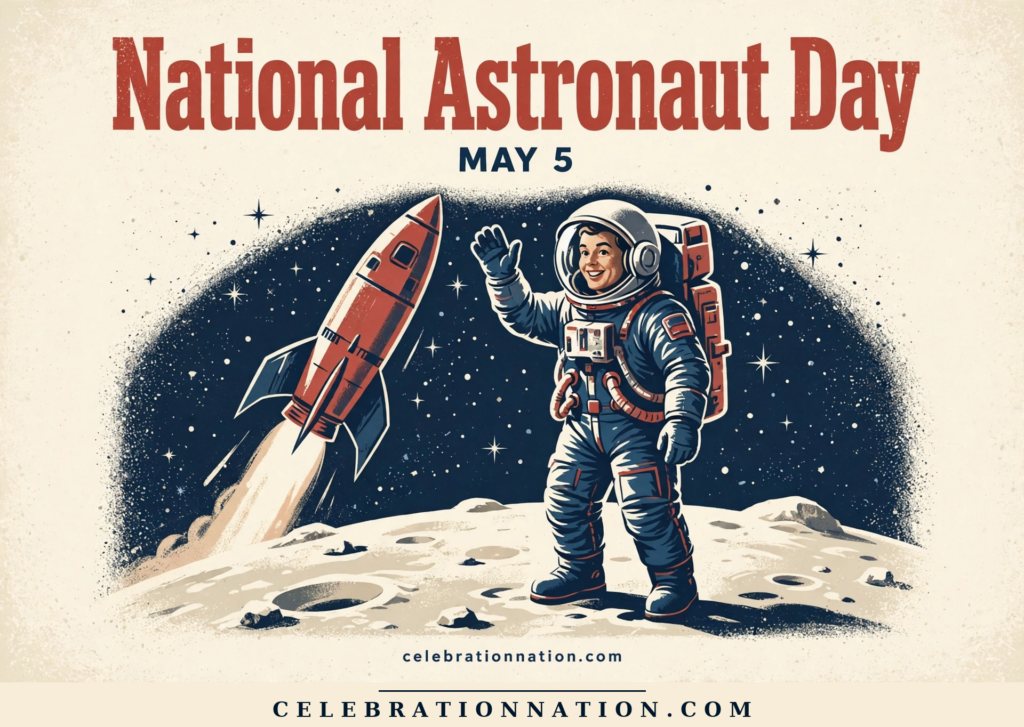
National Astronaut Day
National Astronaut Day on May 5 marks the anniversary of Alan Shepard's 1961 flight — the first American in space — and honors the 400+ Americans who have followed him into orbit, onto the Moon, and beyond. Founded in 2016 by Uniphi Space Agency. A day to reflect on what 65 years of American spaceflight has meant — and where we're going next.
- Vibe
- Frontier & Wonder
- Also on May 5
- Mmiw Awareness Day · Teacher Appreciation Day · Foster Care Day
- Hashtag
- #NationalAstronautDay
Ways to celebrate
Look up, reflect, get inspired:
- 🚀 Watch a launch. SpaceX launches from Cape Canaveral or Vandenberg several times a month. NASA TV, NASASpaceflight YouTube — free livestreams.
- 🌙 Go stargazing. Find a dark-sky location. The ISS is visible to the naked eye — check spotthestation.nasa.gov for your location.
- 📚 Read Scott Kelly or Chris Hadfield. Two astronauts who wrote exceptional memoirs about what spaceflight is actually like.
- 🎬 Watch 'Apollo 13' or 'First Man.' Ron Howard and Damien Chazelle's films are among the best ever made about spaceflight.
- 🏛️ Visit a space museum. Smithsonian Air & Space (DC), Kennedy Space Center Visitor Complex (FL), Johnson Space Center (Houston) — all outstanding.
Make it your kind of celebration
Family
Family launch-watching night. Pick an upcoming launch; livestream it; explain what's happening. Kids LOVE it.
Kids
Build a model rocket. Estes kits cost $20-40 and launch on a parking lot. Genuine STEM engagement.
Couples
Weekend trip to Kennedy Space Center or Johnson Space Center. Deeply inspiring for anyone; includes museum-quality exhibits.
Office
Team launch-viewing event with Starbucks gift cards. Modern remote team-building, basically free.
School
Classic STEM day material. Astronaut Q&A programs are available through NASA's education office. Rockets, physics, biology, engineering all tied in.
Community
Public library astronomy night. Many cities have amateur astronomy clubs who will bring telescopes for free public viewing.
Just me
One astronaut memoir + one evening of stargazing. 'Endurance' by Scott Kelly is a particularly good solo read.
Plan ahead
National Astronaut Day is observed on May 5 every year. Here is where it lands for the next ten years, handy for planners, marketers and party people.
Fast facts
The story
On May 5, 1961, Alan Shepard climbed into a Mercury capsule atop a Redstone rocket and became the first American in space. The flight lasted 15 minutes, reached 116 miles altitude, and did not actually orbit, the Soviet Union's Yuri Gagarin had orbited Earth three weeks earlier. Shepard was second. But he launched on television; he splashed down alive; he made Americans believe the space age was ours to win.
Read the full story
What followed was the most compressed scientific race in human history. JFK's 1961 'Moon before the decade is out' speech. The Mercury 7. Gus Grissom. John Glenn. Gemini. Apollo. By July 20, 1969, 8 years after Shepard's suborbital flight, Neil Armstrong was standing on the Moon. That level of technical acceleration has never been matched in any engineering program before or since.
The Shuttle era (1981-2011) expanded access. 135 missions. International crews. The Hubble Space Telescope deployed and repaired. The ISS assembled piece by piece. The ISS has been continuously crewed since November 2, 2000 humans have lived in space every single day for a quarter of a century. A generation of American kids has grown up never knowing a time with no humans above them.
The modern era is commercial and international. SpaceX has been flying NASA astronauts to the ISS since 2020. Blue Origin is launching civilians on suborbital hops. Artemis is putting NASA back on track for the Moon. SpaceX's Starship promises Mars. National Astronaut Day, founded in 2016 by Uniphi Space Agency, landed in the right moment, as American spaceflight enters its most ambitious phase since Apollo.
Four reality-check requirements for the 0.04% acceptance rate:
Six Americans who defined what it means to be an astronaut:
Did you know?
Only 12 humans have walked on the Moon. All American. All between 1969-1972.
The 'Apollo 12' is a short list: Armstrong, Aldrin, Conrad, Bean, Shepard, Mitchell, Scott, Irwin, Young, Duke, Cernan, Schmitt. Nine are still living. No human has been beyond low Earth orbit since 1972. Artemis aims to change that.
Astronauts get taller in space.
The spine decompresses without gravity, astronauts grow ~1.5 inches (3-5 cm) during a 6-month ISS mission. They shrink back to normal height within weeks of return. Also: eye pressure changes cause vision shifts in ~60% of long-duration astronauts.
Three astronauts have died in spacecraft.
Apollo 1 (1967, Grissom, White, Chaffee, ground fire during test). Challenger (1986, 7 crew). Columbia (2003, 7 crew). 17 total American astronaut/cosmonaut deaths in training or mission. A dangerous profession.
The Pale Blue Dot.
Voyager 1's photograph of Earth from 3.7 billion miles away, taken Feb 14, 1990. Shows Earth as a single pixel in a sunbeam. Carl Sagan's essay about the image, 'That's here. That's home. That's us.', remains the most-quoted description of what space teaches us.
Keep the party going
See the calendar



Celebrate every day, all year
Official gear from the people who track 1,700+ celebrations.
Browse the shop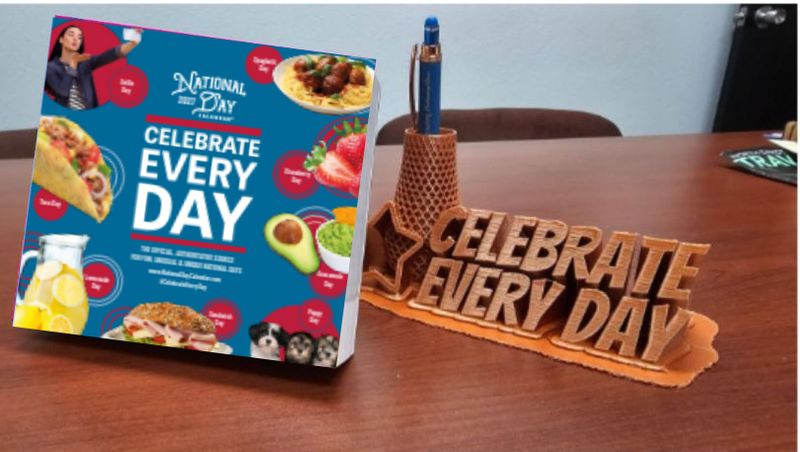 2027 National Day Desk CalendarA new celebration every morning. Daily tear-off.
Never miss a reason to celebrate.
One quick morning email with today's celebrations, ideas and posters. Free, unsubscribe anytime.
🎉 You're on the list! Watch your inbox for The Daily Confetti.