
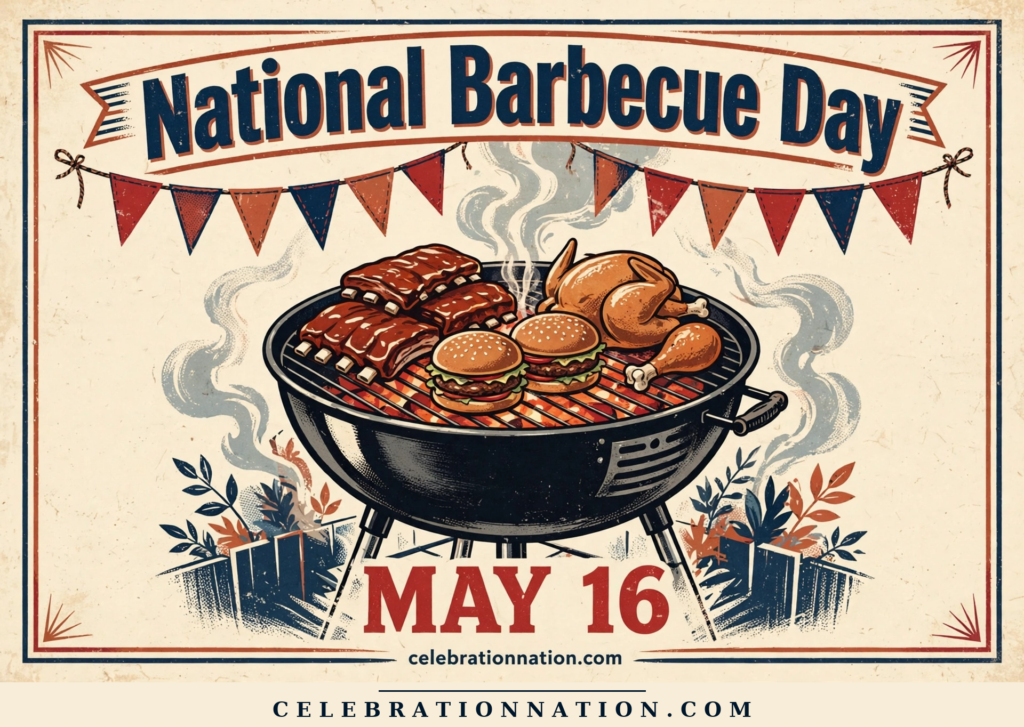
National Barbecue Day
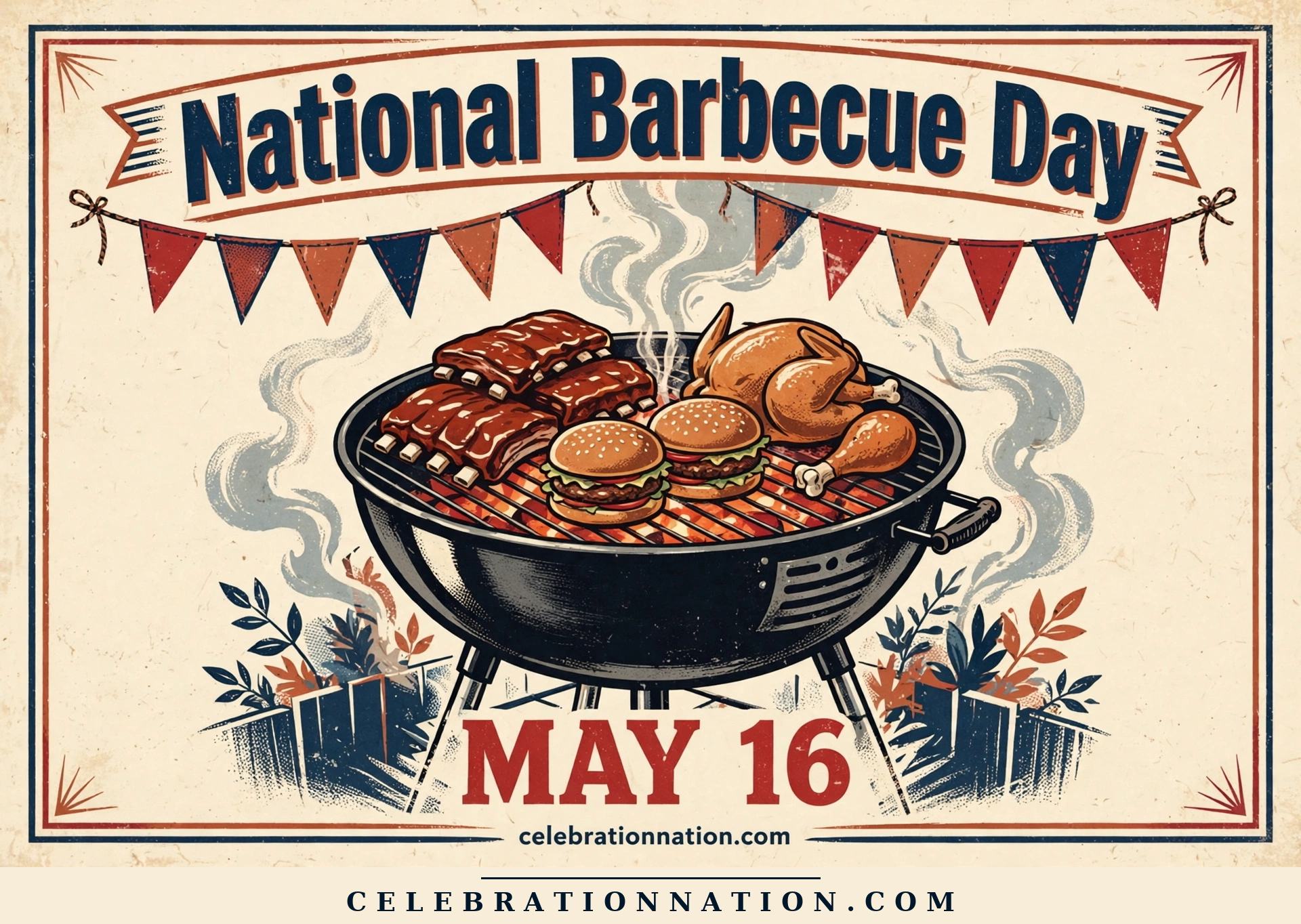
Low heat, long smoke, meat worth waiting for. National Barbecue Day on May 16 honors the most regional, most patient, most specifically American cooking tradition there is — and the community that has always gathered around it.
- Vibe
- Smoked & Patient
- Also on May 16
- Armed Forces Day · Check Your Wipers Day · Honor Our LGBT Elders Day
- Hashtag
- #NationalBarbecueDay
Ways to celebrate
Find your tradition:
- 🔥 Smoke something. A pork shoulder, a brisket, ribs. 8-12 hours. Patience. Wood (oak, hickory, pecan).
- 🚗 BBQ pilgrimage. Visit a legendary regional spot — Franklin BBQ (Austin), Joe's KC (Kansas City), Skylight Inn (Ayden, NC), Central BBQ (Memphis).
- 🍽️ Try a new region. Order from a style you don't usually eat. Carolina vinegar BBQ is a revelation if you've only had KC-style.
- 📚 Read BBQ history. The African-American roots of Southern BBQ are genuinely important and under-told.
- 👨👩👧👦 Host a cookout. The oldest American community tradition. Invite the neighbors.
Make it your kind of celebration
Family
Family BBQ day means backyard + grill + everyone contributing a side. Old tradition for good reason — it scales, relaxes, and memory-makes.
Kids
Kids help with sides: coleslaw, potato salad, baked beans. Teach them that BBQ is about the whole table, not just the meat.
Couples
BBQ date night at a great local spot. Cheap enough to keep it casual; special enough to remember.
Office
Catered BBQ lunch from a local place is a reliable team morale win. Order the variety tray; get a pit of sides.
School
BBQ-as-American-history is a rich classroom topic. The African-American origin story is essential; regional differences are fascinating.
Community
Neighborhood BBQ potluck = everyone brings a side, one host smokes the meat. Easy community building.
Just me
Treat yourself to take-out BBQ from a great local spot. Eat with no phone; just the food.
Plan ahead
National Barbecue Day is observed on May 16 every year. Here is where it lands for the next ten years, handy for planners, marketers and party people.
Fast facts
The story
American barbecue is African in root, Native in technique, and Southern in evolution. It is one of the most layered cuisines this country has produced.
Read the full story
The word "barbecue" likely comes from the Taíno word barbacoa a wooden frame used by Caribbean natives to smoke meat over low heat. Spanish conquistadors encountered it in the 16th century; the word entered English soon after. The technique, slow-smoking meat over hardwood, existed in West African and Caribbean cultures long before European contact.
American BBQ as a regional cuisine developed in the 17th and 18th-century American South. Enslaved Africans in Virginia, the Carolinas, Georgia, and throughout the Deep South applied their own smoking traditions, often combined with Caribbean and indigenous techniques, to the plantation's lesser cuts of meat. The resulting cooking tradition was hard labor, long patience, and transformative results. The foundational American BBQ tradition was built by Black Americans; this fact was obscured for much of the 20th century but is increasingly recognized.
The four modern American BBQ regions crystallized in the late 19th and early 20th centuries, shaped by local ingredients, regional preferences, and the Great Migration. Texas specialized in beef brisket (cattle country). Kansas City became a BBQ "melting pot" thanks to Black migrants from the South; its sweet molasses sauce became the national template. Memphis emphasized pork ribs with dry rubs. The Carolinas developed pulled pork with vinegar-based (Eastern) or tomato-vinegar (Western) sauces.
National Barbecue Day, May 16, has been informally observed for decades and crystallized into a widely-recognized holiday in the 2000s. Americans spend billions of dollars per year on BBQ restaurants, equipment, catering, festivals. And yet the tradition remains profoundly local. The best BBQ in America is mostly found in small joints you've never heard of, run by pitmasters whose families have been at it for three generations. Honor the lineage. Eat the meat.
Four things that separate great BBQ from burnt meat:
American barbecue in four distinct regional traditions:
Did you know?
Aaron Franklin fans wait in line 3-6 hours.
Franklin BBQ in Austin sells out daily. People start lining up at 7am for an 11am opening. A pilgrimage, and worth every minute, honestly.
The "Presidential BBQ" is a White House tradition.
LBJ held the first White House BBQ in 1964. Many presidents since have kept up the tradition, often on July 4th. Menu is usually Texas-style.
Rodney Scott's is Black-owned, James Beard-winning.
Rodney Scott, a whole-hog pitmaster from South Carolina, won the James Beard Award for Best Chef Southeast in 2018. First Black pitmaster to win. Essential.
World-class BBQ joints have no websites.
The best BBQ in America is often sold out of small joints with minimal marketing. The signal-to-noise ratio is inverse to most cuisines. Ask locals.
Keep the party going
See the calendar
Celebrate every day, all year
Official gear from the people who track 1,700+ celebrations.
Browse the shop 2027 National Day Wall CalendarGet the 2026 edition free. 1,700+ observances.
Never miss a reason to celebrate.
One quick morning email with today's celebrations, ideas and posters. Free, unsubscribe anytime.
🎉 You're on the list! Watch your inbox for The Daily Confetti.