




National Bat Appreciation Day
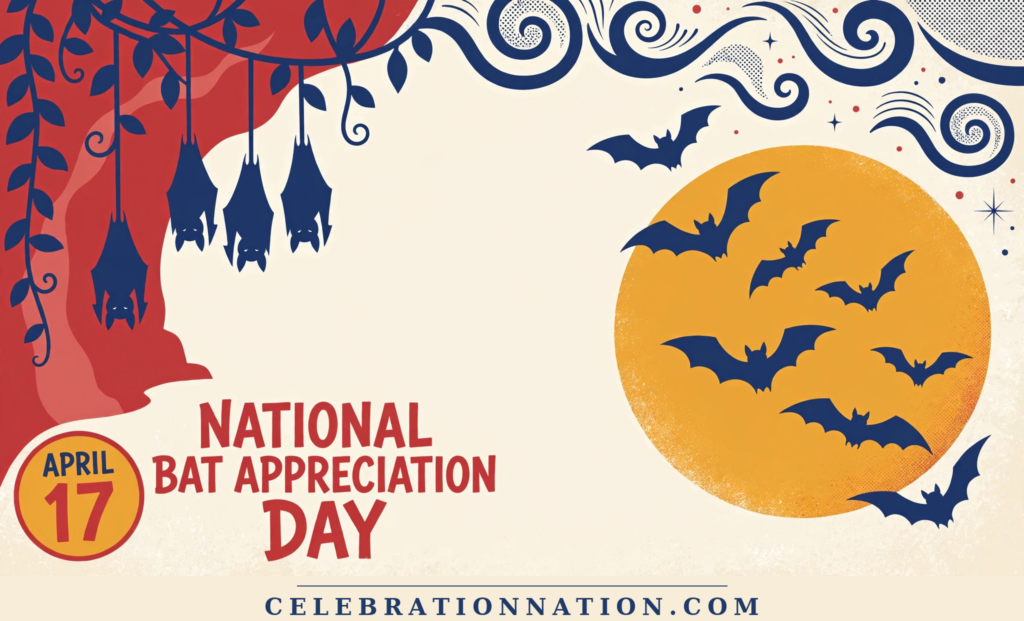
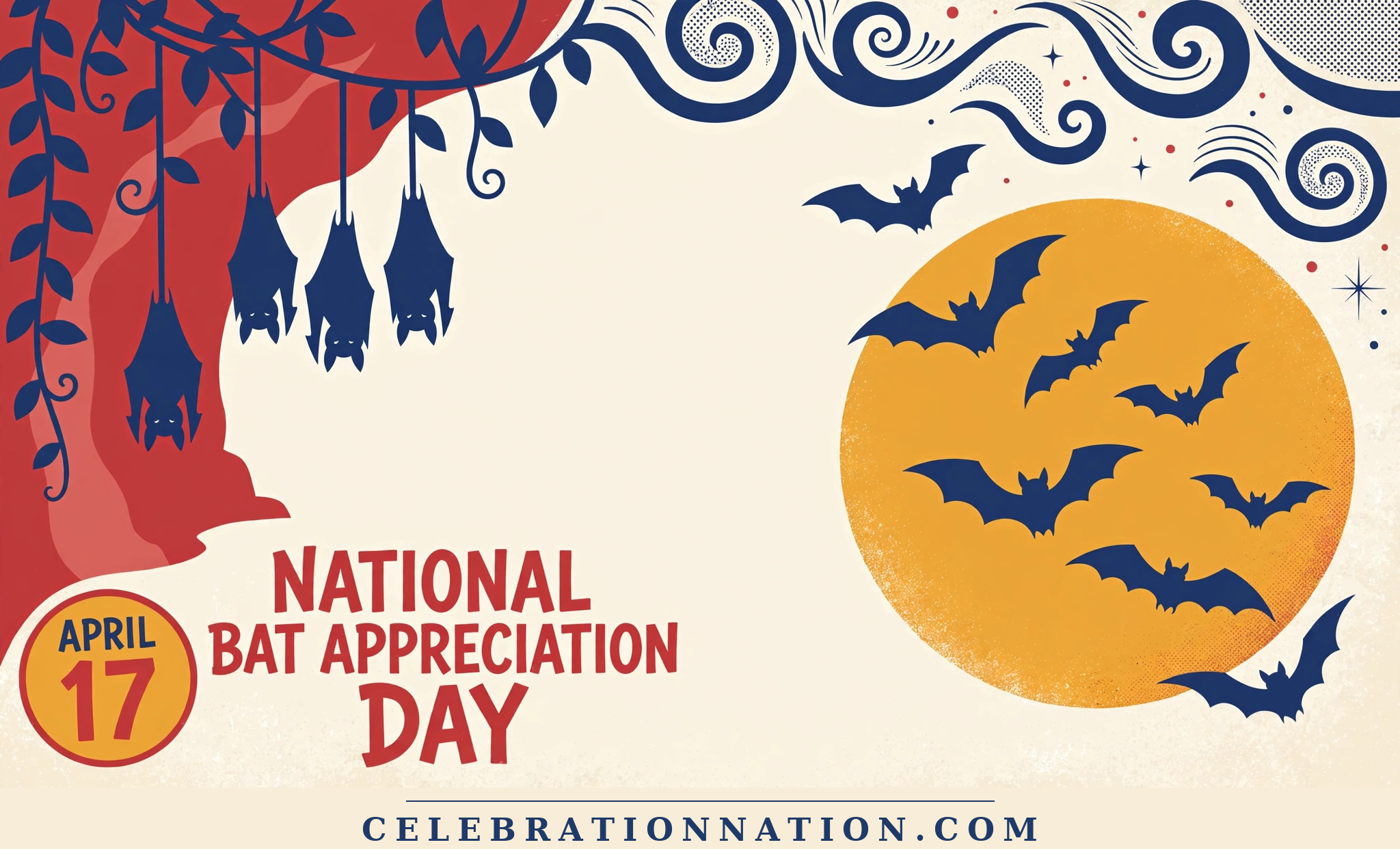
National Bat Appreciation Day on April 17 celebrates one of the most misunderstood and ecologically critical animals on Earth — the only flying mammal, a pollinator of agaves and fruits across the Americas, a pest controller on a massive scale, and a species currently collapsing from white-nose syndrome. Bats save American agriculture an estimated $3-23 billion per year in pest control alone.
- Vibe
- Conservation & Wonder
- Also on Apr 17
- World Hemophilia Day · International Bat Appreciation Day · Cheeseball Day
- Hashtag
- #NationalBatAppreciationDay
Ways to celebrate
Watch, learn, conserve:
- 🌙 Watch an evening bat emergence. Austin, TX's Congress Avenue Bridge has 1.5M Mexican free-tailed bats that emerge at dusk; it's a nightly tourist event. Bracken Cave is even larger.
- 🏠 Install a bat house. A properly-built bat house houses dozens of bats and provides natural mosquito control. Bat Conservation International has plans.
- 🦇 Visit a bat cave. Carlsbad Caverns (NM), Mammoth Cave (KY), or any National Park with bat tours. Most run in April-October.
- 💰 Donate to Bat Conservation International. The leading bat conservation organization; funds white-nose syndrome research.
- 📖 Read 'Bats: An Illustrated Guide to All Species.' Marianne Taylor's visual guide is accessible and beautiful.
Plan ahead
National Bat Appreciation Day is observed on April 17 every year. Here is where it lands for the next ten years, handy for planners, marketers and party people.
Fast facts
The story
Bats are the only mammals capable of true flight. There are about 1,400 bat species worldwide, more than one in five mammal species is a bat. North America has 48 native species, ranging from the 3-gram bumblebee-sized Kitti's hog-nosed bat (not US) to the 2-pound flying foxes (not US, but the American spotted bat and hoary bat are the largest native species). All US bats are insectivores or nectar-feeders; no US bats drink blood (vampire bats are Latin American).
Read the full story
Bats are ecologically critical. A single Mexican free-tailed bat consumes about half its body weight in insects every night, 5,000-10,000 mosquitoes, moths, and beetles per bat. Multiplied across millions of bats, this represents massive natural pest control. A 2011 study in Science estimated US agriculture saves $3-23 billion per year thanks to bat-mediated pest control alone. Some bats (notably the lesser long-nosed bat) are also essential pollinators, agave plants, which produce tequila and mezcal, rely on bat pollination.
The defining bat crisis of our era is white-nose syndrome, a fungal disease (Pseudogymnoascus destructans) discovered in New York in 2006. The fungus grows on bats' noses and wings during hibernation, causing them to wake too often and starve. White-nose syndrome has killed an estimated 6+ million bats in North America since 2006. Some species have declined 90%+, the little brown bat, once the most common US bat, is now rare in parts of its former range. It's one of the worst wildlife disease crises in American history, ongoing today.
Bat conservation is led in America by Bat Conservation International (founded 1982 by Merlin Tuttle, the iconic bat biologist and photographer). Their work includes white-nose syndrome research, bat-house campaigns, and cave-protection programs. The Mexican free-tailed bat colony at Bracken Cave (Texas), 20 million bats, the largest colony on Earth, is protected by BCI. Austin's Congress Avenue Bridge colony (1.5 million bats) has become a major tourist attraction. Bats need conservation allies more than ever; April 17 is the day to become one.
From tiny to massive, diverse and crucial:
Where to find, and protect, the nation's bats:
Did you know?
Bats are more closely related to humans than mice are.
Bats are in the order Chiroptera; humans are primates. Both are placental mammals in superorder Laurasiatheria. Genetic studies show bats are closer to humans than rodents are, despite superficial resemblance.
Only 3 of 1,400 bat species drink blood.
The 'vampire bat' stereotype applies only to 3 Latin American species. None are in the US. Nearly all bats are insect-eaters, fruit-eaters, or nectar-feeders. Most Americans live around bats and never see one.
Bat echolocation is 10x more precise than radar.
Bats emit ultrasonic pulses (20-200 kHz, beyond human hearing) and interpret echoes to navigate. They can distinguish objects as small as a human hair at 10 feet. Among the most sophisticated biological sensors known.
White-nose syndrome jumped from Europe.
The fungus causing white-nose syndrome evolved in European bats, where it's largely harmless. It arrived in North America (probably on a caver's gear) around 2006. European bats have resistance; North American bats do not. A cautionary tale about accidental species introductions.
Keep the party going
See the calendar


Celebrate every day, all year
Official gear from the people who track 1,700+ celebrations.
Browse the shop 2027 National Day Desk CalendarA new celebration every morning. Daily tear-off.
Never miss a reason to celebrate.
One quick morning email with today's celebrations, ideas and posters. Free, unsubscribe anytime.
🎉 You're on the list! Watch your inbox for The Daily Confetti.