



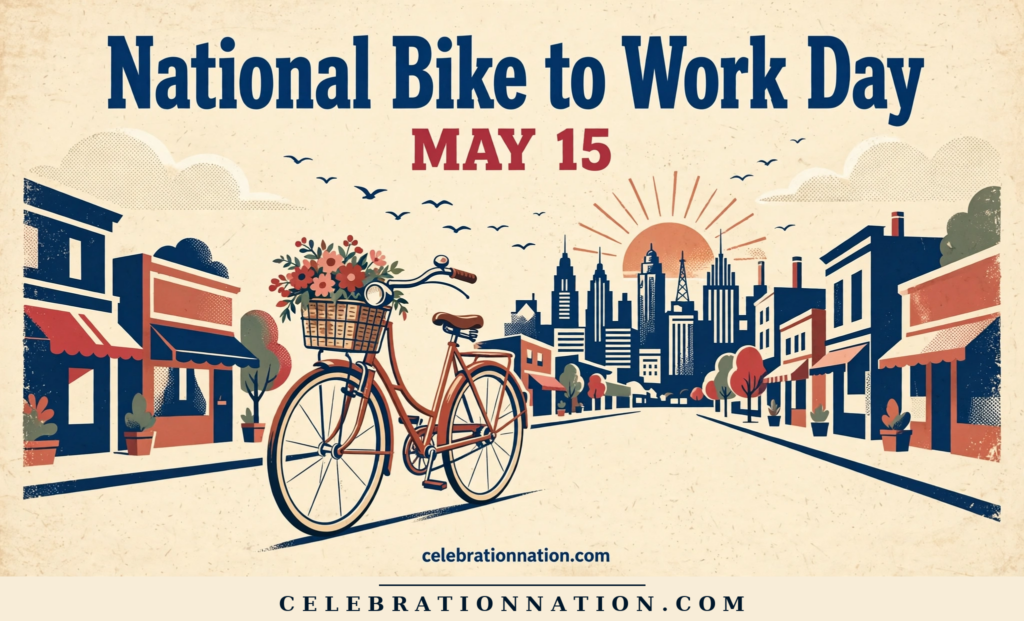
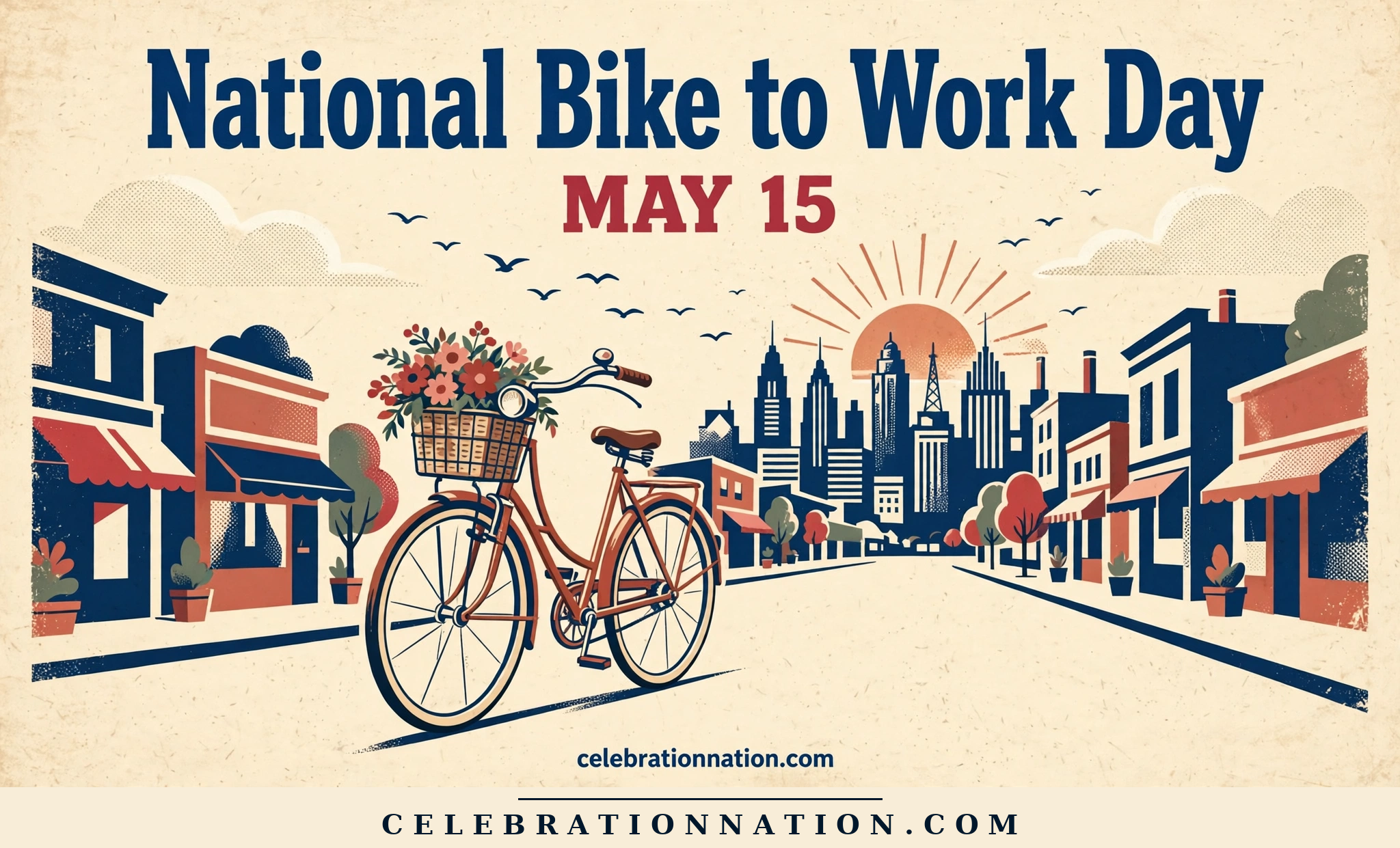
National Bike to Work Day
Two wheels, one commute, zero gasoline. National Bike to Work Day — the third Friday in May — is the climax of National Bike Month and one of the cheapest quality-of-life upgrades available to any American with a working bike.
- Vibe
- Self-Powered
- Also on May 15
- Nylon Stocking Day · Pizza Party Day · Peace Officers Memorial Day
- Hashtag
- #NationalBikeToWorkDay
Ways to celebrate
Today's the day to try:
- 🚴 Ride your bike to work. Even once. Even part of the way. Many cities have bike-share near transit stops.
- 🛣️ Plan your route. Google Maps' bike directions find lower-traffic roads, bike lanes, trails.
- 💧 Pack a water bottle, a snack, a change of shirt. Basic commuting kit. Nothing fancy.
- ⚙️ Tune-up if needed. Flat tires, squeaky chain. Most bike shops will do a free 5-minute check on bike-month Friday.
- 🚴♀️ Organize a team ride. Bike to work with a coworker. Miles always go faster in good company.
Make it your kind of celebration
Family
Weekend family bike outing. Paved trails, gentle slopes, destination with ice cream. Kids who bike as families become adults who bike as commuters.
Kids
A balance bike for toddlers, a pedal bike for age 5-6. Kids pick up cycling fast; most adults forget that biking was an early childhood joy.
Couples
Tandem ride if the relationship can handle it. (It mostly can.) Side-by-side on a paved trail; talk without distraction.
Office
Company-sponsored Bike to Work Day — free breakfast for bike commuters, secure bike parking, shower access. One small investment, real commuting culture shift.
School
Bike Safety Day at elementary schools. Local bike shops often donate helmets; kids learn hand signals, street crossings, and rules of the road.
Community
Local bike advocacy groups (Cascade Bicycle Club in Seattle, Bike New York, etc.) run free Bike to Work Day stations with coffee, pastries, and air pumps. Find yours.
Just me
Try it once. That's it. See if it works for your commute. Thousands of Americans who 'don't bike' became daily riders after one Bike to Work Day.
Plan ahead
National Bike to Work Day is observed on the third Friday in May. Here is where it lands for the next ten years, handy for planners, marketers and party people.
Fast facts
The story
America has more than 100 million bicycles in private ownership, but less than 1% of commutes are by bike. Bike to Work Day exists to nudge that number upward, one rider at a time.
Read the full story
The League of American Bicyclists was founded in 1880 (as the League of American Wheelmen) and is the oldest cycling advocacy organization in the country. In 1956, the League established National Bike Month, an annual May celebration of cycling. In the 1950s, the idea was quaint. Americans were buying cars. Bike commuting was for children.
Bike to Work Day began in 1956 as a single-day event within Bike Month. It was, for decades, a small-scale affair, cycling clubs, a few employers, some college campuses. Then came the 1970s oil crisis, the 1990s environmental movement, the 2000s urban-cycling renaissance, and the 2010s bike-share explosion. By 2020, 1,000+ cities and towns were participating in Bike to Work Day in some form.
The U.S. has about 100 million bicycles in private ownership and 900,000+ bike-commuters who ride to work daily. American bike commuting has roughly doubled since 2000, though it remains a tiny fraction of total commutes. Cities like Portland, Minneapolis, Washington DC, and New York have the highest rates, each around 6-8% of commuters.
The League still coordinates Bike to Work Day. Today, the event pairs advocacy (safer infrastructure, protected bike lanes) with participation (free breakfast stations, group rides, employer incentives). If you've never biked to work, today's the day to try. If you already do, today's the day to encourage one coworker.
Four reasons cycling to work beats driving, measurably:
Six U.S. cities where commuting by bike is actually pleasant:
Did you know?
Bikes are more energy-efficient than cars by 50x.
A calorie of human effort on a bike moves you farther than a calorie of gasoline in a car. The most efficient transportation ever devised, by a huge margin.
The Netherlands has more bikes than people.
23 million bikes, 17 million people. Biking accounts for 36% of all Dutch trips. The Dutch cycle infrastructure is a policy choice American cities can copy.
The bicycle was invented in 1817.
Karl von Drais's "Draisine", essentially a two-wheeled walking device, became the ancestor of the bicycle. The pedal-driven version came in the 1860s.
Tour de France winners average 25 mph for 21 days.
World's most prestigious cycling race. Riders cover 2,000+ miles at near-marathon pace. Nothing in human athletic endurance compares.
Keep the party going
See the calendar

Celebrate every day, all year
Official gear from the people who track 1,700+ celebrations.
Browse the shop 2027 Wall Calendar, signed by Marlo AndersonSigned by the founder of National Day Calendar.
Never miss a reason to celebrate.
One quick morning email with today's celebrations, ideas and posters. Free, unsubscribe anytime.
🎉 You're on the list! Watch your inbox for The Daily Confetti.