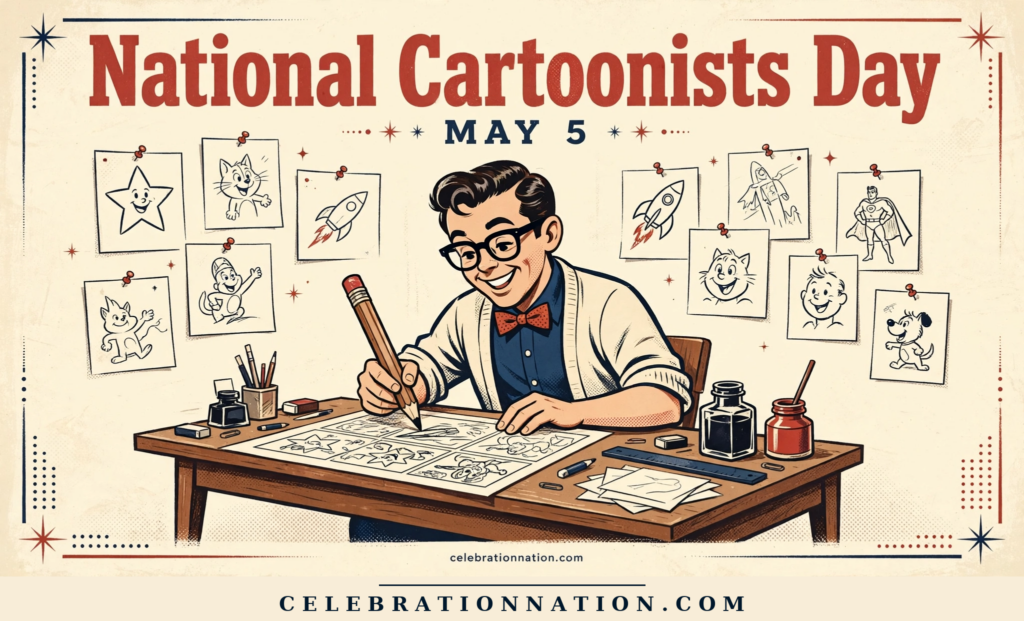
National Cartoonists Day
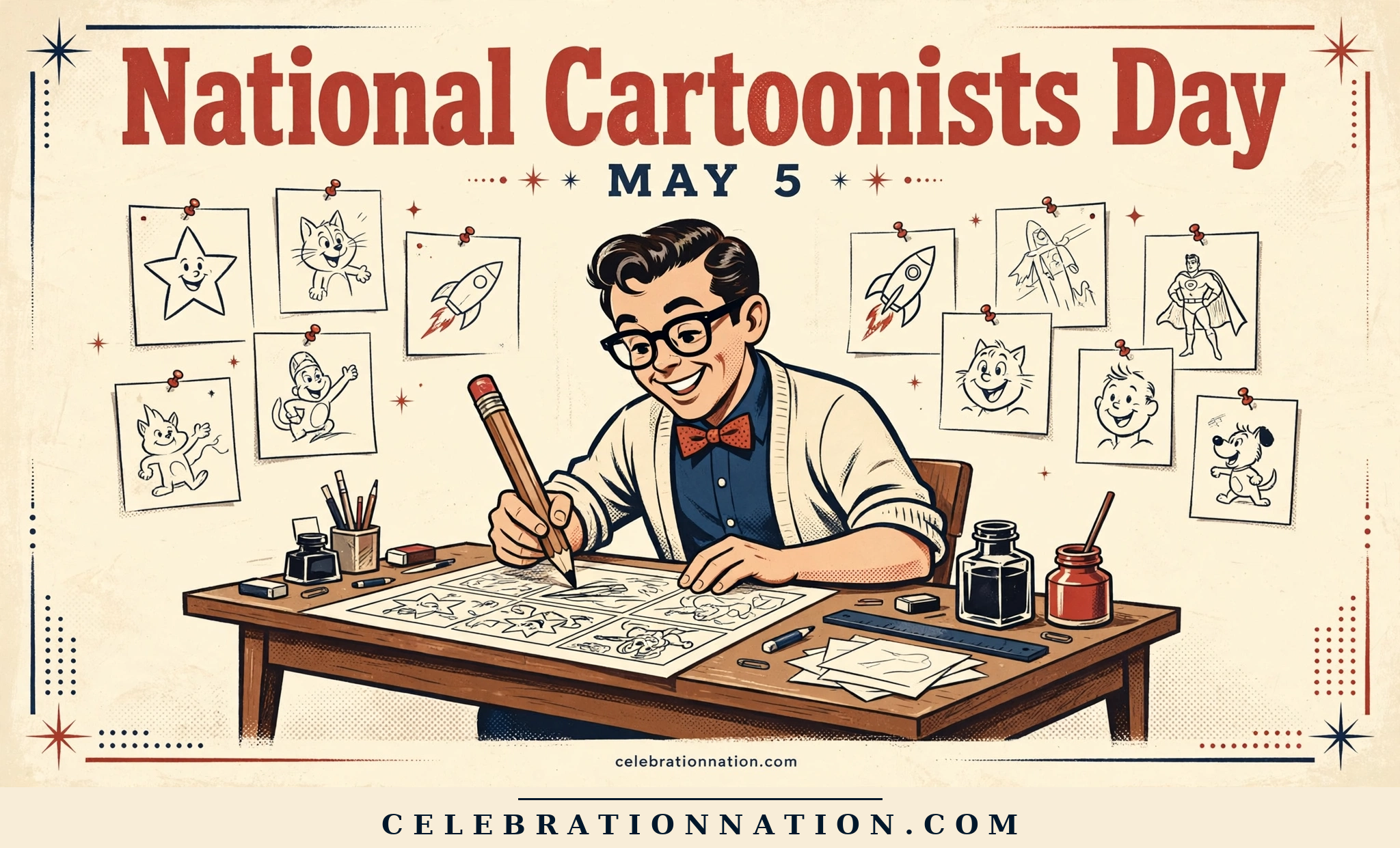
National Cartoonists Day on May 5 honors the men and women who've made America laugh for 130 years — the newspaper strip creators, political cartoonists, comic book artists, New Yorker gag cartoonists, and modern webcomic illustrators who have quietly shaped American culture with a pencil and a punchline. May 5 marks the 1895 first publication of 'Hogan's Alley,' widely credited as the first American comic strip.
- Vibe
- Witty & Unpretentious
- Also on May 5
- Mmiw Awareness Day · Teacher Appreciation Day · World Asthma Day
- Hashtag
- #NationalCartoonistsDay
Ways to celebrate
Honor the pen-and-ink tradition:
- 📰 Read the Sunday comics. A dying institution; still beautiful. Most major American newspapers still publish the funnies section on Sunday. Support them.
- 📚 Buy a collection. 'The Complete Peanuts,' 'The Far Side Gallery,' 'Calvin and Hobbes' — coffee-table books that become family heirlooms.
- ✏️ Try drawing. A stick figure a day for a week. Humility-inducing; bonds you to the craft.
- 📖 Read a cartoonist memoir. Schulz bio, Charles Addams bio, Gary Larson retrospectives. These are exceptional American lives.
- 🏛️ Visit a museum. Charles Schulz Museum (Santa Rosa, CA), Billy Ireland Cartoon Library (Ohio State), National Cartoon Museum (Norwalk, CT).
Make it your kind of celebration
Family
Family comic-strip night. Pull up 'Peanuts' classics online; read them aloud. Kids love the Snoopy Sunday strips.
Kids
Give them a notebook and a pencil. Let them invent a character. Single most reliable rainy-afternoon activity.
Couples
Watch Schulz's 'A Charlie Brown Christmas' together in any season. 25 minutes. Timeless.
Office
Far Side or New Yorker cartoon printed and taped to the break room fridge is the single longest-running office morale-builder in America.
School
Classic English/art cross-curricular project: analyze a comic strip's visual language. High school students love the 'Calvin and Hobbes' stuff.
Community
Support your local newspaper's comics page; subscribe; mention cartoonists by name on social media.
Just me
A good cartoonist collection + a coffee + a quiet Saturday morning. Healing.
Plan ahead
National Cartoonists Day is observed on May 5 every year. Here is where it lands for the next ten years, handy for planners, marketers and party people.
Fast facts
The story
The first American comic strip appeared on May 5, 1895, 'Hogan's Alley' by Richard Outcault, in the New York World. The main character was the 'Yellow Kid,' a bald, jug-eared street urchin with a yellow nightshirt. He was America's first recurring comic-strip character. He was wildly popular. Within 5 years, every American newspaper was running a comic strip.
Read the full story
The golden age began around 1900. Krazy Kat (1913), Gasoline Alley (1918), Little Orphan Annie (1924), Popeye (1929), Dick Tracy (1931), Blondie (1930), Peanuts (1950). Newspaper strips were the mass medium, the way America met ideas before television. A top strip was syndicated to 2,000+ papers and reached 100 million readers a day.
The postwar era produced the canon. Charles Schulz drew Peanuts every single day from October 2, 1950 to February 12, 2000 50 years, 17,897 strips, all in his own hand. Schulz did not use assistants. Never missed a strip. Died one day before his final Sunday strip ran. Calvin and Hobbes (Bill Watterson, 1985-1995), Doonesbury (Garry Trudeau, 1970-present), The Far Side (Gary Larson, 1980-1995) followed in the same spirit, artist-driven, uncompromising, culturally central.
The digital age transformed cartooning. Newspaper circulation collapsed; syndicate strips declined. But webcomics flourished. xkcd, Dinosaur Comics, Saturday Morning Breakfast Cereal, Sarah's Scribbles, a new generation reached millions online without newspaper middlemen. The New Yorker's cartoon tradition continued. Political cartooning survived. National Cartoonists Day, founded by the National Cartoonists Society in 1995 (the 100th anniversary of Hogan's Alley), honors this 130-year lineage.
Four artists whose work defines the medium:
Six institutions that publish, honor, and preserve American cartoon art:
Did you know?
Peanuts strips appeared in 2,600+ newspapers at peak.
In the 1990s, Peanuts was syndicated in 2,600 newspapers across 75 countries in 21 languages. Estimated daily readership: 355 million. The most-read comic strip in history.
Bill Watterson refused to sell Calvin and Hobbes merchandise.
Watterson was offered ~$400 million for merchandising rights (stuffed animals, lunchboxes, cartoons). He refused every offer. He believed merchandising would destroy the integrity of the strip. Those Calvin-peeing-on-things car decals? All pirated; none authorized.
The first Pulitzer for cartooning was in 1922.
Awarded to Rollin Kirby of the New York World for his editorial cartoon 'On the Road to Moscow.' The category has honored political cartoonists ever since. Garry Trudeau (Doonesbury, 1975) was the first strip cartoonist to win.
Hogan's Alley triggered the term 'yellow journalism.'
The Yellow Kid appeared in two papers (Hearst's Journal and Pulitzer's World) in 1896, sparking a bidding war. The sensationalist tactics of both papers gave us the term 'yellow journalism', named directly after the Yellow Kid's yellow nightshirt.
Keep the party going
See the calendar
Celebrate every day, all year
Official gear from the people who track 1,700+ celebrations.
Browse the shop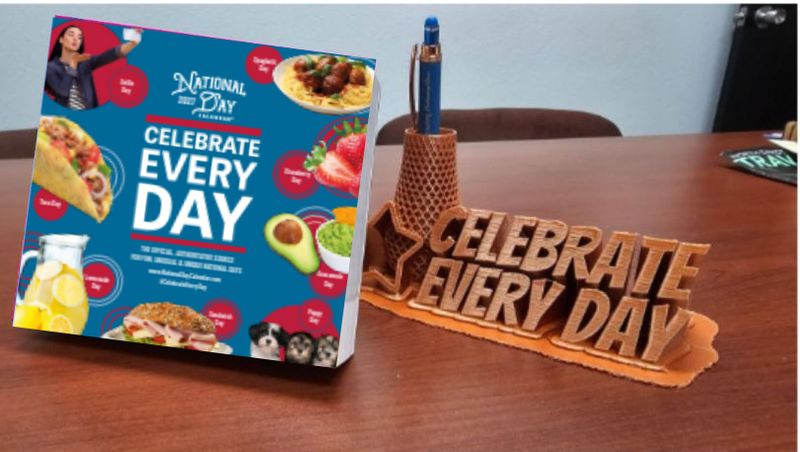 2027 National Day Desk CalendarA new celebration every morning. Daily tear-off.
Never miss a reason to celebrate.
One quick morning email with today's celebrations, ideas and posters. Free, unsubscribe anytime.
🎉 You're on the list! Watch your inbox for The Daily Confetti.