

National Day of Prayer
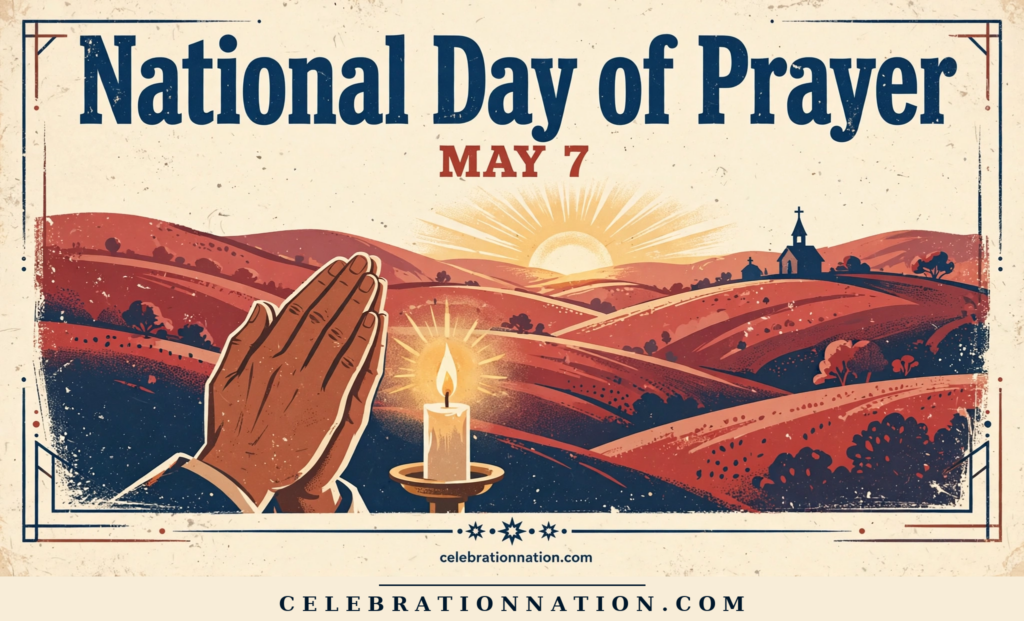
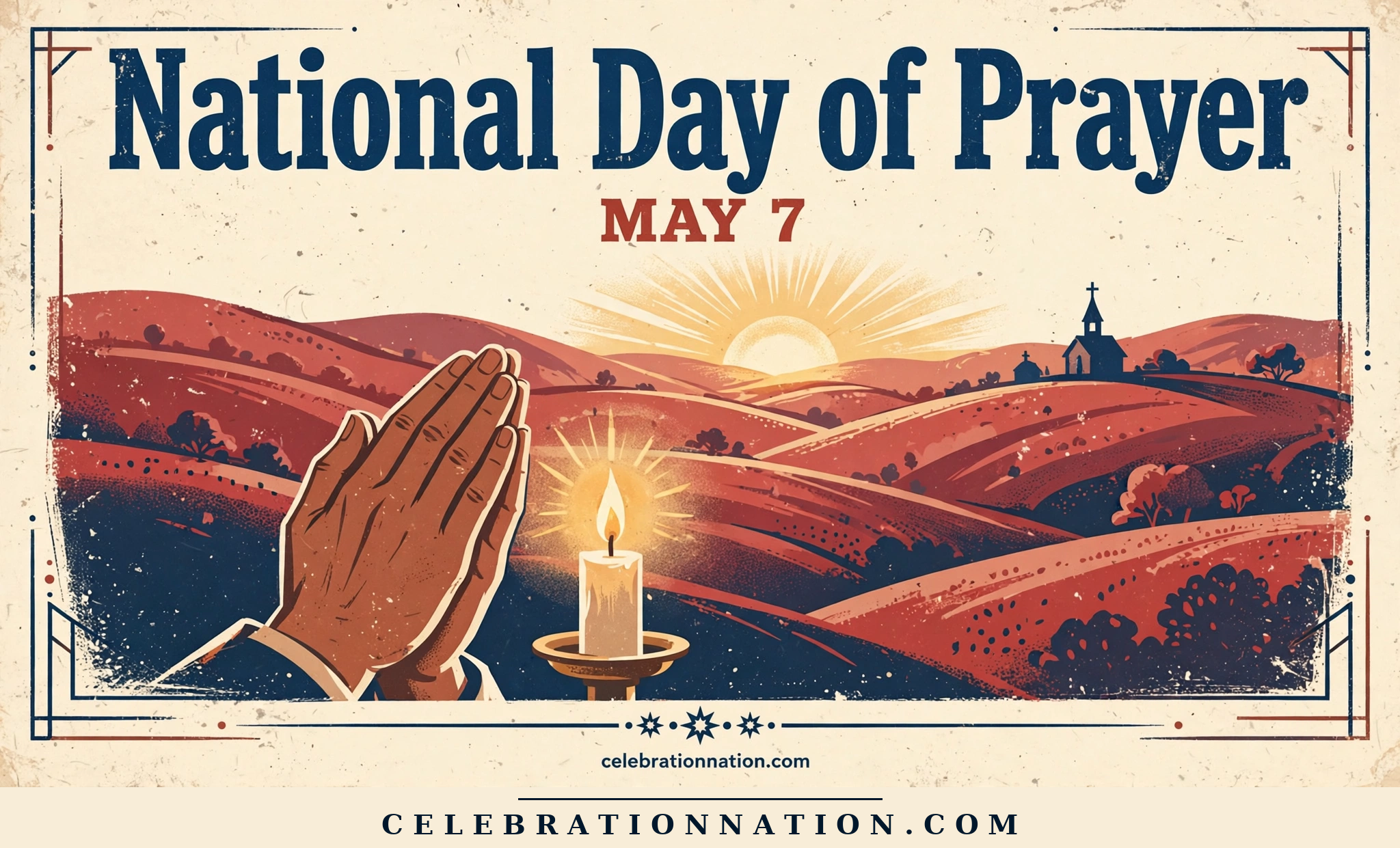
National Day of Prayer on the first Thursday of May (May 7, 2026) is an annual observance signed into law by President Truman in 1952 and set on its current Thursday-in-May date by President Reagan in 1988. It invites Americans of all faiths — or none — to pause for reflection, gratitude, and prayer for the nation. Presidents of both parties have proclaimed it every year since 1952.
- Vibe
- Reflective & Reverent
- Also on May 7
- World Athletics Day · Barrier Awareness Day · Packaging Design Day
- Hashtag
- #NationalDayOfPrayer
Ways to celebrate
Honor the day in your own tradition:
- 🙏 Take a moment. Set aside 5 minutes at noon (the traditional hour). Pray, meditate, or simply reflect in silence.
- ⛪ Attend a service. Most American churches, synagogues, and many mosques hold observances. Many are interfaith and open to all.
- 🏛️ Watch the ceremony. The National Observance at the US Capitol is livestreamed on nationaldayofprayer.org.
- 📝 Write a prayer or reflection. A journal entry, a letter to a loved one, a gratitude list. The act of writing deepens the practice.
- 🤝 Pray across faiths. Attend a service at a tradition different from your own. Many communities host interfaith gatherings on this day.
Make it your kind of celebration
Family
Family dinner prayer circle — each person names one gratitude and one hope. Universally meaningful across faith traditions.
Kids
Simple: at dinner, each family member shares 'one thing I'm grateful for, one thing I hope for.' Young kids understand gratitude instinctively.
Couples
Shared 5-minute silence together, morning or evening. Holding hands; no words. The shared quiet is itself a prayer.
Office
A quiet 'reflection room' for the day — a conference room with no meetings, available for anyone who wants 10 minutes of silence.
School
Student-led 'See You at the Pole' events are common. Check local policies; most states permit voluntary student-led observance.
Community
Most American towns hold an interfaith gathering at noon — the courthouse steps, city hall, the town green. Show up; bring a friend.
Just me
A candle, 10 minutes, a window. That's enough. No theology required.
Plan ahead
National Day of Prayer is observed on the first Thursday in May. Here is where it lands for the next ten years, handy for planners, marketers and party people.
Fast facts
The story
America has been calling itself to prayer since before it was a country. On June 12, 1775, three weeks before the Battle of Bunker Hill, more than a year before the Declaration of Independence, the Continental Congress, at John Hancock's urging, proclaimed a day of 'humiliation, fasting, and prayer' for the colonies' cause. Washington invoked prayer at every major inflection point of the Revolution. Lincoln proclaimed multiple days of fasting and prayer during the Civil War.
Read the full story
But the National Day of Prayer as an annual institution is a 20th-century creation. In 1952, at the height of the Cold War, the Reverend Billy Graham delivered a sermon on the Capitol steps calling for a national day of prayer. Senator Absalom Robertson of Virginia introduced a joint resolution three days later. President Harry Truman signed it into law on April 17, 1952, establishing a permanent annual National Day of Prayer, with the President to proclaim the date each year.
For 36 years, the date floated, sometimes summer, sometimes fall, sometimes spring, at each President's discretion. In 1988, President Ronald Reagan signed an amendment fixing the National Day of Prayer on the first Thursday of May, every year, forever. Since then, the date has not moved, and every American President, Republican and Democratic, has signed the annual proclamation.
In practice, the day has evolved into a decentralized American civic ritual. Tens of thousands of local events happen each year, ecumenical services in church sanctuaries, interfaith gatherings on courthouse lawns, state capitol prayer breakfasts, student-led flagpole gatherings. The National Observance at the US Capitol draws Congressional leaders and clergy; it's livestreamed. The day is not a federal holiday and does not close offices, it is purely an invitation. What you do with the hour is yours.
Four common practices, honor the one that fits your tradition:
Six traditions observed on this day, brief, respectful notes:
Did you know?
Billy Graham's role was pivotal.
Billy Graham's 1952 Capitol steps sermon is widely credited as the direct trigger for Truman's legislation. Senator Robertson's bill was introduced three days after Graham's sermon. One of the most direct clergy-to-legislation arcs in modern American history.
Only one President has skipped the proclamation signing, almost.
In 2009, President Obama did not hold a public White House ceremony for the National Day of Prayer (unlike George W. Bush's tradition), but he did issue the legally required proclamation. No President since 1952 has failed to proclaim the day.
The Continental Congress called for prayer 7 times.
Between 1775 and 1783, the Continental Congress proclaimed seven separate days of prayer, fasting, or thanksgiving. These pre-constitutional prayer days are the direct historical ancestors of the modern National Day of Prayer and Thanksgiving.
Courts have upheld the law repeatedly.
The Freedom From Religion Foundation challenged the National Day of Prayer as unconstitutional in 2010. A district court initially ruled in FFRF's favor, but the 7th Circuit Court of Appeals reversed in 2011, finding the law does not violate the Establishment Clause because it is an invitation, not a compulsion.
Keep the party going
See the calendar

Celebrate every day, all year
Official gear from the people who track 1,700+ celebrations.
Browse the shop National Day Celebration Card GameA party in a box, any day of the year.
Never miss a reason to celebrate.
One quick morning email with today's celebrations, ideas and posters. Free, unsubscribe anytime.
🎉 You're on the list! Watch your inbox for The Daily Confetti.