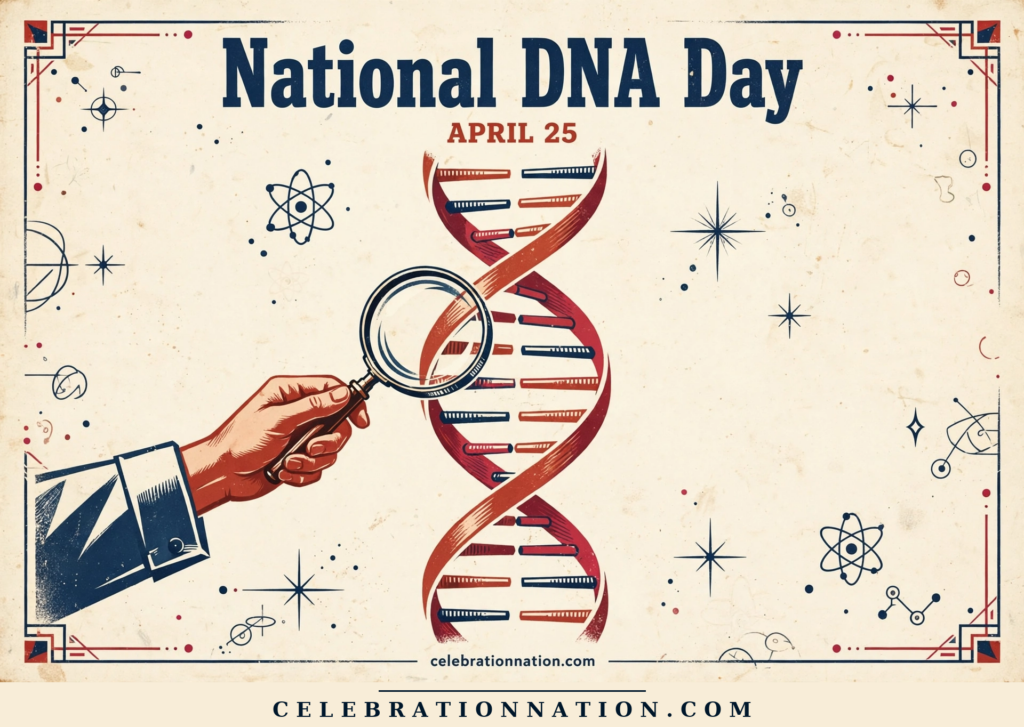
National DNA Day
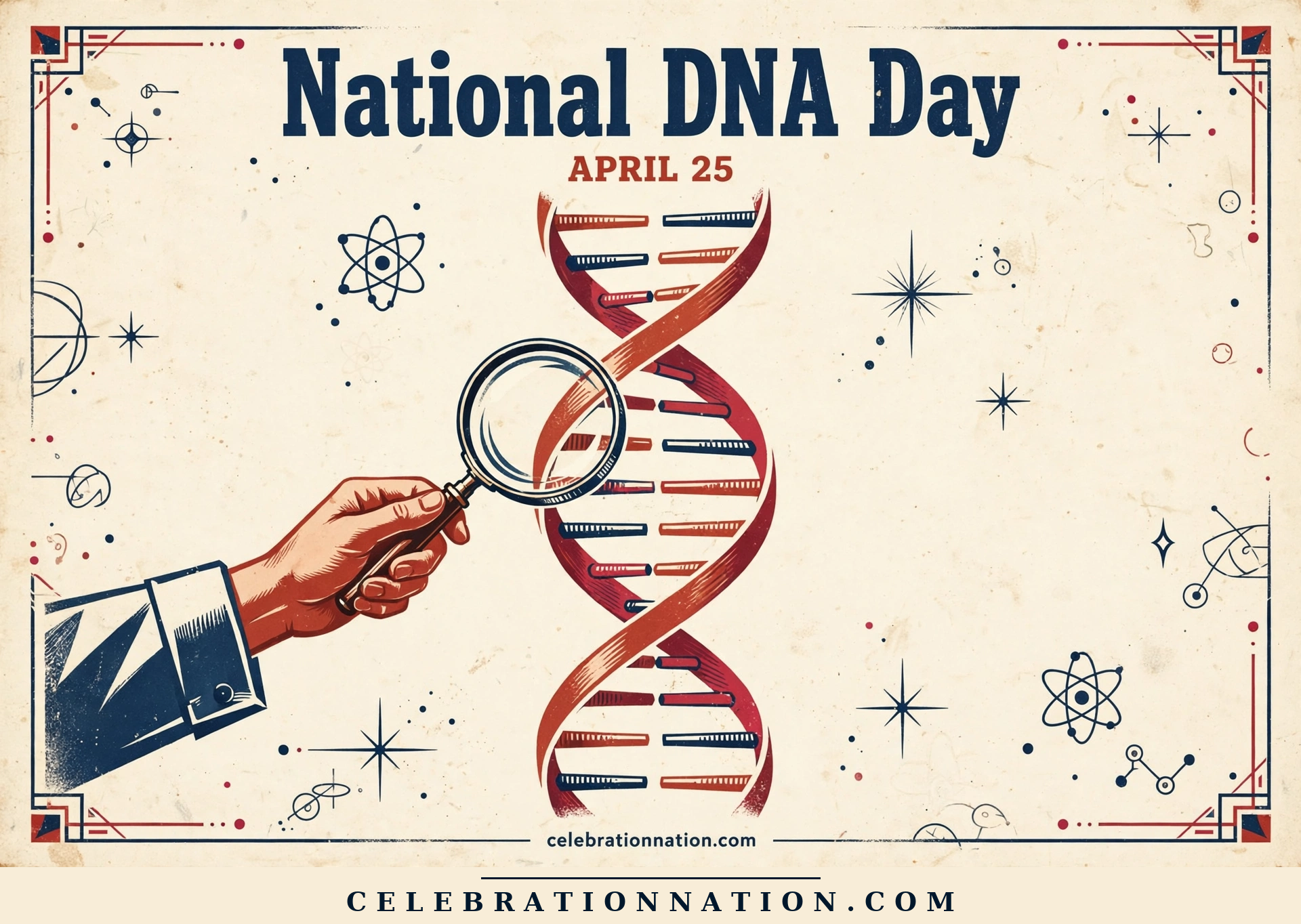
On April 25, America honors the molecule that makes you, you. National DNA Day marks the 1953 publication of the double-helix paper — the single most important page ever published in the history of biology.
- Vibe
- Mind-Blown
- Also on Apr 25
- World Penguin Day · Parental Alienation Day · World Malaria Day
- Hashtag
- #NationalDNADay
Ways to celebrate
A surprisingly rich holiday for a molecule:
- 🧬 Take an ancestry test — if you haven't already. 23andMe, Ancestry, MyHeritage. Warning: may lead to new relatives.
- 📚 Read one genome story. The Gene by Siddhartha Mukherjee is the definitive popular history.
- 🎙️ Listen to a genetics podcast — Radiolab's "A Very Lucky Wind" or "Blame" episodes are unforgettable.
- 🍇 Try the strawberry DNA experiment — mash strawberries with dish soap and rubbing alcohol; actual DNA strands appear. Kids love this.
- 🏥 Ask about family medical history. Call a parent today. Write down what they remember. Some of the most useful DNA info is free and conversational.
Make it your kind of celebration
Family
Family tree + DNA test combo. Even one person testing reveals the family branches, surprising migrations, genetic quirks. Start a shared document.
Kids
Strawberry DNA extraction — it's a classic home science experiment. Actual visible DNA in 20 minutes. Blows their minds.
Couples
Test together if you're starting a family or considering it. Knowing what each of you carries is useful — not scary if approached with a good doctor.
Office
Health-benefits reminder: many employers cover genetic testing for specific conditions. Today's a good day to check your plan's coverage.
School
A genetics lesson that doesn't need a lab: Punnett squares, Mendel's peas, a family pedigree project. Kids love it — everyone wants to know about themselves.
Community
Library science-talk or a public screening of "The Gene: An Intimate History" (the Ken Burns doc). Perfectly accessible for all ages.
Just me
Read one chapter of The Gene tonight. You will go to bed a little changed.
Plan ahead
National DNA Day is observed on April 25 every year. Here is where it lands for the next ten years, handy for planners, marketers and party people.
Fast facts
The story
The discovery of DNA's structure is one of the great detective stories of the 20th century, and one of its most morally complicated.
Read the full story
By 1952, scientists knew DNA carried genetic information but had no idea what it looked like. Two teams raced to solve the structure: James Watson and Francis Crick in Cambridge, and Maurice Wilkins and Rosalind Franklin at King's College London. Franklin was the world's leading X-ray crystallographer of the period. In May 1952, she captured Photo 51 the clearest X-ray diffraction image of DNA ever taken. It showed a helix.
In January 1953, Wilkins showed Photo 51 to Watson, without Franklin's permission or knowledge. Watson and Crick spent the next weeks building wire-and-cardboard models, and on April 25, 1953, they published the now-famous 1,000-word paper in Nature announcing the double-helix structure. In 1962, Watson, Crick, and Wilkins won the Nobel Prize for the discovery. Franklin had died of ovarian cancer four years earlier, at age 37, and was not credited.
The 50-year project to read the entire human genome, the Human Genome Project, was declared complete on April 14, 2003, 50 years (almost to the day) after Watson and Crick's paper. Cost: $2.7 billion. Today, you can sequence your own genome for under $300. The speed of that cost collapse is the fastest in the history of technology faster than Moore's Law, faster than any biotech revolution before or since.
National DNA Day was declared by Congress in 2003 to mark both anniversaries. It's a rare American holiday that celebrates a scientific moment, and a rarer one that asks us to reckon with who gets credit. Rosalind Franklin's photograph made the discovery possible. Her name belongs on every DNA Day.
The four ways DNA quietly shapes your life:
Six moments that changed what DNA means:
Did you know?
Your DNA stretches to the sun and back, 600 times.
If you uncoiled every strand in your body end-to-end. 6 feet of DNA per cell, trillions of cells. The human body is a library.
Humans and bananas share ~60% of DNA.
Because a huge amount of DNA runs basic cellular machinery that evolved once, way back, and has barely changed since. Life is conservative.
Rosalind Franklin's work is now memorialized on Mars.
The European Space Agency's ExoMars rover, launching for Mars in 2028, is named Rosalind Franklin in her honor.
The first genome sequenced belonged to... a virus.
Bacteriophage φX174, 1977. Frederick Sanger's team sequenced all 5,386 letters. Sanger won two Nobel Prizes, one of only a handful of people ever to do so.
Keep the party going
See the calendar
Celebrate every day, all year
Official gear from the people who track 1,700+ celebrations.
Browse the shop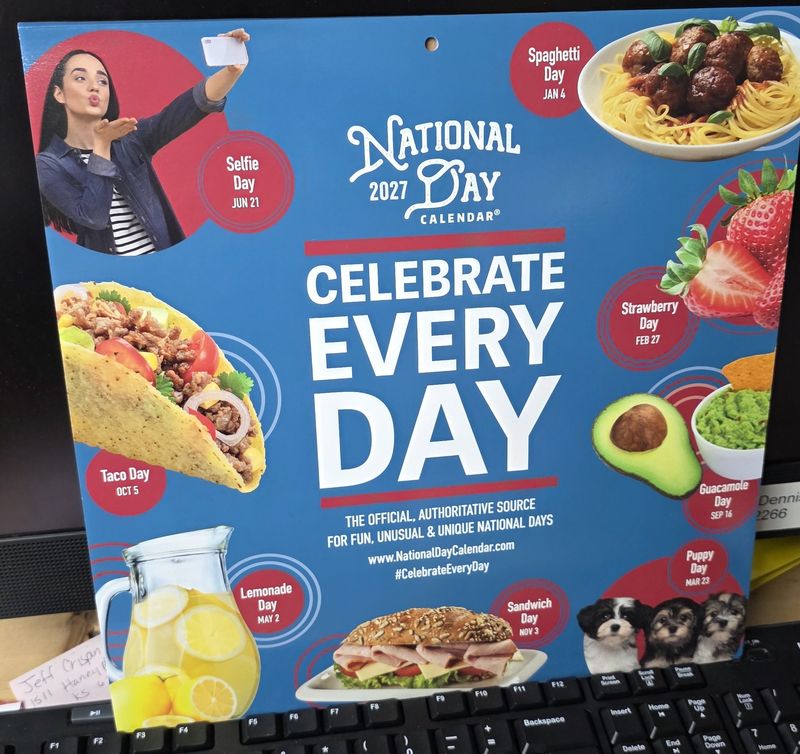 2027 Wall + Desk Calendar BundleCelebrate every day at home and at work.
Never miss a reason to celebrate.
One quick morning email with today's celebrations, ideas and posters. Free, unsubscribe anytime.
🎉 You're on the list! Watch your inbox for The Daily Confetti.