



National Find a Rainbow Day
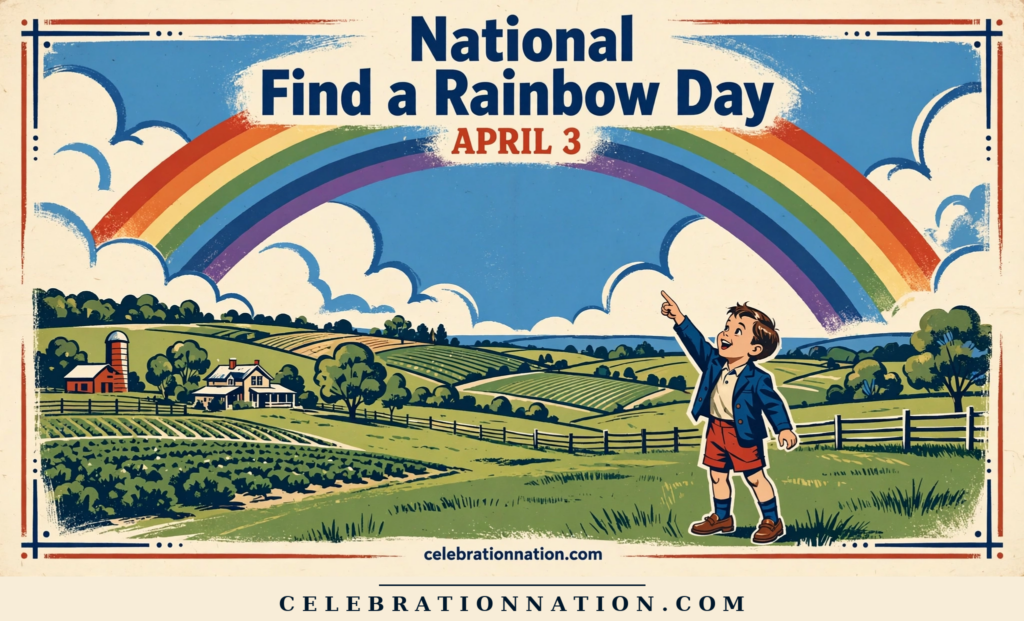
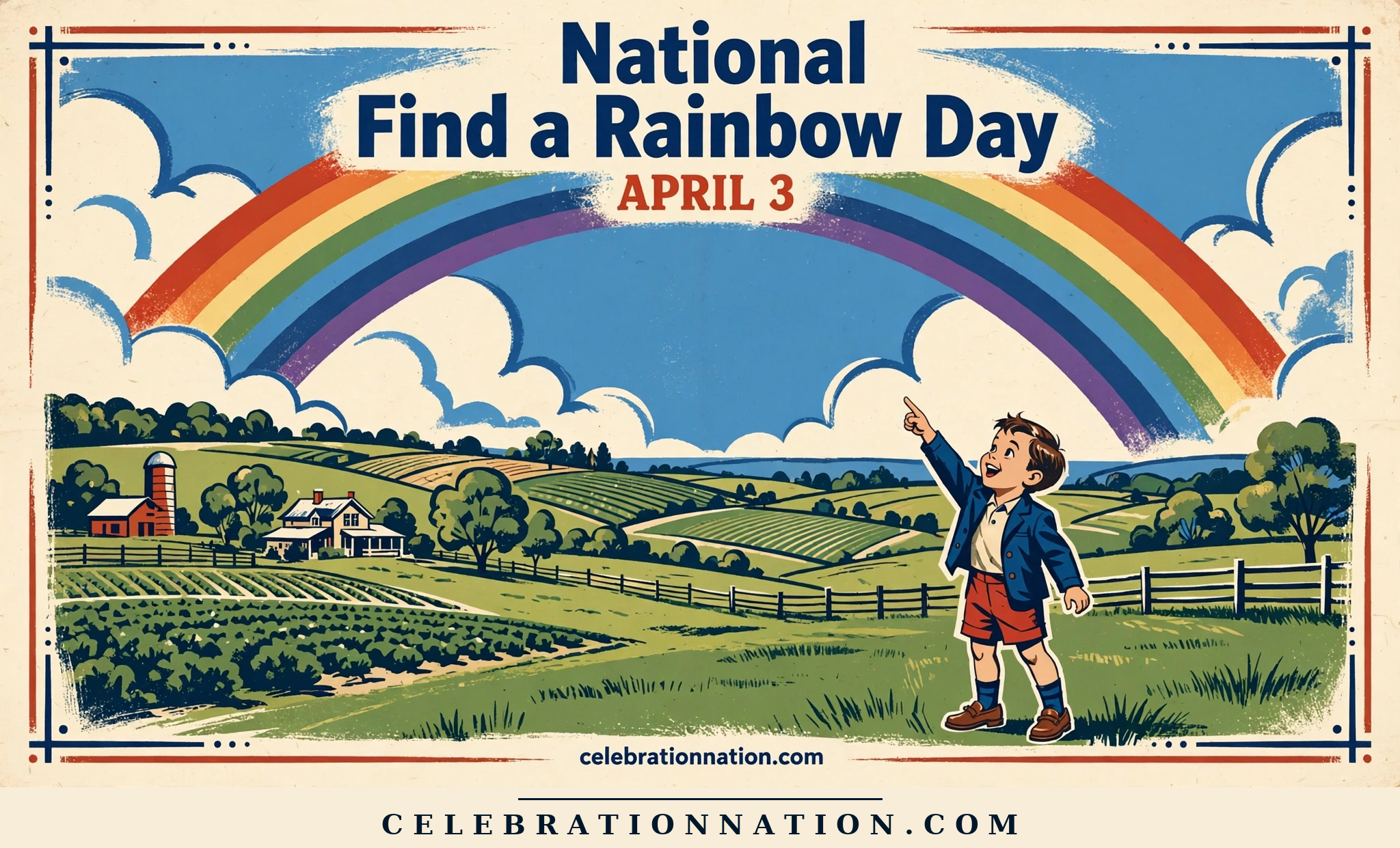
National Find a Rainbow Day on April 3 is the most charming observance on the April calendar — a day for going outside after a spring shower, looking up, and catching one of nature's most reliable acts of optical kindness. No ceremony, no sponsor, no history beyond word of mouth. Just: find a rainbow.
- Roots
- Folk observance
- Vibe
- Wonder-Filled
- Also on Apr 3
- Chocolate Mousse Day · Film Score Day · Tweed Day
- Hashtag
- #NationalFindARainbowDay
Ways to celebrate
Get outside and get lucky:
- 🌦️ Time your walk. Best viewing: right after a rain shower, when the sun breaks through from behind you. Late afternoon is ideal in spring.
- 🧭 Face away from the sun. Rainbows appear in the sky opposite the sun. Put the sun at your back and scan the clouds.
- 📷 Photograph it (fast). Rainbows fade as the cloud moves. Use your phone's panorama mode to get the whole arc.
- 💧 Make your own. Garden hose + sunny yard + fine mist = guaranteed rainbow. Works every time.
- 📖 Read Isaac Newton. He's the one who proved white light is actually every color. His 1672 letter to the Royal Society changed physics.
Make it your kind of celebration
Family
After-dinner rainbow hunt. Check the weather app — if there's any sun-and-rain forecast, plan a walk.
Kids
Prism + sunny window = instant indoor rainbow. Kids lose their minds; you explain refraction.
Couples
Walk after a spring rain. Phone down, eyes up. This is what the word 'stroll' was made for.
Office
5-minute 'step outside' break if the sky cooperates. Best team-building is the free kind.
School
Great 3rd-grade science lesson — prisms, the color wheel, Newton's experiments. Ends with the class making their own rainbows outside.
Community
Post your rainbow pics to the community group. Someone always has a better one than you.
Just me
A walk, a phone, and the sky. You don't need anything else.
Plan ahead
National Find a Rainbow Day is observed on April 3 every year. Here is where it lands for the next ten years, handy for planners, marketers and party people.
Fast facts
The story
Nobody registered National Find a Rainbow Day. Nobody claims to have founded it. It appeared in online calendars and greeting cards, and stuck, one of those observances that thrives precisely because it has no gatekeeper.
Read the full story
April 3 is perfectly placed for rainbow-hunting. In most of the Northern Hemisphere, early April is the collision point of fading winter weather and spring sunshine, which means scattered showers followed quickly by blue-sky breaks. That is literally the weather pattern that manufactures rainbows.
The physics was first cracked by Isaac Newton in 1666, holed up in his mother's house during the Plague closures. He passed sunlight through a glass prism and discovered that white light is actually every color in the rainbow stacked on top of itself. Before Newton, Europeans had spent centuries arguing that rainbows contained their own intrinsic colors. Newton proved that rainbows are white light, broken.
The ancient explanation was more poetic. Genesis says the rainbow was God's promise to never flood the earth again. In Norse mythology it was Bifröst, the bridge between realms. The Irish tucked a leprechaun's gold at the far end. Across cultures, rainbows have always been signals that the hard part has passed. Which is exactly why they feel as good as they do.
Four things happening inside every raindrop to make the show possible:
Different skies, different stories, same optics:
Did you know?
You'll never see someone else's rainbow.
Every rainbow is unique to the viewer's exact position. The person next to you is seeing a slightly different one, composed of light reflecting off different raindrops. Literally: your rainbow is yours alone.
Moonbows exist.
Rainbows made by moonlight instead of sunlight. They're real but rare, you need a bright full moon plus rain, no city light pollution, and luck. Kentucky's Cumberland Falls is a famous moonbow-viewing spot.
The longest rainbow lasted 9 hours.
Spotted over Yangmingshan, Taiwan, on November 30, 2017. Recorded by researchers at Chinese Culture University. The previous record was 6 hours, over Sheffield, UK, in 1994.
Rainbows have no end.
The optics make them circular and relative to you, so as you walk toward one, it retreats at the same rate. The 'end of the rainbow' is physically unreachable. This fact was mildly crushing for 19th-century children.
Keep the party going
See the calendar



Celebrate every day, all year
Official gear from the people who track 1,700+ celebrations.
Browse the shop 2027 Wall + Desk Calendar BundleCelebrate every day at home and at work.
Never miss a reason to celebrate.
One quick morning email with today's celebrations, ideas and posters. Free, unsubscribe anytime.
🎉 You're on the list! Watch your inbox for The Daily Confetti.