





National Leap Day
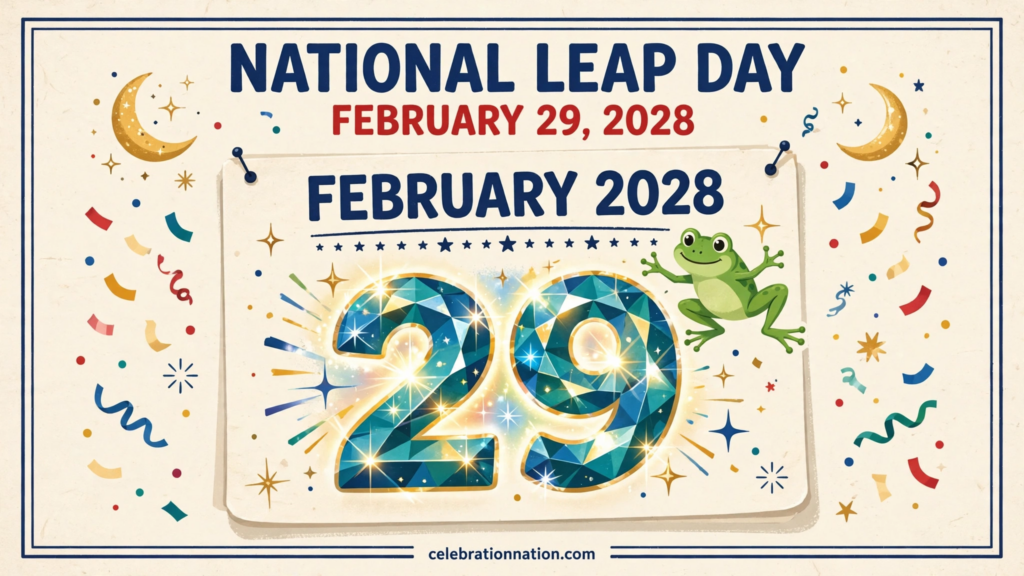
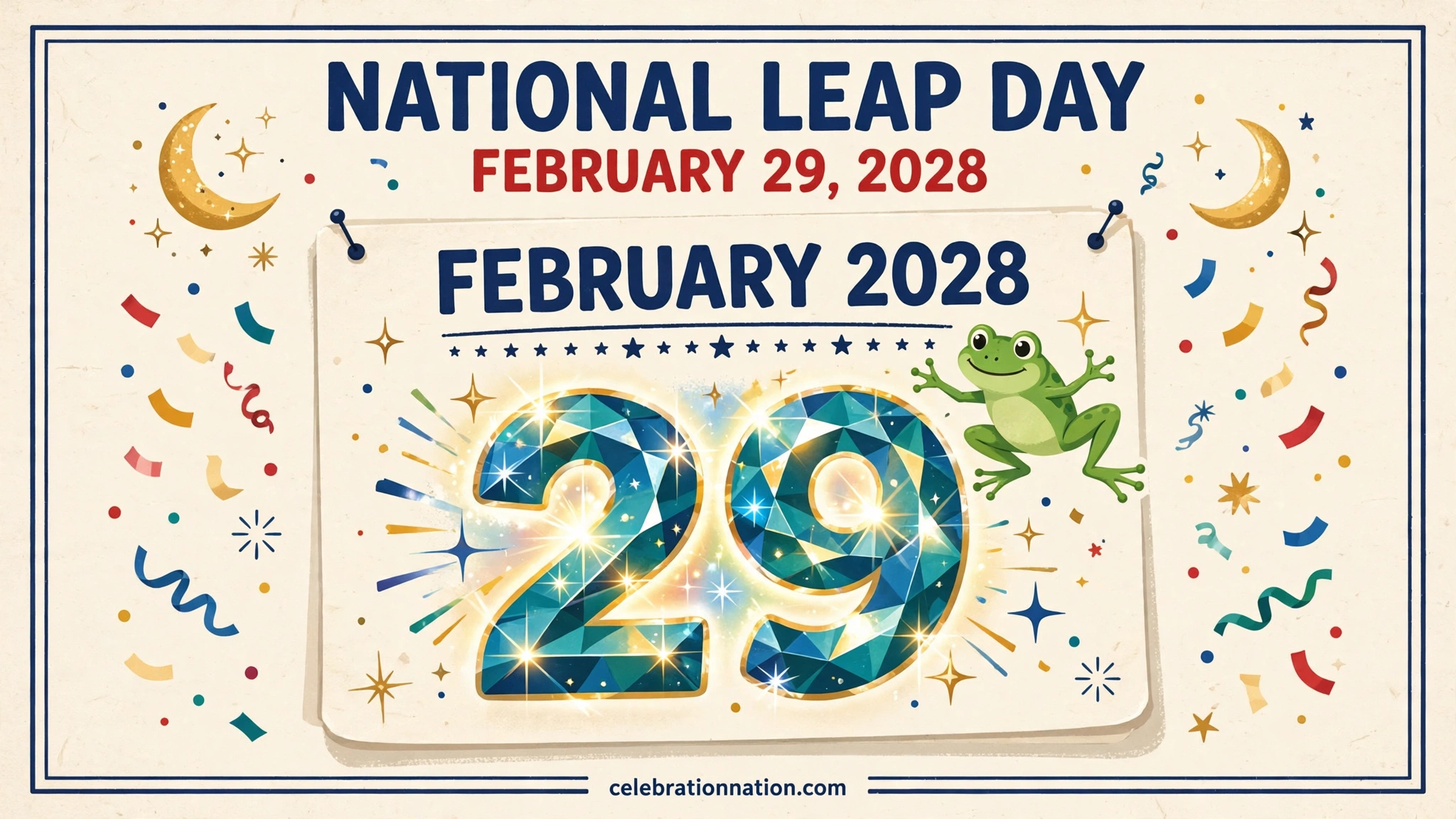
Every four years on February 29, the calendar grants us 24 hours that exist nowhere else: a day borrowed from time itself. National Leap Day celebrates February 29, the bonus day that keeps our calendars honest and our seasons on schedule. It shows up only in leap years, most recently in 2024, and the next one lands on Tuesday, February 29, 2028. Four years of waiting for one glorious day.
- Also on Feb 29
- Time Refund Day
- Hashtag
- #NationalLeapDay
NATIONAL LEAP DAY
Every four years on February 29, the calendar grants us 24 hours that exist nowhere else: a day borrowed from time itself. National Leap Day celebrates February 29, the bonus day that keeps our calendars honest and our seasons on schedule. It shows up only in leap years, most recently in 2024, and the next one lands on Tuesday, February 29, 2028. Four years of waiting for one glorious day.
Leap Day exists because our planet refuses to run on a round number. According to NASA, it takes Earth 365 days, five hours, 48 minutes, and 46 seconds to orbit the sun. The calendar rounds that down to 365 days, but those nearly six extra hours do not disappear. They pile up, year after year, until we bundle them into a single extra day. Without leap days, the calendar would drift about 24 days off in a century, and in roughly 700 years the Northern Hemisphere would be starting summer in December.
The fix is ancient. In 45 B.C., Julius Caesar devised the Julian calendar, which added a leap day every fourth year, originally on February 24, to stop political manipulation of corrective days and keep the lunar and solar years aligned. The system worked, except the solar year is 365.242199 days, not exactly 365.25, and the small difference added up. By 1582 the discrepancy had grown to about ten days, so Pope Gregory XIII created the Gregorian calendar and established February 29 as Leap Day. His refinement added a famous exception: century years that are not evenly divisible by 400 are not leap years. That is why 1800 and 1900 were not leap years, but 2000 was. In the 1700s, British law formally designated February 29 as Leap Day.
Why February, though? The answer reaches back to ancient Rome. In the 8th century B.C., the Roman calendar was just ten months long, with winter treated as one long undivided stretch. When January and February were eventually established, February, the final month, got the fewest days. As Hamline University astronomy professor Ben Gold once explained, the Romans simply did not like February very much, so when Caesar needed a place to stash the extra day, February was the natural drawer.
Leap Day carries a suitcase full of traditions. The most romantic dates to 5th century Ireland, where lore says Saint Brigid complained to Saint Patrick that young women grew tired of waiting for shy men to propose. To appease her, Saint Patrick declared February 29 a day when women could propose to men, a custom known as “Bachelor’s Day” or “Ladies’ Privilege.” The Scots reportedly took it further: in 1288, Queen Margaret is rumored to have made it law that women could propose on February 29 while wearing red petticoats to signal their intentions, with a fine charged to men who refused. There is no documentation supporting Saint Patrick’s decree and no such law on the Scottish books, but the tradition marched on anyway. In upper-class European society, a man who refused a Leap Day proposal was expected to protect the lady’s honor with a gift, often gloves to cover her un-ringed hand. In some countries, February 29 is still known as Bachelor Day.
Not every culture treats the day as a gift. In Greece, couples avoid getting married during a leap year, believing it brings bad luck. Italy has a saying for the whole affair: “Anno bisesto, anno funesto,” or “Leap year, unlucky year.” Whether you see February 29 as a bonus or a bad omen, nobody disputes that it is unusual, and unusual days collect superstitions the way attics collect boxes.
History has a habit of landing on Leap Day. On February 29, 1504, a lunar eclipse gave Christopher Columbus the perfect foil to persuade the Indigenous people of Jamaica to keep supplying his stranded expedition, after he warned that his god would take away the moon as punishment. On leap day 1940, Hattie McDaniel, beloved as Mammy in Gone with the Wind, received the Academy Award for Best Supporting Actress, the first Oscar ever awarded to an African American. Late on the evening of leap day 1960, the Moroccan city of Agadir shook for 15 seconds in an earthquake that devastated the city of 2,500 and killed two thirds of its residents. And Catholics honor Saint Oswald, a beloved saint who died on leap day in the year 972; his feast is celebrated on February 28 each year.
Then there are the Leaplings, the people born on February 29, who celebrate actual birthdays only once every four years. Famous Leaplings include Italian composer Gioachino Rossini, born in 1792 and celebrated for The Barber of Seville; rapper and actor Ja Rule, born in 1976; and motivational speaker Tony Robbins, born in 1960. Most Leaplings pick February 28 or March 1 in off years, which means every one of them has strong opinions about when their birthday really is.
The next chance to celebrate arrives Tuesday, February 29, 2028, followed by Sunday, February 29, 2032. Between now and then, the day lives mostly in legend, in proposal stories, birthday debates, and the quiet satisfaction of a calendar that works. When it finally comes, treat it like the rarity it is: a day that exists only because the universe runs a few hours long, and we were clever enough to catch up.
The mathematics of the day are oddly comforting. A leap year happens whenever the year is divisible by four, with the century exception keeping the calendar honest across the ages. The pattern means the next three Leap Days after 2028 fall on Sunday, February 29, 2032; Friday, February 29, 2036; and Wednesday, February 29, 2040. It is one of the few celebrations whose entire future schedule is written in the stars, literally, in Earth’s unhurried orbit around the sun.
THE STORY BEHIND NATIONAL LEAP DAY
🏛️ Caesar’s Calendar Fix
In 45 B.C., Julius Caesar introduced the Julian calendar, adding a leap day every fourth year, originally on February 24, to keep the calendar aligned with the sun and to stop political meddling with corrective days.
⛺ Pope Gregory’s Refinement
By 1582, the Julian system had drifted about ten days off, so Pope Gregory XIII created the Gregorian calendar and established February 29 as Leap Day, with the rule that century years must be divisible by 400 to qualify. In the 1700s, British law formally designated February 29 as Leap Day.
💍 Ladies’ Privilege
Irish lore says Saint Brigid complained to Saint Patrick that women waited too long for proposals, so he declared February 29 a day when women could propose to men. The custom became known as “Bachelor’s Day” or “Ladies’ Privilege.”
👑 The Scottish Rumor
Legend holds that in 1288, Queen Margaret of Scotland made it law that women could propose on February 29 while wearing red petticoats, with a fine for men who refused. No such law exists on the books, but the story survives.
🌕 History Written on the Day
Leap Day 1504 saw Columbus use a lunar eclipse to secure supplies in Jamaica; leap day 1940 brought Hattie McDaniel the first Oscar awarded to an African American; and Saint Oswald, who died on leap day in 972, is honored by Catholics each February 28.
🎂 The Leaplings
People born on February 29, called Leaplings or Leapers, get a true birthday only every four years. Famous ones include composer Gioachino Rossini (1792), rapper Ja Rule (1976), and speaker Tony Robbins (1960).
WAYS TO CELEBRATE
🎉 Do Something Once-Every-Four-Years
Take on a bucket-list adventure, start a time capsule to open in 2032, or do anything that feels worthy of a day this rare. Ordinary Tuesdays can wait.
💍 Pop the Question, Ladies First
Honor the Bachelor’s Day tradition and let the women do the proposing. Even if no proposal is planned, raise a toast to Saint Brigid’s bold idea.
📱 Shout Your Leapling Status
Born on February 29? Claim your day loudly with #NationalLeapDay and #LeapDay, and settle the great debate: is your off-year birthday February 28 or March 1?
Celebrate National Leap Day
On Tuesday, February 29, 2028, live like the day is borrowed. It is: 24 hours the calendar only lends us every four years.
Plan ahead
National Leap Day is observed on February 29, leap years only. Here is where it lands for the next ten years, handy for planners, marketers and party people.
Celebrate every day, all year
Official gear from the people who track 1,700+ celebrations.
Browse the shop 2027 National Day Wall CalendarGet the 2026 edition free. 1,700+ observances.
Never miss a reason to celebrate.
One quick morning email with today's celebrations, ideas and posters. Free, unsubscribe anytime.
🎉 You're on the list! Watch your inbox for The Daily Confetti.