


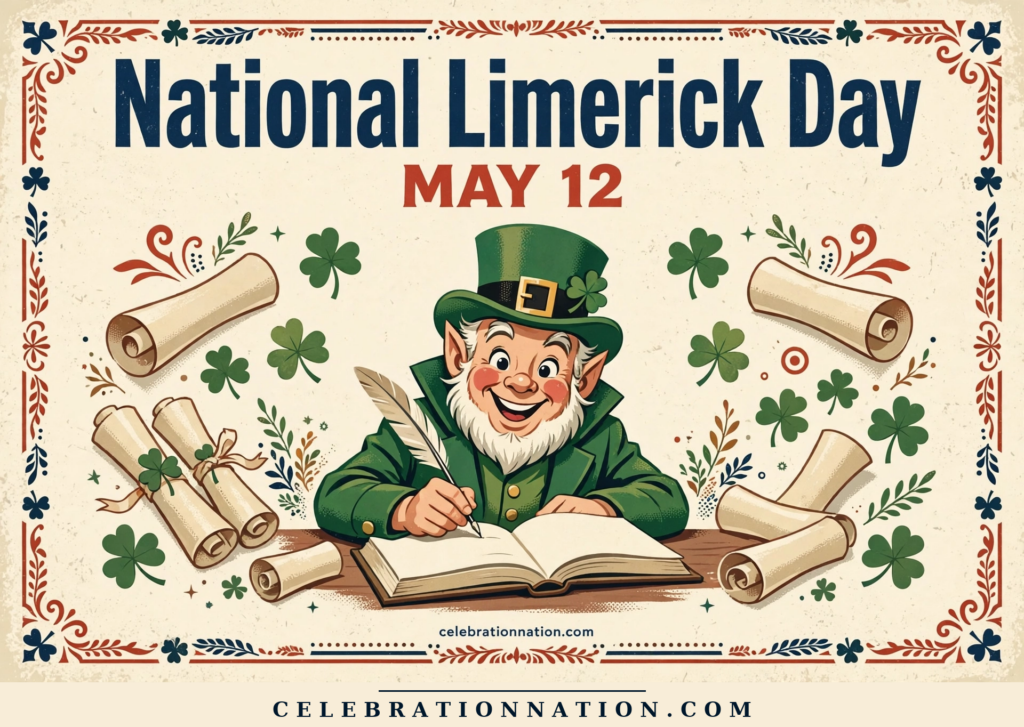
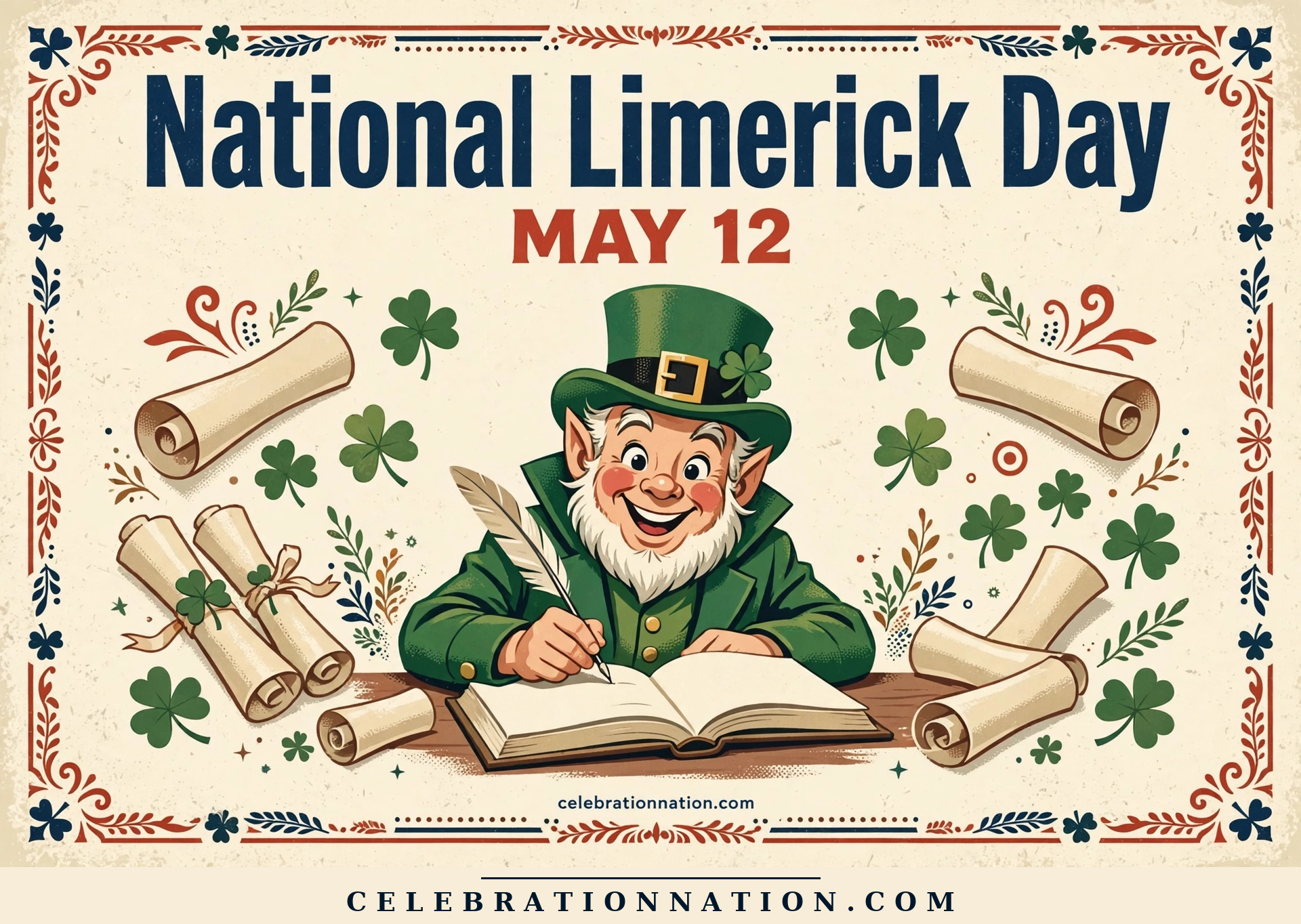
National Limerick Day
There once was a holiday on May twelve / That honored a verse every nerd loves to delve / Five lines, two rhymes, a structure quite tight / A bit of a chuckle if you do it right / Here's a day for these poems to shelve.
- Vibe
- Whimsically Rhymed
- Also on May 12
- International ME/CFS Awareness Day · International Nurses Day · Fibromyalgia Awareness Day
- Hashtag
- #NationalLimerickDay
Ways to celebrate
Write one. Read five. Send one to a friend:
- 📝 Write your own. Pick a proper noun (a friend, a place, a thing). Start: "There once was a [noun] from [place]..." The structure mostly forces itself.
- 📖 Read Edward Lear. His Book of Nonsense (1846) is the greatest limerick collection. Free online, takes 30 minutes.
- 📮 Send a limerick by text or card. A handwritten limerick is a charming piece of mail.
- 🎲 Host a limerick contest. At dinner, after drinks, on social media. Best one wins. Low-lift fun.
- 🎓 Teach the meter. Limerick meter (anapestic trimeter/dimeter) is the most accessible meter in English. Great kid-level poetry lesson.
Make it your kind of celebration
Family
Limerick dinner game. Each family member writes one; read aloud; funniest wins. Works for any age literate enough to rhyme.
Kids
Kids LOVE limericks. The silliness, the rhythm, the permission to be funny. Best gateway to poetry for ages 7-12.
Couples
Write limericks about each other's flaws. Affectionately. Classic romance activity, secretly.
Office
Team limerick contest. Pick a company-specific theme. Three minutes to write. Thirty seconds to share. Morale-boosting.
School
Limerick writing is THE easiest poetry lesson. Kids engage, produce, share. Teaches meter and rhyme without pain.
Community
Library limerick night. Free, welcoming, mostly hilarious. Surprisingly well-attended events.
Just me
Write ten tonight. About your life, your work, your pets, your complaints. Therapeutic; funnier than you'd expect.
Plan ahead
National Limerick Day is observed on May 12 every year. Here is where it lands for the next ten years, handy for planners, marketers and party people.
Fast facts
The story
The limerick, five lines, AABBA rhyme, bouncy meter, became an English institution because of one Victorian illustrator who made them his escape.
Read the full story
The limerick form is probably older than Edward Lear, but he made it famous. Lear (1812-1888) was an English illustrator, landscape painter, and poet who was the 20th of 21 children. He suffered from epilepsy, depression, and a lifelong sense of not fitting in. Writing nonsense verse for children became his private escape from Victorian seriousness.
His Book of Nonsense, first published in 1846 (expanded 1855), contained 110 limericks with his own illustrations. Most began "There was an old man..." or "There was a young lady..." The form had existed before, folk verses, drinking songs, obscene ditties, but Lear's clean, whimsical, child-friendly versions brought limericks into the Victorian drawing room and made them respectable.
The name "limerick" for the form doesn't actually appear in print until 1880, four decades after Lear's first book. The origin of the name is disputed. One theory: a tavern chorus "Will you come up to Limerick?" (the Irish city) was sung between verses, and the form took its name from the refrain. Another: Irish Brigade soldiers in the Napoleonic Wars popularized the form and named it after their home city. No conclusive answer.
Today the limerick is the most recognizable English verse form outside the haiku. A competent writer can produce one in 60 seconds. It shows up in everything from children's books to advertising to obscene drinking games. National Limerick Day on May 12, Lear's birthday, is a quiet, joyful English-speaking tradition. Write one tonight. They're easier than they look.
Four elements of a proper limerick:
Six classic limericks spanning 200 years:
“There was an Old Man with a beard / Who said,”
It is just as I feared!, / Two Owls and a Hen, / Four Larks and a Wren, / Have all built their nests in my beard!", EDWARD LEAR, A BOOK OF NONSENSE (1846)
Did you know?
Edward Lear illustrated his own limericks.
His line drawings are as famous as the verses. Awkward figures with giant noses, deliberately ugly, definitely charming. Lear was primarily a landscape painter; the nonsense illustrations were his private joy.
The limerick form has been used in serious poetry.
T.S. Eliot, James Joyce, and Rudyard Kipling all wrote limericks (though mostly as jokes). The form's association with silliness is so strong it has mostly resisted "serious" use.
"Nantucket" limericks are an entire genre.
The city's name is famously rhymable ("bucket," "duck it," "luck it," etc.), which is why thousands of limericks start "There was an old man from Nantucket." Most of them are unrepeatable.
The limerick is banned in some formal poetry contests.
Many prestige poetry awards exclude limericks on the grounds that they're "too easy", which is itself a kind of backhanded compliment.
Keep the party going
See the calendar
Celebrate every day, all year
Official gear from the people who track 1,700+ celebrations.
Browse the shop National Day Celebration Card GameA party in a box, any day of the year.
Never miss a reason to celebrate.
One quick morning email with today's celebrations, ideas and posters. Free, unsubscribe anytime.
🎉 You're on the list! Watch your inbox for The Daily Confetti.