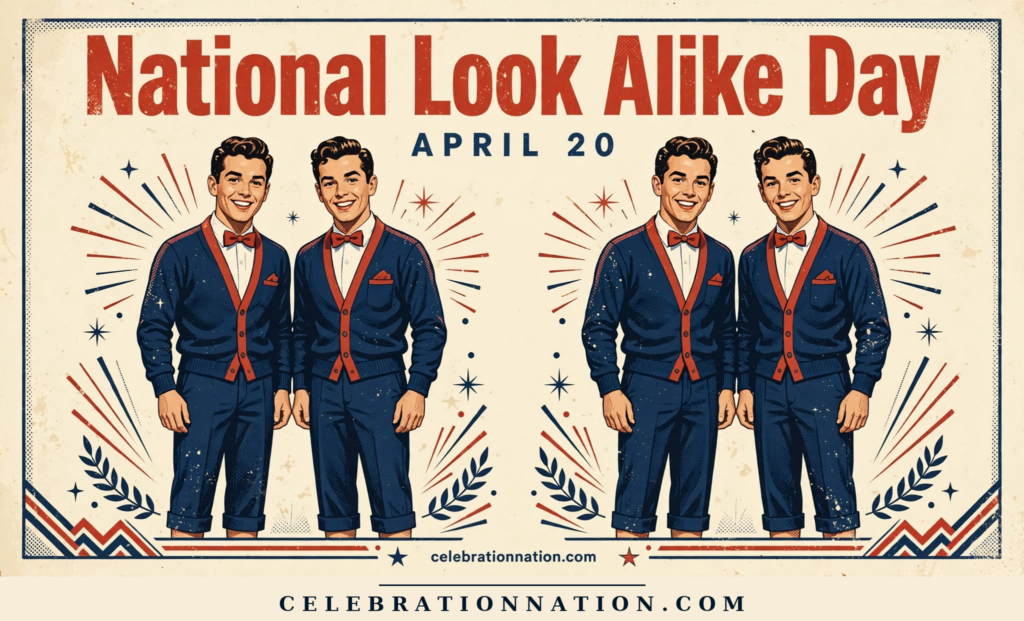
National Look Alike Day
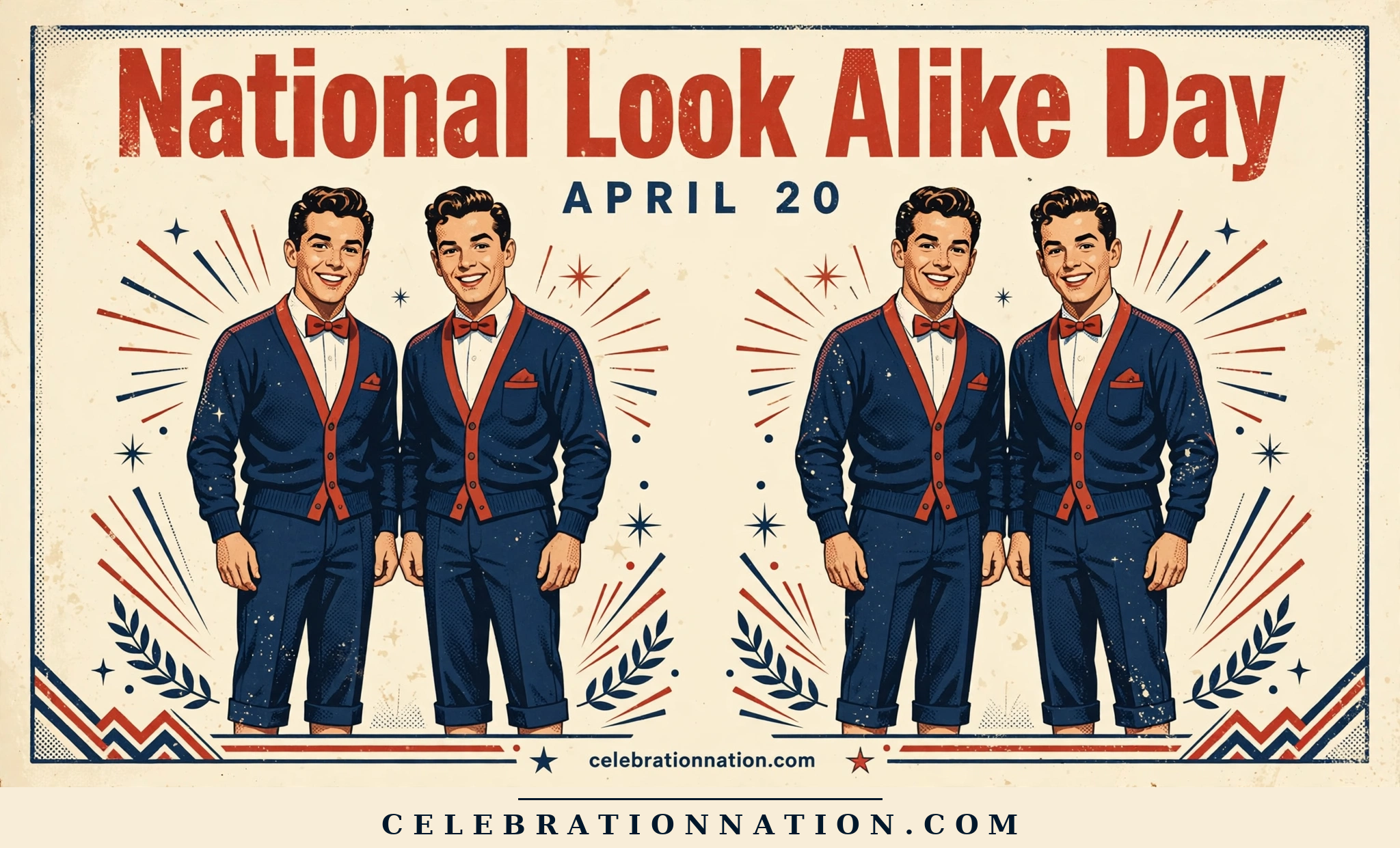
National Look Alike Day on April 20 is a cheerful American observance dedicated to doppelgängers, celebrity impersonators, identical twins, and anyone who's ever been told 'you look just like so-and-so.' Created in 1980 by Jack Etzel as a tribute to his look-alike son, it's become an excuse for look-alike contests, genetic curiosity, and the occasional identity crisis.
- Vibe
- Fun & Quirky
- Also on Apr 20
- Chinese Language Day · Volunteer Recognition Day · 420 Day
- Hashtag
- #NationalLookAlikeDay
Ways to celebrate
Spot, pose, share:
- 📸 Post your celebrity look-alike. Social media's favorite #LookAlikeDay tradition — post the photo of the famous person you get compared to most.
- 👯 Hang with your twin. Identical twins, siblings with strong resemblance, or doppelgänger friends. Take coordinated photos.
- 🎭 Visit a celebrity impersonator show. Las Vegas is the capital — shows honoring Elvis, Frank Sinatra, Cher, and dozens of others.
- 🔬 DNA test your 'twin.' Services like 23andMe or AncestryDNA can reveal hidden family connections. Look-alikes sometimes turn out to be distant cousins.
- 📖 Read 'The Psychology of Doppelgängers.' Academic but accessible exploration of why our brains love human resemblance.
Make it your kind of celebration
Family
Family photo challenge: find the celebrity who looks most like each family member. Often revealing and funny.
Kids
Kids love 'you look like so-and-so' conversations. A good day to show them old photos of relatives they resemble.
Couples
Couple's version: find celebrity couples you resemble. Beyoncé and Jay-Z? Blake and Ryan? Harry and Meghan? Play-along is the fun.
Office
Office 'celebrity look-alike' game — everyone anonymously submits a celebrity match for a coworker. Light HR-friendly fun.
School
Art class: drawing faces that resemble each other. Cognitive-psychology lesson about facial recognition.
Community
Some small-town festivals include look-alike contests. Fun community event; easy to organize.
Just me
Upload a selfie to a 'celebrity-match' app. They're surprisingly accurate. Good for a smile.
Plan ahead
National Look Alike Day is observed on April 20 every year. Here is where it lands for the next ten years, handy for planners, marketers and party people.
Fast facts
The story
National Look Alike Day was created in the 1980s by Jack Etzel of Pittsburgh after a local TV feature with photographer Rick Minutello spotlighted look-alikes. Etzel registered the day with Chase's Calendar of Events (the unofficial registry of American observances). The date, April 20, has no particular significance; Etzel picked it for convenience. The day grew from a personal tribute into a national observance celebrated by twin organizations, celebrity impersonators, and internet culture.
Read the full story
The science of look-alikes is fascinating. Identical twins share 100% of their DNA and are biologically the most look-alike humans possible. Fraternal twins share about 50%. Siblings, on average, also share 50%. Unrelated people, doppelgängers, can sometimes look strikingly alike due to similar genetic backgrounds, similar environments, or pure coincidence. A 2022 study published in Cell Reports found that strangers who looked alike shared surprisingly similar DNA profiles, suggesting doppelgängers are genetically closer than coincidence alone.
The celebrity-impersonator industry is a genuine American economy. Las Vegas alone hosts dozens of impersonator shows, Elvis Presley, Frank Sinatra, Marilyn Monroe, Cher, Elton John. Legends in Concert (Vegas) and Impersonator Productions employ professional impersonators. The world's largest Elvis convention takes place in Graceland, Memphis, attracting 600+ Elvis impersonators from 20+ countries annually. Look-alike culture is business.
Social media has supercharged the look-alike tradition. Apps like 'Gradient,' 'FaceApp,' and various celebrity-match tools let users submit a selfie and get matched to a famous person. These tools have become a staple of Instagram, TikTok, and Twitter engagement. Historical look-alike moments, Adolfo Nicolás (ex-Jesuit superior general) and Ghandi; Charles Dickens and Matthew Gray Gubler ('Criminal Minds'); Josef Stalin and Steve Buscemi, have become internet canon. The modern look-alike experience is entirely online.
Coincidental resemblances that captured imaginations:
How different countries celebrate human resemblance:
Did you know?
You share 99.9% of your DNA with every human.
All humans are 99.9% genetically identical. The 0.1% that varies accounts for all human appearance variation. Doppelgängers simply share more of the variable 0.1% by chance.
Fingerprints of identical twins differ.
Even identical twins, who share 100% of DNA, have different fingerprints. Fingerprint patterns form partly based on uterine positioning, not genes alone. Twin courts still use fingerprints for identification.
Facial recognition software can be fooled by look-alikes.
A 2018 study found that current facial-recognition AI gets about 10-20% false positives on close doppelgängers. This has legal implications for surveillance and criminal identification.
The most famous historical doppelgänger case: the Tichborne Claimant.
In 1866, a man claimed to be the missing English aristocrat Sir Roger Tichborne, despite clear physical differences. His look-alike resemblance was enough to fool many. The resulting trial was one of the longest in English history.
Keep the party going
See the calendar
Celebrate every day, all year
Official gear from the people who track 1,700+ celebrations.
Browse the shop 2027 National Day Wall CalendarGet the 2026 edition free. 1,700+ observances.
Never miss a reason to celebrate.
One quick morning email with today's celebrations, ideas and posters. Free, unsubscribe anytime.
🎉 You're on the list! Watch your inbox for The Daily Confetti.