

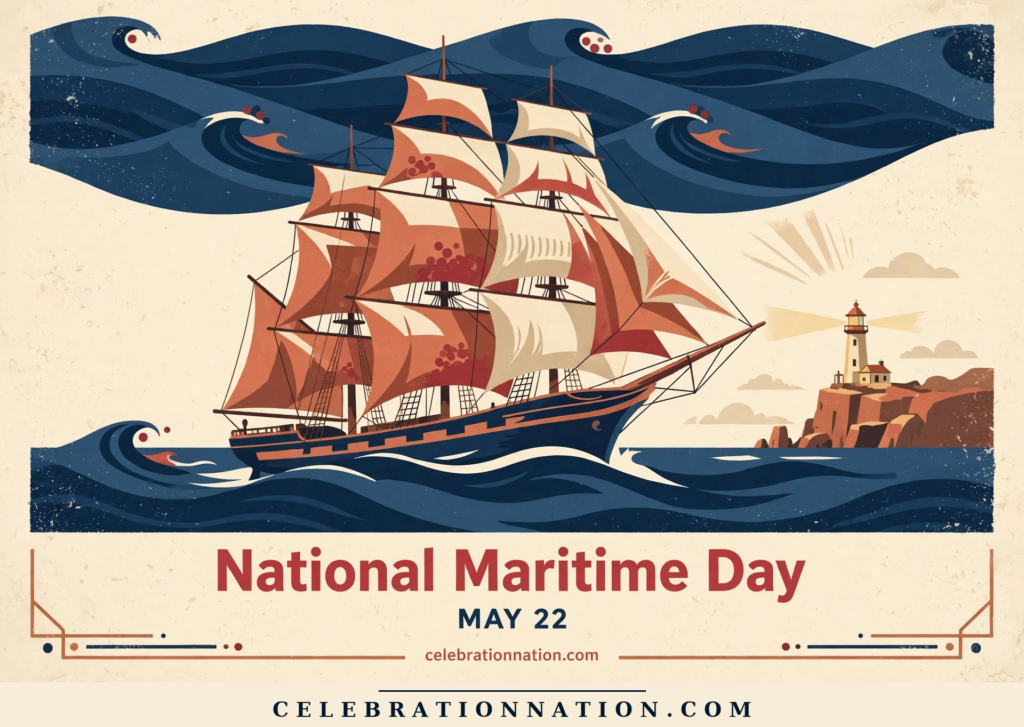
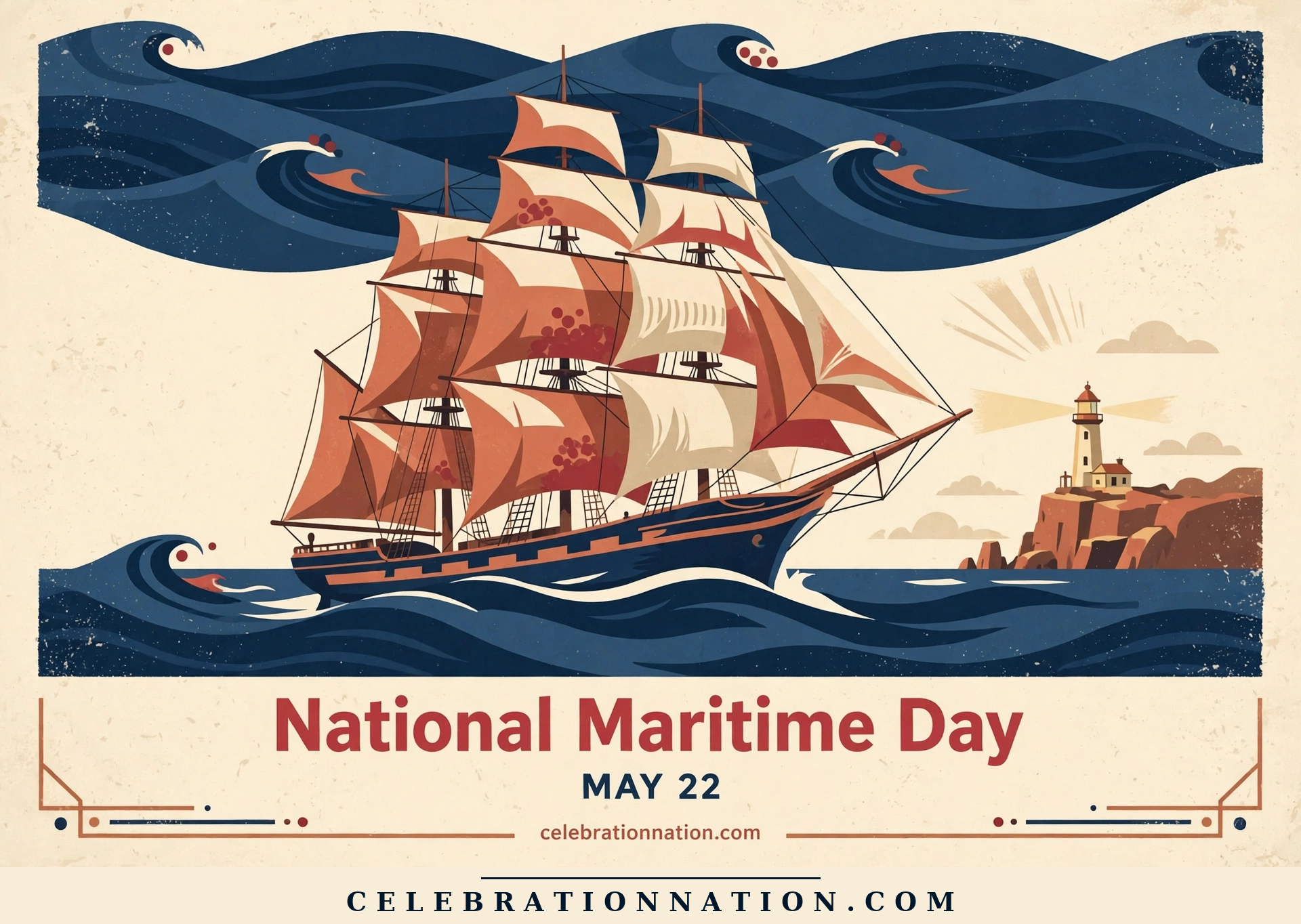
National Maritime Day
National Maritime Day on May 22 honors the US Merchant Marine and the history of American seafaring — established by Congress in 1933 to mark the anniversary of the 1819 voyage of the SS Savannah, the first steamship to cross the Atlantic. From Civil War-era naval power to WWII merchant seaman casualties (the highest of any US service branch), from global trade to commercial fishing fleets, the day honors all who sail American waters.
- Vibe
- Salt & Tradition
- Also on May 22
- Buy a Musical Instrument Day · Craft Distillery Day · Solitaire Day
- Hashtag
- #NationalMaritimeDay
Ways to celebrate
Honor and remember:
- ⚓ Visit a maritime museum. Mystic Seaport (CT), San Francisco Maritime NHP, Seattle's Center for Wooden Boats, New Bedford Whaling Museum. American seafaring's physical archives.
- 🚢 Ride a historic ship. USS Constitution (Boston), USS Midway (San Diego), SS Queen Mary (Long Beach). Walk the decks.
- 📖 Read Moby-Dick. Or any Joseph Conrad, or Patrick O'Brian, or Herman Melville's 'Benito Cereno.' American seafaring literature.
- 🎬 Watch 'The Perfect Storm' (2000) or 'Captain Phillips' (2013). Modern maritime disaster and adventure films.
- 🎖️ Honor a WWII merchant marine vet. Fewer each year. Their recognition was 40+ years overdue.
Make it your kind of celebration
Family
Family visit to a maritime museum. Kids love old ships, lighthouses, and nautical equipment. Teach them about America's sea history.
Kids
Pirate books are a gateway to maritime history. Robert Louis Stevenson's 'Treasure Island,' Peter Pan, age-appropriate naval fiction.
Couples
Lighthouse visit, sunset sail, harbor tour. Maritime romance is its own thing.
Office
Port-city offices can organize boat tours. Otherwise, a moment of silence for merchant marine casualties.
School
History class: the Merchant Marine's WWII sacrifice. Under-taught American history. Essential lesson.
Community
Coastal communities often hold Maritime Day events — flag ceremonies at ports, harbor visits, wreath-laying at maritime memorials.
Just me
A walk along the docks. Read a sea novel. Listen to sea shanties. Meditate on America's maritime history.
Plan ahead
National Maritime Day is observed on May 22 every year. Here is where it lands for the next ten years, handy for planners, marketers and party people.
Fast facts
The story
National Maritime Day was established by a joint resolution of Congress on May 20, 1933, designating May 22 as 'National Maritime Day.' The date commemorates the voyage of the SS Savannah, an American steamship that departed Savannah, Georgia on May 22, 1819, becoming the first steamship to cross the Atlantic Ocean. The voyage took 29 days; the SS Savannah used sail power most of the way to conserve coal, but the event proved transoceanic steam travel was possible. It transformed global shipping.
Read the full story
The US Merchant Marine is a fleet of civilian ships that transport cargo and passengers in US waters and on international routes. In peacetime, they're merchant sailors. In wartime, they become auxiliary naval support, the 'fourth arm of defense.' The US Merchant Marine Academy (Kings Point, NY) is one of the five federal service academies, alongside West Point, Annapolis, the Air Force Academy, and Coast Guard Academy. Its graduates serve the Merchant Marine in peace and war.
WWII Merchant Marine service was extraordinarily dangerous. Of 250,000 merchant mariners, approximately 9,300 died, a 3.6% casualty rate. This was the highest casualty rate of any US service branch, higher than the Marines, Army, or Navy. Merchant mariners delivered every bullet, bean, and tank to the war effort. Despite this, they were not recognized as WWII veterans until 1988, 43 years after the war ended. President Reagan signed the legislation granting retroactive veterans' status. Many of the original merchant sailors had already died; few received their benefits.
The modern US merchant fleet has dramatically declined. In the 1950s, about 1,268 US-flagged merchant ships sailed the oceans. Today fewer than 80 US-flagged ships are in international commerce. The 1920 Jones Act still requires US-flagged ships for domestic water transport, controversial (critics say it raises shipping costs in Hawaii, Puerto Rico, Alaska), but still in force. The US Maritime Administration (MARAD) and the US Merchant Marine Academy continue training mariners. National Maritime Day on May 22 honors all American maritime tradition: the merchant sailors, the Navy, the Coast Guard, the fishermen, the longshoremen, and the two centuries of American seafaring.
Defining events in US seafaring history:
Coastal cities with deep seafaring traditions:
Did you know?
Merchant Mariners won WWII veteran status 43 years late.
WWII Merchant Mariners were denied veteran status until President Reagan signed GI Bill Improvement Act in 1988. Many original mariners had died without benefits. A long-overdue recognition.
The US flagged merchant fleet is tiny now.
From 1,268 ships in the 1950s to fewer than 80 today. Global shipping shifted to 'flags of convenience', Panama, Liberia, Marshall Islands, where taxes and regulations are lower. The US industry has been in structural decline for decades.
The Jones Act is century-old law.
The Merchant Marine Act of 1920 (Jones Act) requires domestic water transport to use US-built, US-flagged, US-crewed ships. Protects US shipyards; raises shipping costs. Endures despite recurring repeal attempts.
Commercial fishing is the most dangerous US profession.
Bureau of Labor Statistics consistently rates commercial fishing as the most dangerous US occupation, fatality rates 30x the national average. Alaska king crab fishing is the most dangerous subset. 'Deadliest Catch' TV documents it accurately.
Keep the party going
See the calendar

Celebrate every day, all year
Official gear from the people who track 1,700+ celebrations.
Browse the shop National Day Celebration Card GameA party in a box, any day of the year.
Never miss a reason to celebrate.
One quick morning email with today's celebrations, ideas and posters. Free, unsubscribe anytime.
🎉 You're on the list! Watch your inbox for The Daily Confetti.