

National Mother Goose Day
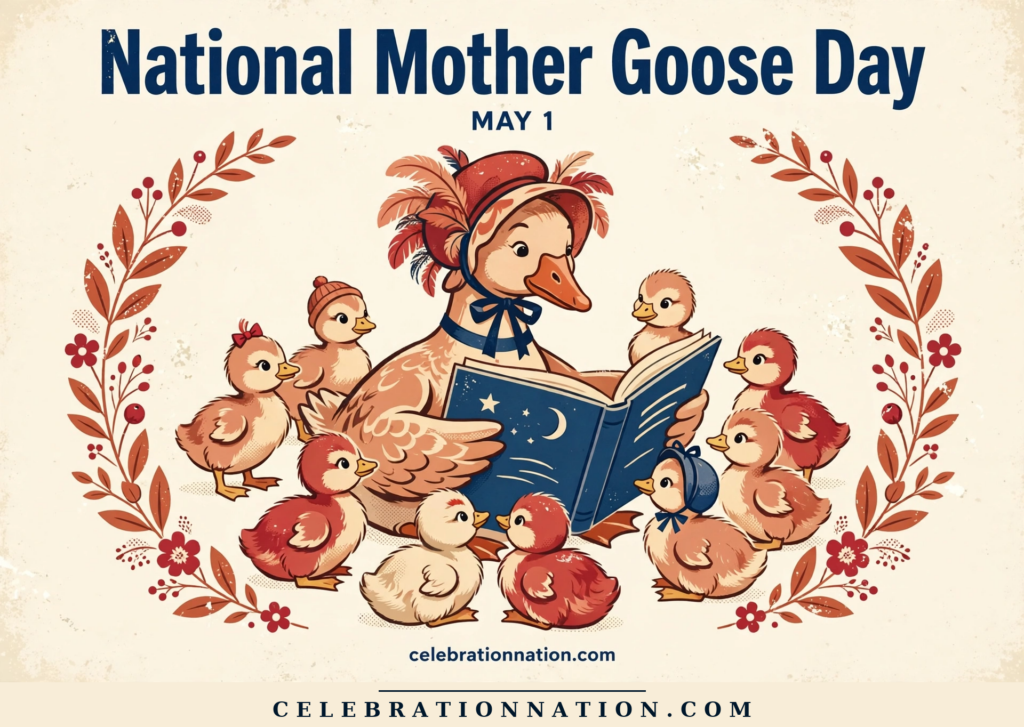
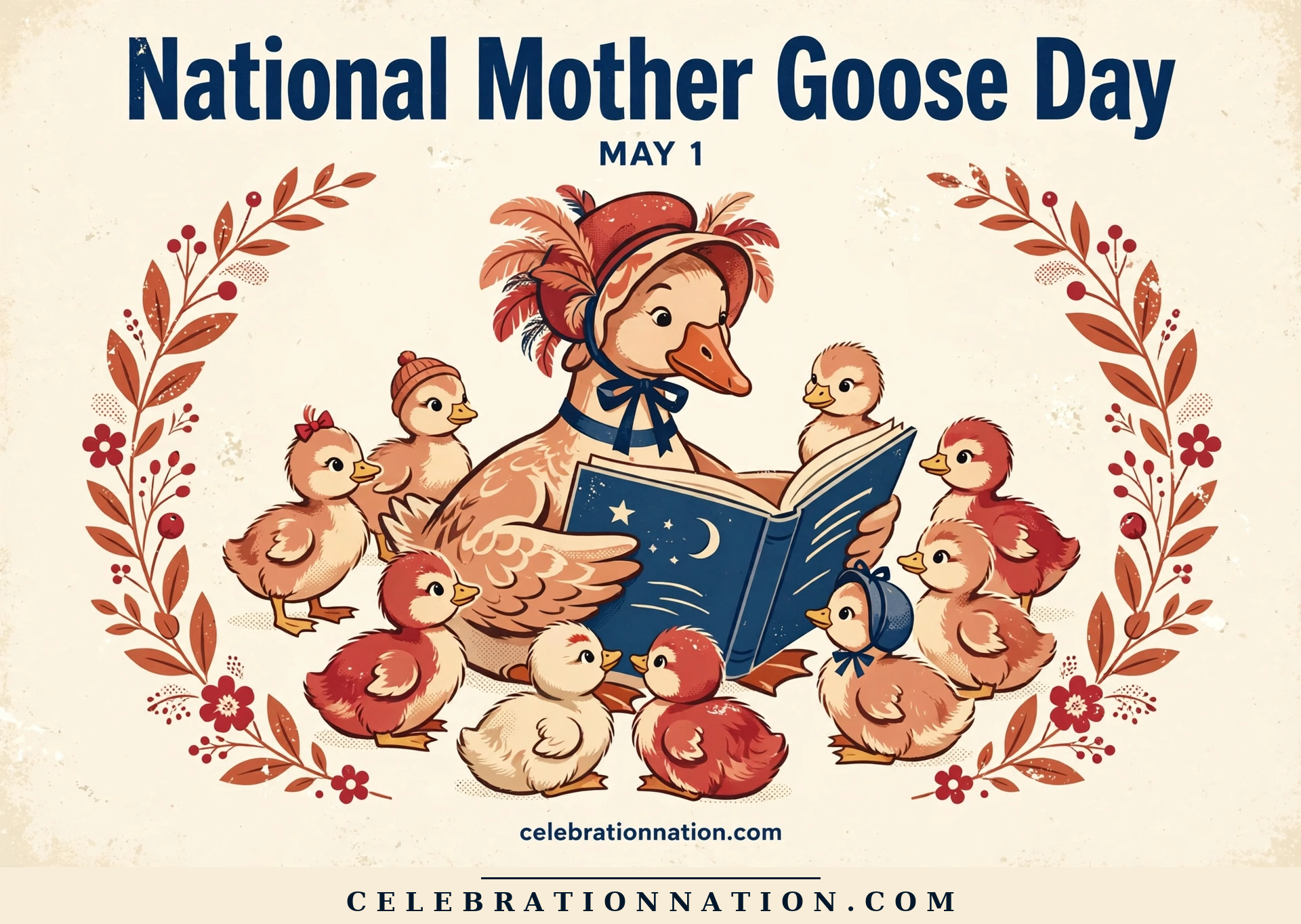
National Mother Goose Day on May 1 honors the centuries-old nursery-rhyme tradition that taught every English-speaking child to read, rhyme, and remember. 'Hey Diddle Diddle,' 'Humpty Dumpty,' 'Mary Had a Little Lamb,' 'Jack and Jill' — these aren't just rhymes, they're the shared oral foundation of English literature. Founded as an observance in 1987 by Gloria Delamar, author and Mother Goose scholar.
- Vibe
- Nostalgic & Melodic
- Also on May 1
- Investing Day · Loyalty Day · Space Day
- Hashtag
- #NationalMotherGooseDay
Ways to celebrate
Read, recite, pass it on:
- 📖 Read aloud. Even 5 minutes of nursery rhymes to a toddler changes brain development. Get them into a rhythm and into books.
- 🎭 Recite classics. Pick a favorite and say it from memory. Adults who still know 'Hickory Dickory Dock' inherited it from a childhood that worked.
- 🎨 Draw with the rhymes. 'Mary Had a Little Lamb' + crayons = instant preschool activity.
- 📚 Visit the library. Check out a beautifully illustrated Mother Goose edition. Most libraries have the Tasha Tudor or Michael Hague classics.
- 🪿 Tell an origin story. Kids love that 'Humpty Dumpty' was probably a cannon, not an egg. Add some history.
Make it your kind of celebration
Family
Nursery-rhyme night. One parent reads; other acts out. Guaranteed universal delight from ages 2-7.
Kids
Memorize one. Recite at bedtime. Easier than reading; builds memory muscle.
Couples
Whichever of you grew up with a specific rhyme as a lullaby — share it with the other. Tiny, intimate piece of the past.
Office
Not really an office holiday. Unless you have kids-at-work day — then BRING MOTHER GOOSE.
School
Preschool / kindergarten essentials. National Mother Goose Day falls on May 1 — perfect kickoff for end-of-year reading celebrations.
Community
Library story times, bookstore readings, daycare events. May 1 is programmed nationally by children's librarians.
Just me
Find your own childhood favorite. Read it once aloud. It lives in your memory for a reason.
Plan ahead
National Mother Goose Day is observed on May 1 every year. Here is where it lands for the next ten years, handy for planners, marketers and party people.
Fast facts
The story
There was never one person named Mother Goose. The name first appears in print in France in 1650, in a satirical reference to old women telling tales. Charles Perrault's 1697 fairy tale collection 'Contes de ma Mère l'Oye' (Tales of My Mother Goose) cemented the name. The collection contained Cinderella, Little Red Riding Hood, Puss in Boots, and Sleeping Beauty, the foundation of European fairy-tale tradition.
Read the full story
Nursery rhymes, however, are older. Many trace back to 16th-century England, some even older, passed down orally before anyone wrote them down. 'Ring a Ring o' Roses' appears in print in 1881 but had been sung for generations. 'Humpty Dumpty' was a riddle (original answer: a large cannon, 'Humpty Dumpty sat on a wall' during an English Civil War battle, then fell). Others have more speculative histories.
The first American Mother Goose book was published in 1786 by Isaiah Thomas in Worcester, Massachusetts. The 19th century turned nursery rhymes into an American industry. Every publisher had a Mother Goose. Illustrators competed for the best visuals. Kate Greenaway (UK, 1881), Arthur Rackham (UK, 1913), and Tasha Tudor (US, 1944) set the golden standard for illustrated editions that still define the visual imagination of American childhood.
National Mother Goose Day was founded in 1987 by Dr. Gloria Delamar, a Mother Goose scholar who had written the 1987 book 'Mother Goose: From Nursery to Literature.' She picked May 1 because it falls within Children's Book Week and is an iconic spring celebration date. The observance caught on slowly through librarians and preschool teachers. It's now commonly programmed at public libraries, preschools, and children's bookstores across the country.
Four classics that every American child has (or should have) heard by age 4:
Six illustrated editions that shaped American childhood:
Did you know?
'Mother Goose' may have been a real Bostonian.
A persistent Boston legend claims a woman named Elizabeth Goose (1665-1758) told nursery rhymes to her grandchildren and they became the famous ones. Almost certainly false, Mother Goose existed in French print before Elizabeth was born, but it's a durable American myth.
Most 'hidden meaning' interpretations are wrong.
'Ring Around the Rosie' is NOT about the Black Plague (that myth was debunked in 1961). 'London Bridge is Falling Down' is NOT about child sacrifice. Most nursery rhymes are just nursery rhymes. But the myth-making is irresistible.
Nursery rhymes predict reading success.
Extensive 1987-present research shows that children who memorize nursery rhymes before age 4 read earlier and better. Phonological awareness, the brain's ability to hear syllables, is built by rhythmic speech.
Mother Goose has been adapted to every language.
There are Mother Goose editions in French, Spanish, Mandarin, Japanese, Swahili, and dozens more. Most include both translated English rhymes AND the local language's indigenous nursery rhymes.
Keep the party going
See the calendar
Celebrate every day, all year
Official gear from the people who track 1,700+ celebrations.
Browse the shop 2027 National Day Desk CalendarA new celebration every morning. Daily tear-off.
Never miss a reason to celebrate.
One quick morning email with today's celebrations, ideas and posters. Free, unsubscribe anytime.
🎉 You're on the list! Watch your inbox for The Daily Confetti.