
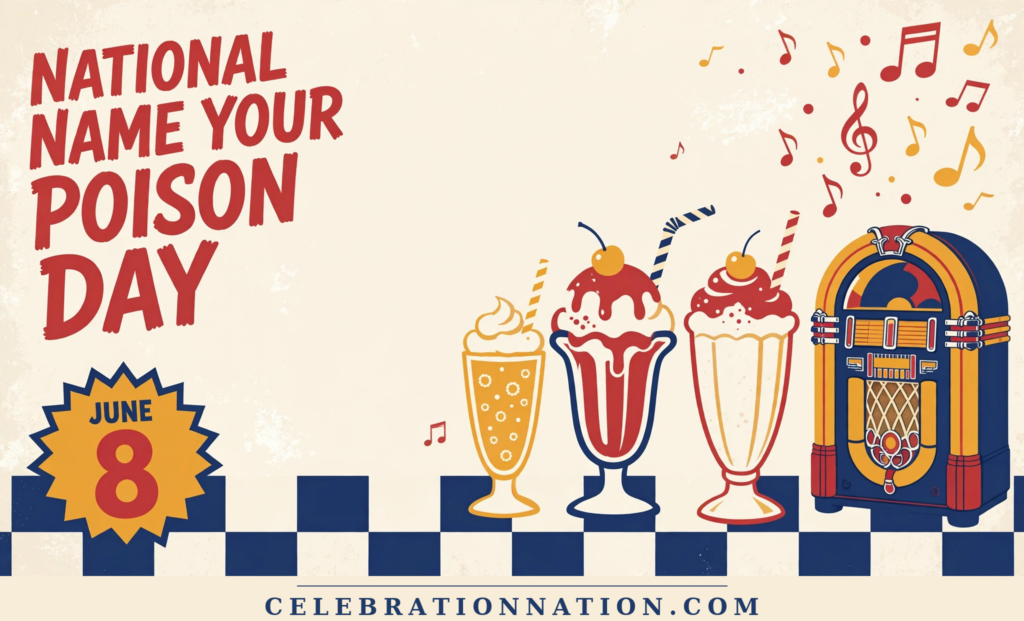
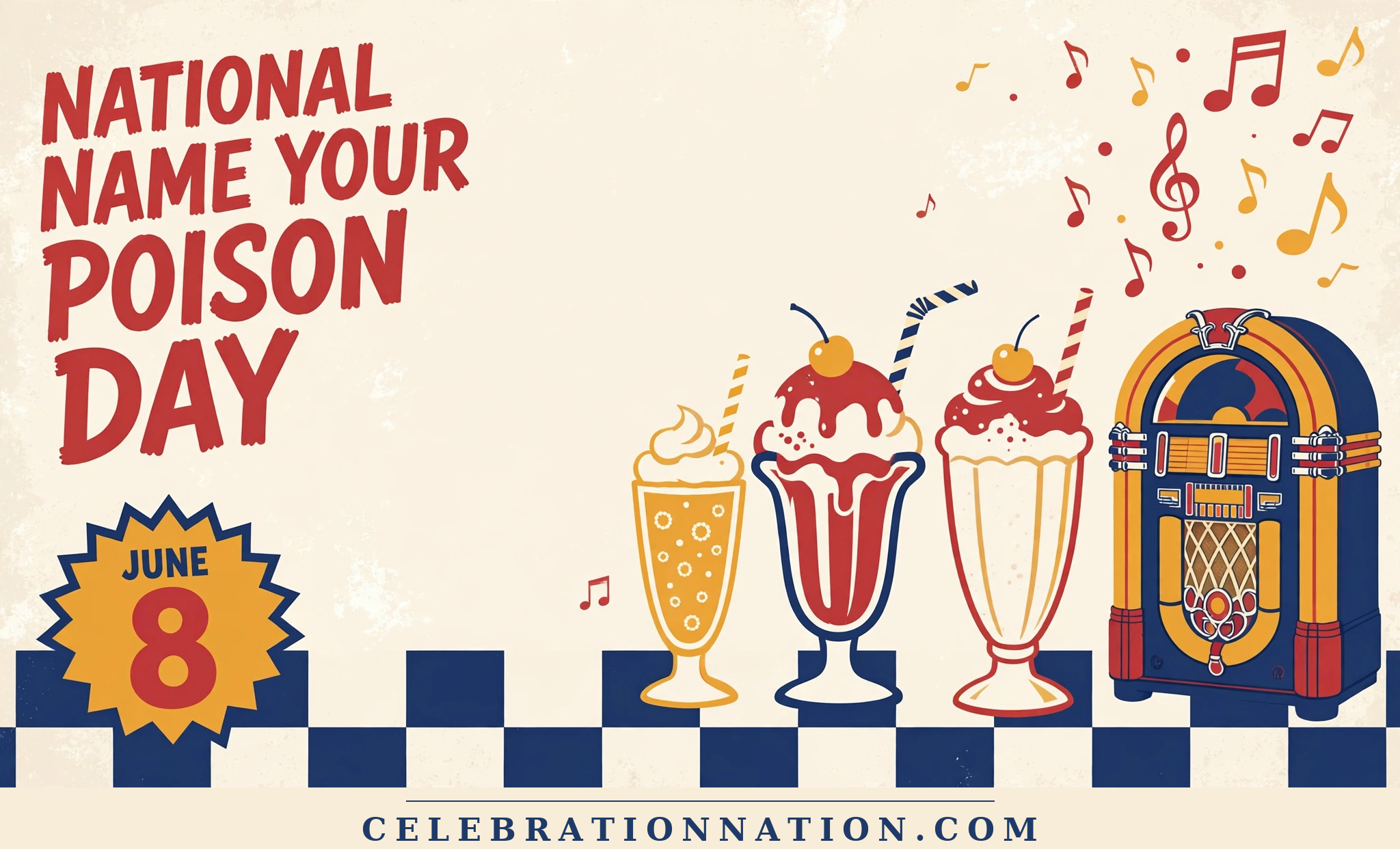
National Name Your Poison Day
On June 8, National Name Your Poison Day encourages us to embrace the power of decision-making with a playful spirit.
- Roots
- Colloquial phrase dating back to the 19th century, implying a choice between undesirable options, now used humorously for any selection.
- Vibe
- Decisive, Reflective, Playful
- Also on Jun 8
- Best Friends Day · Upsy Daisy Day · World Brain Tumor Day
- Hashtag
- #NationalNameYourPoisonDay
3 ways to celebrate
Mix your signature
Craft your all-time favorite drink at home.
Order boldly
Everyone picks their signature drink and toasts the day.
Mocktail hour
Bring mocktail ingredients for a fun office drink break.
Plan ahead
National Name Your Poison Day is observed on June 8 every year. Here is where it lands for the next ten years, handy for planners, marketers and party people.
Fast facts
The story
The phrase "name your poison" carries an intriguing historical resonance, often conjuring images of dimly lit saloons or dramatic showdowns from old Westerns. Its origins, however, are more rooted in the everyday vernacular of the 19th century, particularly in American English. While it literally refers to a choice of alcoholic beverage, a "poison" in a playful, self-deprecating sense, it quickly evolved into a broader idiom. It implies a situation where one must make a selection, perhaps from a limited or even unappealing set of options, yet the act of choosing itself asserts a degree of control and agency. The humor lies in the mock-gravity of the choice, elevating a simple decision to a matter of mock-consequence.
Read the full story
Culturally, "name your poison" has permeated various forms of media, from classic films to contemporary literature, often signaling a pivotal moment or a lighthearted challenge. In cinema, a bartender's dry delivery of the line often precedes a character's critical decision, not just about a drink, but about their next move in a narrative. This pervasive usage underscores a fundamental human experience: the constant negotiation of choices. Whether faced with two equally tempting paths or two less-than-ideal alternatives, the ability to articulate one's preference, to "name one's poison"is an act of self-definition, however small the choice may seem.
The modern observance of National Name Your Poison Day on June 8 reimagines this historical phrase for a contemporary context. It moves beyond the literal interpretation of a drink order, inviting individuals to consider the metaphorical "poisons" they encounter daily. This could involve choosing a career path, deciding on a community initiative, or simply selecting a dinner entrée. The day serves as a gentle reminder that decision-making, while sometimes daunting, is an integral part of personal growth and societal progress. It encourages a shift from passive acceptance to active selection, fostering a sense of ownership over one's trajectory.
Ultimately, National Name Your Poison Day is a celebration of personal autonomy and the nuanced art of making choices. It’s a day to acknowledge the weight, or the whimsy, of our decisions and to do so with a knowing nod to the past. By embracing this idiom, we are encouraged to approach our options, no matter how complex, with a measure of confidence and even a touch of theatrical flair. It’s an invitation to step forward, articulate a preference, and own the outcome, recognizing that every choice, big or small, contributes to the unique tapestry of our individual and collective experiences.
“It is our choices, Harry, that show what we truly are, far more than our abilities.”
J.K. ROWLING
Did you know?
The Etymology of 'Poison'
The word 'poison' derives from the Latin 'potio,' meaning a drink or potion, highlighting its historical association with liquids, a subtle link to the idiom.
Decision Fatigue
The concept of 'decision fatigue' suggests that the quality of choices deteriorates after making many decisions, impacting everything from court rulings to personal spending.
The Paradox of Choice
Psychologist Barry Schwartz's work explores the 'paradox of choice,' arguing that while more options seem good, an excessive number can lead to anxiety and dissatisfaction.
Bartender's Lore
In many classic bars, a skilled bartender can often 'name your poison' for you, intuiting your preference based on subtle cues and past orders.
Historical 'Potions'
Before modern medicine, many concoctions, both beneficial and harmful, were simply called 'potions,' requiring a choice to be made by the user or patient.
The American Diner's Dilemma
From choosing between cherry or chocolate pie to selecting a milkshake flavor, the classic American diner often presents a delightful, low-stakes 'poison' scenario.
Cognitive Biases in Choice
Human decision-making is influenced by numerous cognitive biases, such as confirmation bias or anchoring bias, which can subtly steer our 'poison' selection.
Around the world
Every culture celebrates a little differently.
- USAmerican Saloon CultureThe phrase 'name your poison' gained significant traction in 19th-century American saloons and Western culture, often used by bartenders to solicit drink orders.
- GBBritish Idiomatic CousinsWhile 'name your poison' is less common, similar British idioms like 'take your pick' or 'choose your weapon' convey the essence of making a selection.
- FRThe Art of DeliberationIn France, the emphasis on careful consideration, 'la réflexion,' often precedes significant choices, reflecting a cultural value placed on thoughtful decision-making.
- JPConsensus and HarmonyJapanese decision-making often prioritizes group consensus, or 'nemawashi,' ensuring harmony before a 'poison' is collectively named.
- DEPrecision in PreferenceGerman culture often values clear communication and directness in expressing preferences, making the act of 'naming one's poison' a straightforward affair.
- INDiverse Culinary ChoicesIn India, the vast array of regional cuisines and beverages often presents a delightful challenge, where 'naming your poison' in a culinary sense is a daily joy.
Keep the party going
See the calendar

Celebrate every day, all year
Official gear from the people who track 1,700+ celebrations.
Browse the shop 2027 National Day Wall CalendarGet the 2026 edition free. 1,700+ observances.
Never miss a reason to celebrate.
One quick morning email with today's celebrations, ideas and posters. Free, unsubscribe anytime.
🎉 You're on the list! Watch your inbox for The Daily Confetti.