
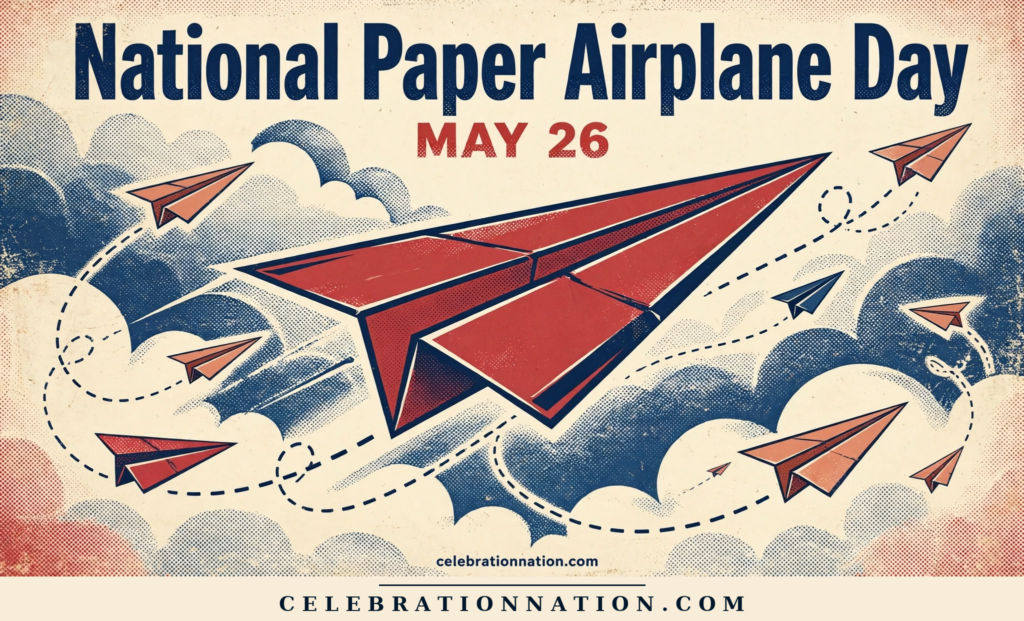
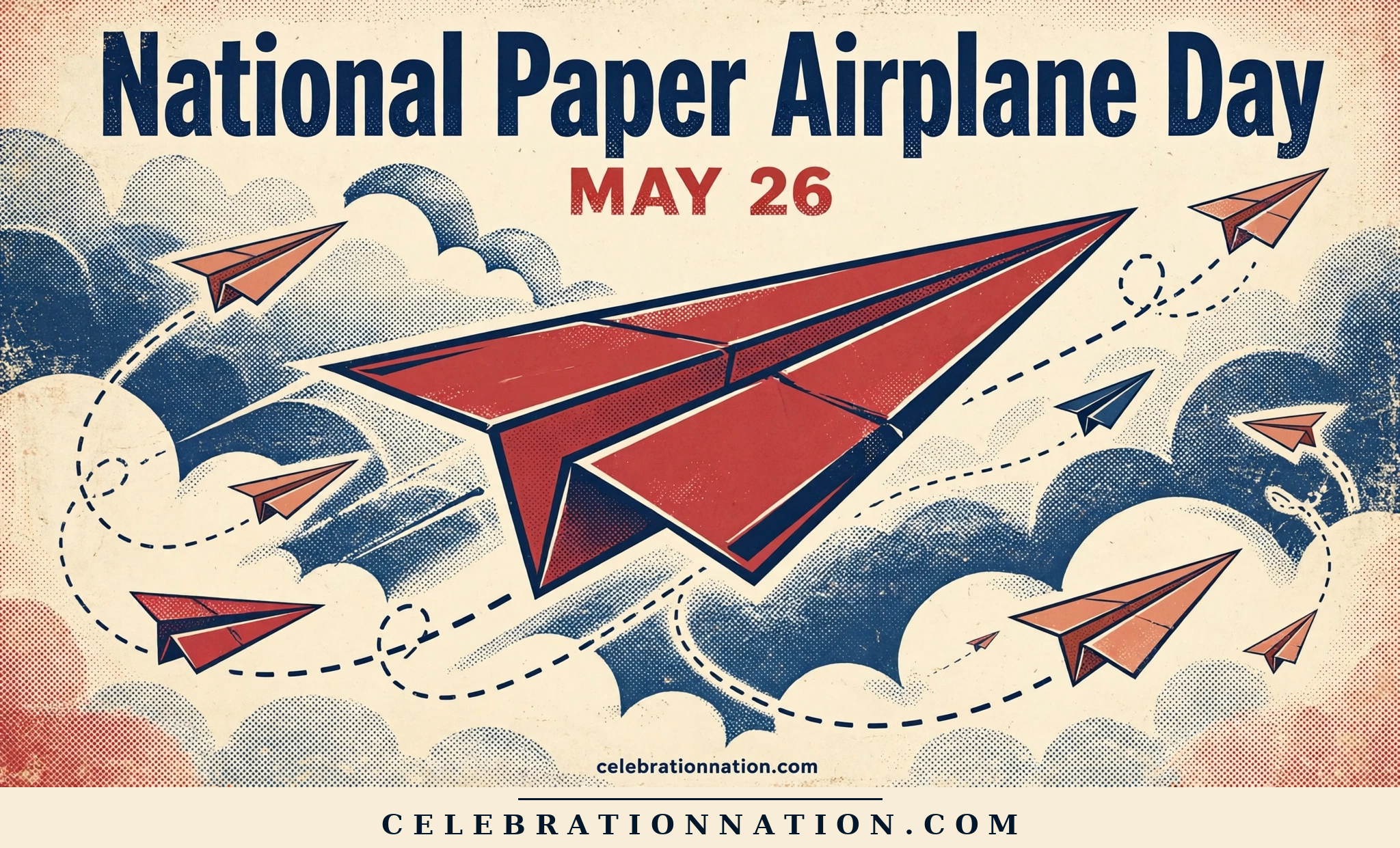
National Paper Airplane Day
One sheet of paper, six folds, a launch. National Paper Airplane Day on May 26 honors the simplest, cheapest, most universal childhood craft — and the surprisingly deep engineering principles behind why some designs glide forever and others nosedive.
- Vibe
- Aerodynamic
- Also on May 26
- Blueberry Cheesecake Day
- Hashtag
- #NationalPaperAirplaneDay
Ways to celebrate
Paper + folds + a throw:
- ✈️ Fold one. The basic "Dart" is a 6-fold design. If you've forgotten, YouTube has it. 60 seconds start-to-finish.
- 🏆 Try a better design. The "Glider" (John Collins's record-setting design) takes 3 minutes. Flies 5x as far.
- 🏁 Competition at home. Longest flight, longest distance, most loops. Kids go feral for this.
- 🎨 Decorate. Markers, stickers, patterns. The prettier they look, the more heartbreaking the crash.
- 📐 Teach the physics. Lift, drag, weight, thrust. Paper airplanes are kid-level aerodynamics.
Make it your kind of celebration
Family
Family paper airplane contest. Everyone folds one; fly across the living room. Three rounds. Unexpected bonding activity.
Kids
This is peak kid activity. Every age 5+ can fold one. Every age 5+ wants to throw it again.
Couples
Paper airplane notes to each other around the house. Silly, charming, memorable.
Office
Office paper airplane contest — conference-room version, prizes optional. Unexpectedly popular team activity.
School
Physics lessons in disguise. Distance, flight time, loop count — all measurable. Kids learn principles via joy.
Community
Library or maker-space paper airplane workshops are easy to host. Free activity; huge crowds.
Just me
Try five designs tonight. Which flies farthest? Which does loops? The iteration is the hobby.
Plan ahead
National Paper Airplane Day is observed on May 26 every year. Here is where it lands for the next ten years, handy for planners, marketers and party people.
Fast facts
The story
Paper airplanes are older than airplanes. They've been flying since paper existed, which in China was around 2,000 years ago.
Read the full story
Paper was invented in China around 105 CE. Chinese artisans began making paper kites soon after, and then smaller paper models that could be folded and thrown. Leonardo da Vinci, in his 1510 notebooks, sketched an "ornithopter" that he described testing with paper models. (Whether da Vinci himself made the first Western paper airplanes is disputed, but he certainly sketched the concept.)
The modern paper airplane, the specific Dart-like fold everyone learns, was developed in the early 20th century, partly inspired by the Wright Brothers' 1903 Wright Flyer. Jack Northrop, co-founder of Lockheed Corporation in the 1930s, used paper airplane testing to work out wing designs for real aircraft. Many aerospace engineers still test scale aerodynamic models with folded paper.
The Guinness World Record for paper airplane distance belongs to John Collins ("The Paper Airplane Guy"), whose design flew 226 feet, 10 inches in 2012, thrown by former NFL quarterback Joe Ayoob. A later throw reached 252 feet, 7 inches in South Korea in 2022. Collins's designs are detailed in his book The New World Champion Paper Airplane Book. The folds are teachable; the throw requires an athletic arm.
National Paper Airplane Day falls on May 26. Its origin is informal, some versions credit corporate folder's workshops; others credit 1970s elementary school traditions. The point is the continuity: paper airplanes have been a universal human activity for 1,900 years, and they're still among the most free, fun, and physics-dense crafts any kid (or adult) can do with a sheet of paper.
Four forces that determine whether your plane flies or flops:
Six designs worth knowing. Each has a purpose:
“The paper airplane is a miracle of engineering disguised as a toy., JOHN COLLINS,”
THE PAPER AIRPLANE GUY"
Did you know?
Paper airplanes were military training.
During WWII, wooden models were expensive; paper airplanes were used to test aerodynamic principles. Jack Northrop studied flight theory with paper before testing real aircraft.
The record plane is called "Suzanne."
John Collins named his world-record design after his wife, "because it takes my breath away." The plane set the distance record in 2012.
NASA tested paper airplanes in space.
In 2008, Japanese astronauts launched paper airplanes from the International Space Station to test reentry aerodynamics. Planes burned up on reentry (as expected).
The longest time aloft record: 29.2 seconds.
Set by Takuo Toda in 2010. Throwing a special floating design into rising air currents. The physics is real; the technique is unreal.
Keep the party going
See the calendar
Celebrate every day, all year
Official gear from the people who track 1,700+ celebrations.
Browse the shop National Day Celebration Card GameA party in a box, any day of the year.
Never miss a reason to celebrate.
One quick morning email with today's celebrations, ideas and posters. Free, unsubscribe anytime.
🎉 You're on the list! Watch your inbox for The Daily Confetti.