



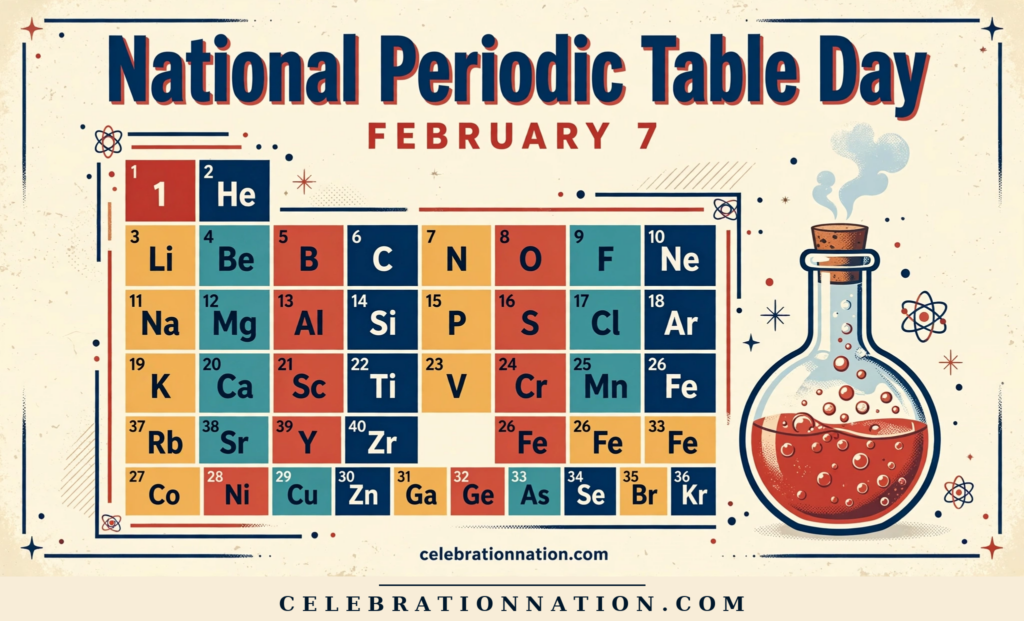
National Periodic Table Day
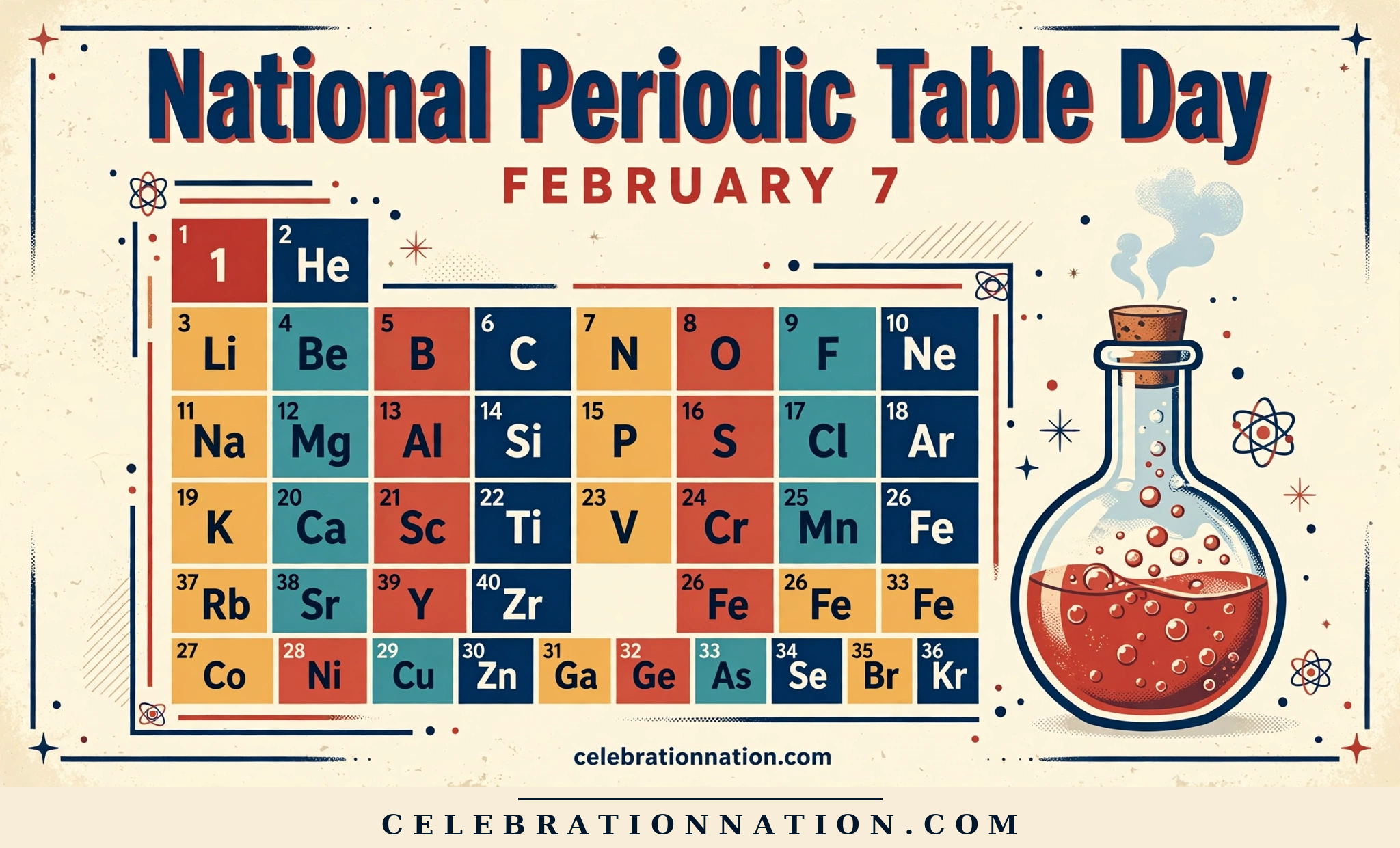
Join us in a day that highlights the importance of the periodic table.
- Roots
- Established to honor Dmitri Mendeleev
- Vibe
- Curiosity and exploration of science
- Also on Feb 7
- E-Day · Fettuccine Alfredo Day · Send a Card to a Friend Day
- Hashtag
- #NationalPeriodicTableDay
3 ways to celebrate
Learn five elements
Pick five elements and learn what they are used for.
Play element bingo
Make bingo cards with element symbols for a game night.
Quiz the class
Challenge classmates to name elements by their symbols.
Plan ahead
National Periodic Table Day is observed on February 7 every year. Here is where it lands for the next ten years, handy for planners, marketers and party people.
Fast facts
The story
The periodic table, first organized by Dmitri Mendeleev in 1869, serves as a vital tool in understanding the elements that compose our world. Each element, with its unique properties, contributes to the vast tapestry of science, from the simplest hydrogen to the complex actinides. National Periodic Table Day is a tribute not only to Mendeleev's groundbreaking work but also to the ongoing exploration of chemistry in contemporary education.
Read the full story
As we delve into the periodic table's structure, we appreciate its systematic arrangement, elements are grouped by similar properties, highlighting the relationships between them. This organization allows scientists and students to predict the behavior of elements and compounds, making it a crucial component of scientific study. The day encourages educators to engage students in hands-on experiments and discussions about the elements, fostering a love for science.
In schools across America, teachers celebrate National Periodic Table Day by hosting interactive lessons that bring the table to life. Students might create models of atoms, perform experiments that demonstrate chemical reactions, or even write reports on their favorite elements. Such activities not only enhance understanding but also ignite curiosity about the natural world.
Globally, the periodic table is recognized as a symbol of scientific achievement. It transcends borders, languages, and cultures, reminding us of our shared quest for knowledge. National Periodic Table Day serves as a reminder to appreciate the role of science in our everyday lives, encouraging future generations to explore the wonders of chemistry and the elements that shape our universe.
Did you know?
Who created the periodic table?
Dmitri Mendeleev is credited with the first widely recognized periodic table.
How many elements are there?
As of 2023, there are 118 confirmed elements on the periodic table.
What is the first element?
Hydrogen is the first element, with the atomic number 1.
What is the heaviest element?
Osmium is one of the densest naturally occurring elements.
What is an isotope?
Isotopes are variations of elements with the same number of protons but different neutrons.
What does the periodic table symbolize?
It represents the organization of chemical elements and their relationships.
Why is it important in education?
The periodic table is a foundational tool in chemistry education.
Around the world
Every culture celebrates a little differently.
- USUnited StatesHome to numerous educational initiatives celebrating science.
- GBUnited KingdomHistoric contributions to chemistry and the periodic table.
- DEGermanyBirthplace of many renowned chemists.
- FRFranceContributions to chemical elements and compounds.
- JPJapanInnovations in chemistry and technology.
- CACanadaStrong emphasis on science education and awareness.
Keep the party going
See the calendar

Celebrate every day, all year
Official gear from the people who track 1,700+ celebrations.
Browse the shop 2027 Wall Calendar, signed by Marlo AndersonSigned by the founder of National Day Calendar.
Never miss a reason to celebrate.
One quick morning email with today's celebrations, ideas and posters. Free, unsubscribe anytime.
🎉 You're on the list! Watch your inbox for The Daily Confetti.