National Rubber Eraser Day
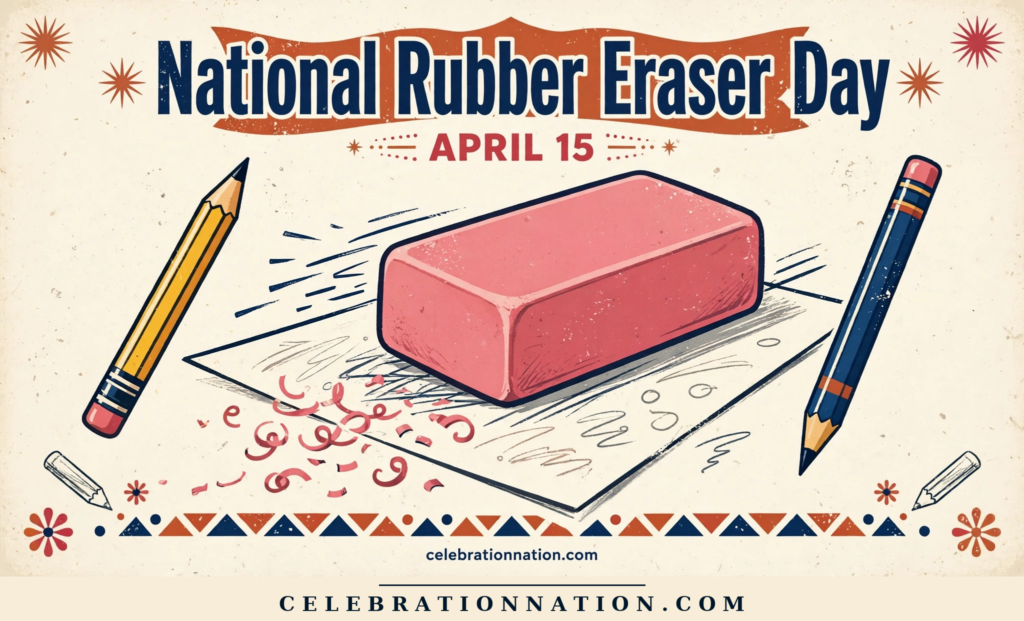
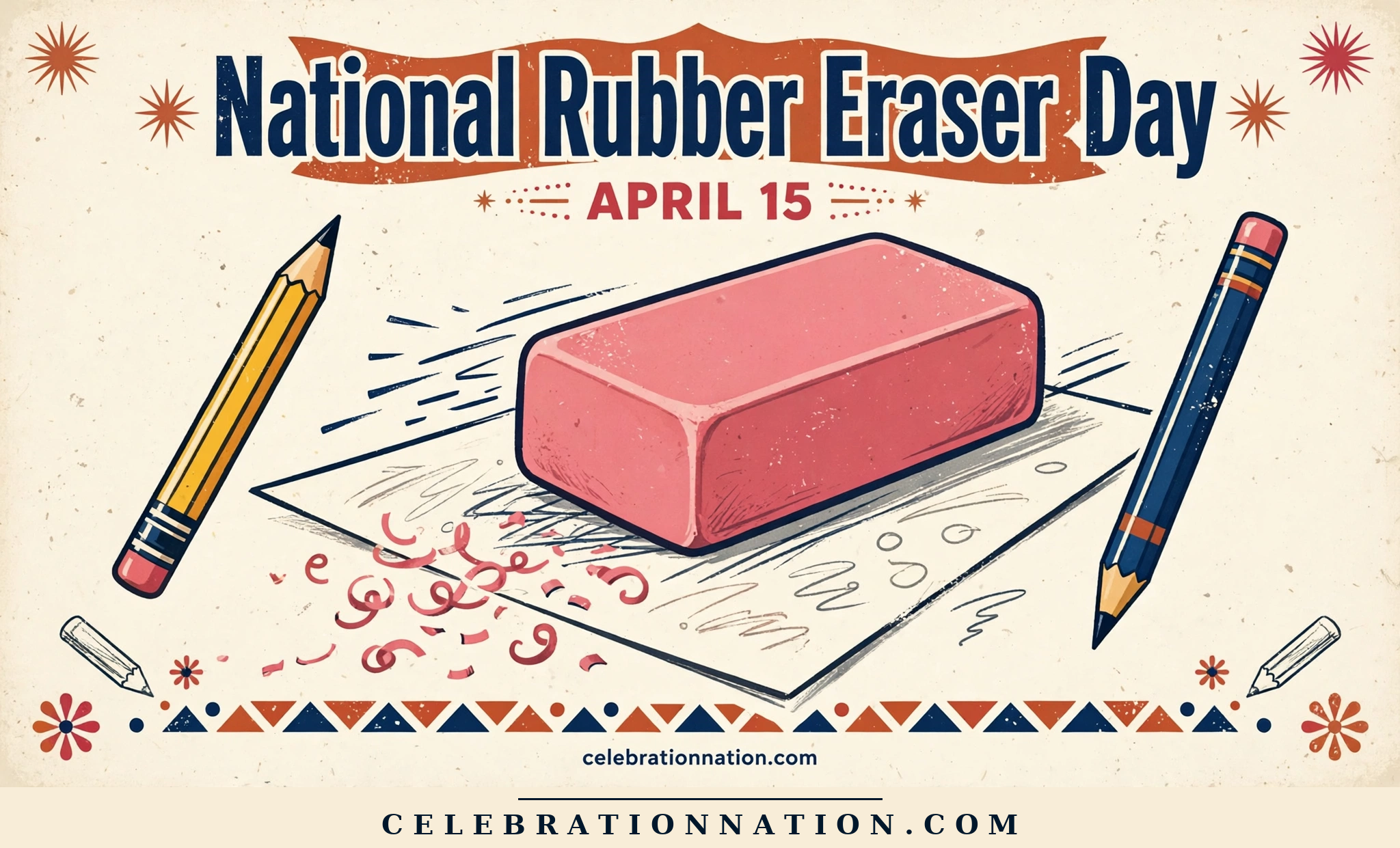
National Rubber Eraser Day on April 15 honors the humble, indispensable, 250-year-old invention that transformed writing, drawing, drafting, and thinking itself — the rubber eraser. The anniversary of Edward Nairne's 1770 discovery that a piece of caoutchouc could 'rub out' pencil marks. The day to appreciate the tool that gave us permission to be wrong.
- Vibe
- Humble & Essential
- Also on Apr 15
- Purple Up! Day · World Art Day · Glazed Spiral Ham Day
- Hashtag
- #NationalRubberEraserDay
Ways to celebrate
Appreciate the tools of correction:
- ✏️ Sharpen a pencil; use the eraser. A small, physical gesture of appreciation. The Staedtler Mars Plastic is the connoisseur's choice; Tombow Mono is the elegant Japanese option.
- 🎨 Try drawing with erasers. Professional illustrators use erasers as drawing tools — lifting charcoal, shaping highlights, creating negative space. A genuine art technique.
- 🏪 Buy good art erasers. Kneaded erasers, art gums, plastic vinyl erasers — a specialty-art-store tour for $10 total. Revelatory.
- 📚 Read 'The Pencil' by Henry Petroski. Definitive book on the history of the pencil (and by extension, the eraser). Brilliant engineering history.
- 📝 Write something by hand. A letter, a journal entry, a sketch. Not everything; just something. The physical presence of the eraser matters.
Make it your kind of celebration
Family
Family drawing night. Pencils, paper, good erasers. Watch kids discover the freedom of being able to erase mistakes.
Kids
Give them a variety of erasers (cube, rectangle, kneaded, pencil-top) and let them experiment. Different erasers for different pencils; a surprisingly useful lesson.
Couples
Hand-write a letter to each other — real paper, real pencil, real eraser. The fact that each word can be taken back adds intimacy.
Office
Stock the supply closet with good erasers instead of cheap ones. Tiny morale boost; real productivity gain. Staedtler Mars Plastic is the professional choice.
School
Classic stationery-history lesson. How did we correct writing before erasers? What changed? A surprisingly engaging history topic for kids.
Community
Support local stationery stores on this day. Small independent shops (Cult Pens, Goulet Pens, JetPens) are the best places to discover quality erasers.
Just me
Fresh pencil, fresh eraser, journal. The physical act of hand-writing with the permission to edit is genuinely therapeutic.
Plan ahead
National Rubber Eraser Day is observed on April 15 every year. Here is where it lands for the next ten years, handy for planners, marketers and party people.
Fast facts
The story
Before the rubber eraser, correcting pencil marks was a genuine problem. Leonardo da Vinci used breadcrumbs. Michelangelo used damp bread. Joshua Reynolds, in his 1770 diary, describes using 'stale bread' to erase preliminary sketches. The rubber eraser's 1770 invention, by English engineer and optician Edward Nairne, was genuinely transformative. Nairne reportedly picked up a piece of caoutchouc (natural rubber, recently imported from Brazil) instead of his usual bread-crust, discovered it erased pencil marks better, and began selling cubic erasers for 'three shillings each.' A lucky accident that changed writing forever.
Read the full story
The chemist Joseph Priestley, same Priestley who discovered oxygen, coined the term 'rubber' in 1770 specifically to describe the eraser material. 'India rubber' then became the name for the substance itself. For the next 70 years, all rubber everywhere, eraser, waterproofing, tire-rubber, derived its English name from the humble tool that popularized it. A wonderful language-backwards moment.
The pencil-with-eraser-on-top was patented by Hymen Lipman of Philadelphia in 1858. A brilliant practical innovation, put the eraser at the pencil's end, always at hand. Lipman sold the patent to Joseph Reckendorfer for $100,000 (a fortune in 1862). Reckendorfer tried to sue Faber pencils for patent infringement. In 1875, the US Supreme Court ruled in Reckendorfer v. Faber that simply combining two existing items (pencil and eraser) wasn't an invention a foundational US patent-law decision still cited today. The pencil-with-eraser remained on the market; the patent was voided.
Modern erasers have diversified. The classic pink school eraser, the 'Pink Pearl', was advertised by 1923 and is still sold. Plastic vinyl erasers (the 'Staedtler Mars Plastic,' 'Tombow Mono') emerged in the 1950s for professional drafting, cleaner erase, less smudging. Kneaded erasers (shape-shifting gray putty) came from the art world for charcoal and pastel work. Electric erasers exist for professionals. Yet in essential function and form, the rubber eraser of 2026 is a direct descendant of Nairne's 1770 cube. A 254-year-old tool, still indispensable.
If you use a pencil, upgrade your eraser:
Six traditions and specialties in eraser history:
Did you know?
'Rubber' was named after the eraser.
Joseph Priestley coined 'rubber' in 1770 to describe the eraser material. The substance, previously called 'caoutchouc' (from the South American Tupi language), got its English name from the tool that popularized it. A reverse naming that still shapes English vocabulary.
Hymen Lipman's patent was voided in a Supreme Court case.
Reckendorfer v. Faber (1875) is a foundational US patent-law case. Lipman's 1858 pencil-with-eraser-top patent was voided because it combined two existing items without creating a new function. The ruling: 'aggregation is not invention.' Still cited in IP law today.
Before erasers, they used bread.
For 300 years (1400-1770), breadcrumbs and stale-bread crusts were the standard tool for erasing pencil and charcoal marks. Leonardo da Vinci, Michelangelo, Joshua Reynolds, and countless others used bread. The rubber eraser's dominance began only 254 years ago.
The Pink Pearl is an 'acid-free' success story.
Dixon Ticonderoga's Pink Pearl has been manufactured for over a century, documented in Eberhard Faber catalogs as early as 1923. Few product designs remain unchanged that long. Stationery's longest-lived success.
Keep the party going
See the calendar

Celebrate every day, all year
Official gear from the people who track 1,700+ celebrations.
Browse the shop 2027 Wall Calendar, signed by Marlo AndersonSigned by the founder of National Day Calendar.
Never miss a reason to celebrate.
One quick morning email with today's celebrations, ideas and posters. Free, unsubscribe anytime.
🎉 You're on the list! Watch your inbox for The Daily Confetti.