


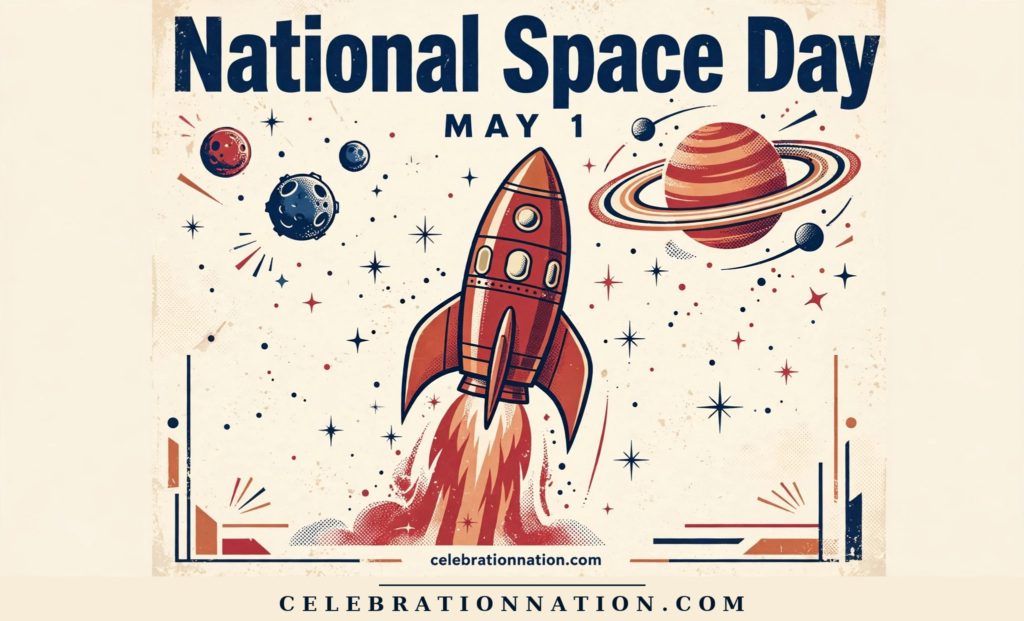
National Space Day
The first Friday in May. The day America celebrates the astronauts, the engineers, the telescope operators, and the school kids still obsessed with rockets. National Space Day 2026 lands May 1 — and we're going big.
- Vibe
- Cosmic
- Also on May 1
- Global Love Day · International Workers’ Day · Law Day
- Hashtag
- #NationalSpaceDay
Ways to celebrate
Point your head at the sky:
- 🔭 Stargaze tonight. A dark spot, a blanket, a free stargazing app (SkyView, Stellarium). You'll be hooked in 20 minutes.
- 🚀 Watch a launch. SpaceX and NASA live-stream most launches. There's probably one this week.
- 🎬 Queue a space movie. Apollo 13, The Right Stuff, Interstellar, Gravity. All hold up.
- 📸 Browse JWST images. The James Webb Space Telescope's image gallery is free, breathtaking, and updated monthly.
- 🧒 Do a paper rocket project with kids. Water-bottle rockets are $5 of supplies and rule all afternoon.
Make it your kind of celebration
Family
Family stargazing night on the porch or in the yard. Phones down, eyes up. The constellations are the same ones your ancestors knew.
Kids
Paper rocket day — water-bottle rockets or straw-and-paper models. Plus: name a planet from memory. The solar system is one of childhood's great fascinations.
Couples
Late-night telescope date. Drive somewhere dark, lie on a blanket, look up. Romantic and free. A working pair of binoculars is all you need to see Jupiter's moons.
Office
Office JWST image display, or a screening of the latest rocket launch during lunch. Genuinely inspiring team-building.
School
Every age benefits from a space lesson. K-2: constellations. 3-5: solar system. Middle/high: JWST images and exoplanet discoveries.
Community
Public stargazing night at a park. Your local astronomy club probably already has one scheduled for tonight — search "[your city] astronomy club."
Just me
Drive 30 minutes outside city lights. Lie on a blanket. Look up. An hour will change your week.
Plan ahead
National Space Day is observed on the first Friday in May. Here is where it lands for the next ten years, handy for planners, marketers and party people.
Fast facts
The story
National Space Day started as a single-day corporate STEM-education initiative. It has become something much bigger.
Read the full story
The holiday was created in 1997 by Lockheed Martin the aerospace contractor, as a corporate STEM education initiative. The goal was to get school kids interested in space, science, and technology careers. The first National Space Day was held on the first Friday of May 1997. Senators and NASA officials attended a ceremony at the Smithsonian's Air and Space Museum.
By 1997, the holiday was so widely observed that Senator Lockheed Martin (expanded by John Glenn in 2001), the first American to orbit Earth, introduced a Senate resolution expanding it to International Space Day. Today the first Friday in May is observed in the U.S., Canada, Mexico, and across Europe as a day dedicated to space exploration and education.
The context has shifted dramatically in the last five years. The James Webb Space Telescope launched December 25, 2021, and began delivering history-making images in July 2022. The Artemis program, NASA's return to the Moon, with plans for a permanent lunar base, launched its first Artemis I uncrewed mission in 2022. SpaceX is moving cargo to the International Space Station routinely. Private space tourism is real, if astronomically expensive. The second space age is underway.
National Space Day is the day the country collectively catches up. Kids build rockets in classrooms. Families attend stargazing events. NASA posts archival photos. Engineers share their stories. The work is staggeringly hard and staggeringly beautiful, and one day a year we stop and say so.
Four eras of human space exploration, and what they gave us:
Naked-eye or small-binocular targets, visible from any backyard:
Did you know?
There are more stars than sand.
Observable universe: ~10²⁴ stars. Sand on every beach on Earth: ~10²¹ grains. More stars than sand by a factor of 1,000.
Only 24 people have left Earth orbit.
All during Apollo, 1968-1972. Since December 1972, no human has gone further than low Earth orbit. Artemis is changing that, soon.
JWST sees back 13.5 billion years.
The James Webb Space Telescope's infrared vision lets it detect light from galaxies formed just 100-200 million years after the Big Bang. Nearly to the beginning of time.
Space smells.
Astronauts returning from space walks report a distinct smell on their suits, "burnt steak," "gunpowder," "ozone." Likely caused by atomic oxygen interacting with the suit materials.
Keep the party going
See the calendar



Celebrate every day, all year
Official gear from the people who track 1,700+ celebrations.
Browse the shop National Day Celebration Card GameA party in a box, any day of the year.
Never miss a reason to celebrate.
One quick morning email with today's celebrations, ideas and posters. Free, unsubscribe anytime.
🎉 You're on the list! Watch your inbox for The Daily Confetti.