






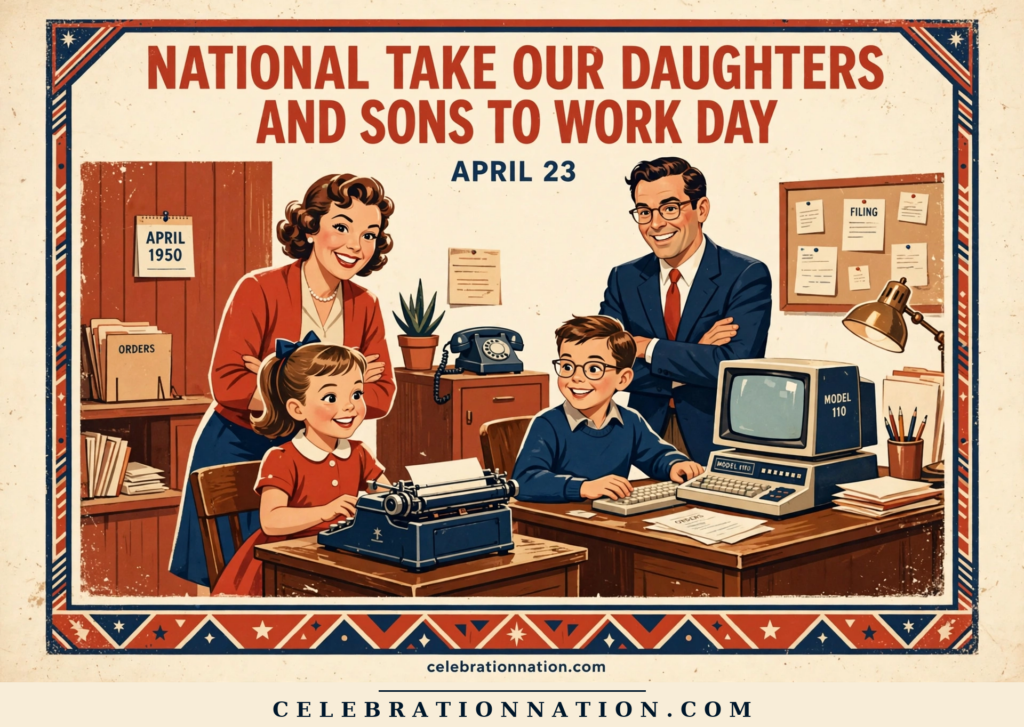
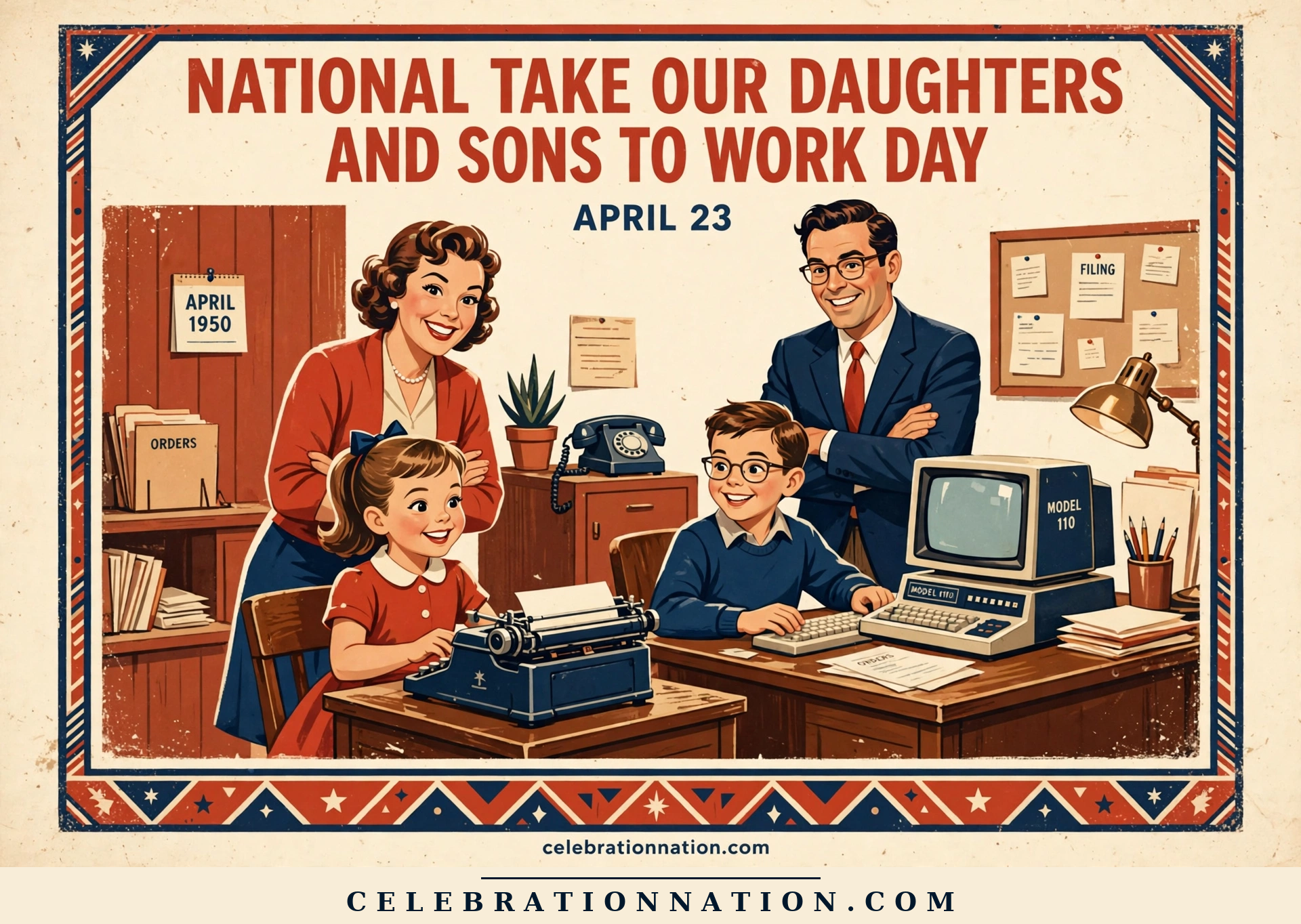
National Take Our Daughters and Sons to Work Day
One Thursday each April. Kids in offices, factories, hospitals, fire stations, and every workplace in between — seeing what their parents actually do. Take Our Daughters and Sons to Work Day is one of the most sincerely-intended, widely-observed American traditions.
- Vibe
- Oversized Badge
- Also on Apr 23
- International Pixel-Stained Technopeasant · World Laboratory Day · English Language Day
- Hashtag
- #NationalTakeOurDaughtersAndSonsToWorkDay
Ways to celebrate
If you have kids: bring them to work. If you host kids: plan something real:
- 👣 Give them a tour. Every cubicle, every conference room, the break room, the server room. Kids love behind-the-scenes.
- 📋 Give them a small job. Real, completable, 30-minute. They own it. They remember it.
- 👥 Introduce them. Every coworker you normally see. Names. Titles. "This is what she does."
- 🍕 Feed them. Pizza lunch with the team. This is non-negotiable; it's the heart of the experience.
- 📸 Take photos. The parent-with-kid-at-desk photo is a keeper. Send to grandparents tonight.
Make it your kind of celebration
Family
Prep kids the night before — what does daddy/mommy actually do? Let them ask questions. Curiosity primes the experience.
Kids
Wear real clothes. Bring a notebook. Ask at least 5 questions. Don't eat your boss's lunch.
Couples
If only one of you can participate — great day to trade off. Photographer-parent; worker-parent with the kid.
Office
A good company makes this genuinely great. Kids' badges, office tours, a proper "day in the life" briefing. One Thursday; massive goodwill.
School
Most schools release kids early or excuse absences today. Teachers who've prepared kids to ask questions and reflect make the day deeper.
Community
Local businesses that welcome kids of customers or community members for the day create lifelong loyalty.
Just me
If you don't have kids — offer to host a friend's kid, niece/nephew, or a local mentee. Single adults can and should participate.
Plan ahead
National Take Our Daughters and Sons to Work Day is observed on the fourth Thursday in April. Here is where it lands for the next ten years, handy for planners, marketers and party people.
Fast facts
The story
The holiday was created to expose girls to career possibilities at a critical age. It has since evolved into something different, but the original impulse still matters.
Read the full story
Take Our Daughters to Work Day was founded in 1993 by Gloria Steinem, Marie C. Wilson, and the Ms. Foundation for Women. The original mission was specific: girls aged 9-15 were losing self-confidence at a critical developmental point, and exposure to real women in real careers could help. The first Take Our Daughters to Work Day involved 300,000 girls. It was a runaway success.
In 2003, the Ms. Foundation expanded the program and renamed it Take Our Daughters AND Sons to Work Day. The logic: boys also benefited from seeing parents at work, from seeing what women did in their careers, from being introduced to the workplace. The renaming was controversial with some feminists who saw the original's mission as specifically about girls' opportunities. Others saw the expansion as natural evolution.
Today, 37 million American parents and kids participate on the 4th Thursday of April. The Ms. Foundation provides official lesson plans and resources (daughtersandsonstowork.org). Many workplaces have formalized the day with kid-specific tours, craft activities, and "junior employee" programs. The day has quietly become one of the most widely-observed workplace holidays in the country.
The original mission still matters. Research continues to show that girls' career aspirations can be significantly shaped by exposure to women in fields they might not otherwise consider, engineering, medicine, law, executive leadership. A single day isn't enough to shift careers, but it's enough to open doors. Take a girl to a law firm today. Take a boy to a veterinary clinic. Take any kid to a workplace where they'd never otherwise go. That's the continuing gift of the holiday.
Four ways to make a kid's workday genuinely memorable:
Six kinds of workplaces that absolutely shine on this day:
Did you know?
The holiday was Gloria Steinem's idea.
Steinem, co-founder of Ms. magazine and the Ms. Foundation, pitched the concept in 1993 after researching why girls' self-esteem drops around age 9. The Ms. Foundation has organized it annually since.
37 million American participants.
Per the Ms. Foundation. The 4th Thursday of April involves roughly 37 million parents, kids, and employers. One of the largest voluntary civic events in America.
The White House hosts a version.
Every First Family since the Clintons has done some form of Take Your Child to Work Day at the White House, involving presidential children, staff children, and specially-invited guests.
Many kids end up in parents' careers.
Career research suggests 30-40% of adults end up in careers they were exposed to early through family. The day's impact may be more direct than it looks.
Keep the party going
See the calendar

Celebrate every day, all year
Official gear from the people who track 1,700+ celebrations.
Browse the shop National Day Celebration Card GameA party in a box, any day of the year.
Never miss a reason to celebrate.
One quick morning email with today's celebrations, ideas and posters. Free, unsubscribe anytime.
🎉 You're on the list! Watch your inbox for The Daily Confetti.