

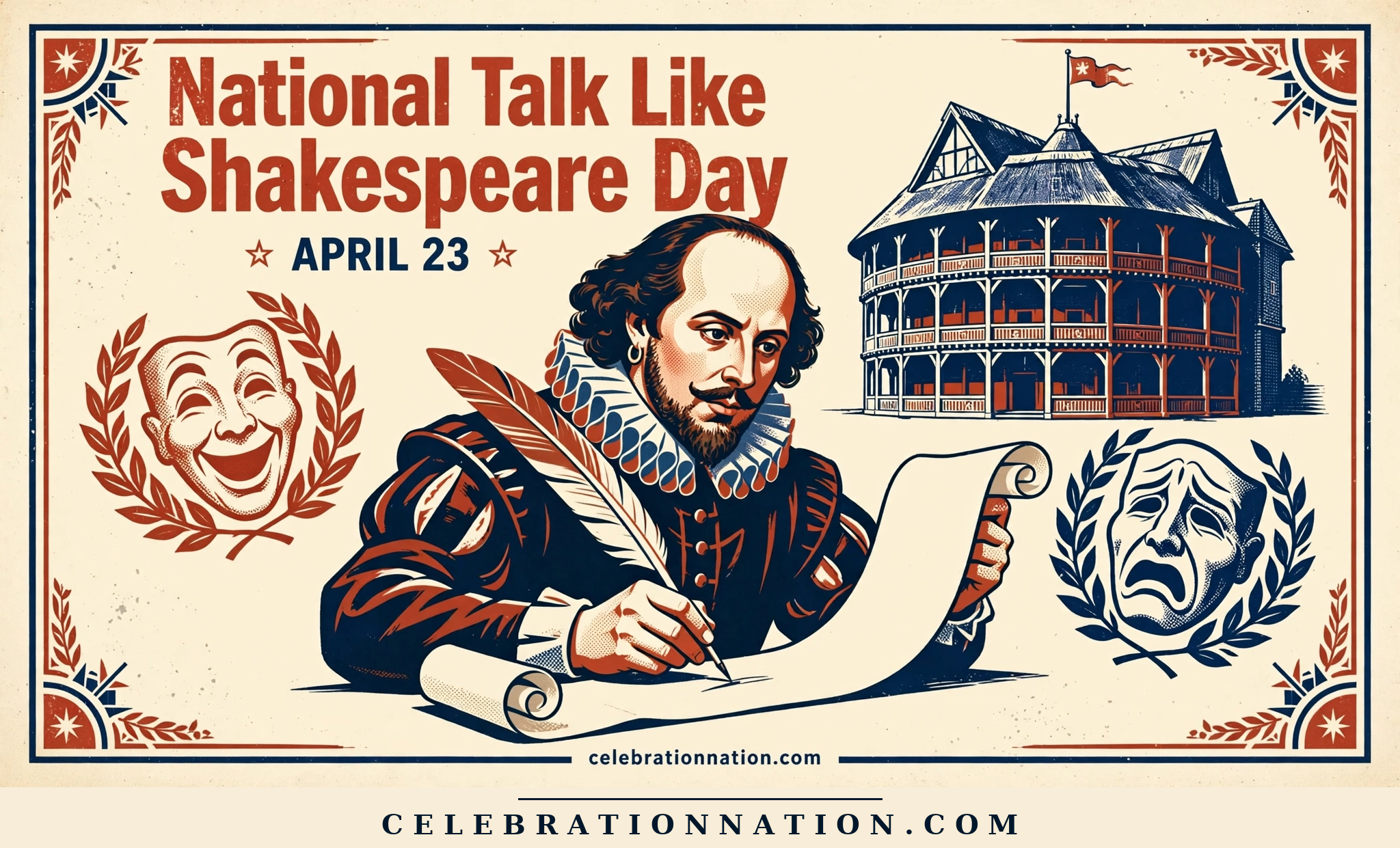
National Talk Like Shakespeare Day
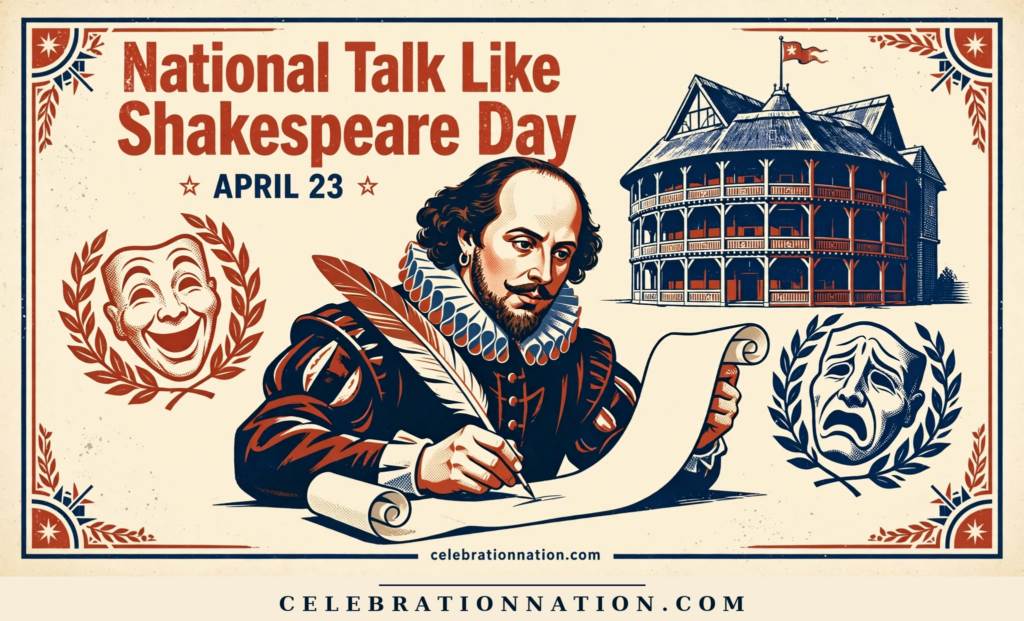
Forsooth, good citizen! April 23 is the Bard's birthday — and the day every one of us is invited to speak like him. Thee, thou, prithee, and a flourish.
- Vibe
- Forsooth-y
- Also on Apr 23
- International Pixel-Stained Technopeasant · World Laboratory Day · English Language Day
- Hashtag
- #NationalTalkLikeShakespeareDay
Ways to celebrate
Play along — the rules are loose, the spirit is generous:
- 🎭 Use one Shakespearean phrase today. "Prithee," "forsooth," "good morrow," "methinks," "anon" — pick one and wield it shamelessly.
- 📖 Read aloud. Ten minutes from any play. Shakespeare was written to be spoken, not scanned silently.
- 🎟️ See a performance. Your local Shakespeare festival, a community theater, or a filmed version on streaming. The plays land differently when you watch them.
- ✉️ Write a love note in sonnet form. 14 lines, iambic pentameter-ish, end on a rhyming couplet. Send it to someone.
- 🃏 Memorize one line. "All the world's a stage," "We are such stuff as dreams are made on," "The course of true love never did run smooth." Carry it with you.
Make it your kind of celebration
Family
Shakespeare insult dinner: every family member pulls a line from an insult generator and hurls it across the table. Kids love this. No actual feelings get hurt — "thou mewling, earth-vexing nut-hook" is too absurd to wound.
Kids
Storybook versions of the plays exist and are genuinely good — start with Leon Garfield's or Marcia Williams's illustrated retellings. Kids come away quoting full lines.
Couples
Read Sonnet 18 to each other at dinner. "Shall I compare thee to a summer's day?" is unembarrassable because it's 400 years old.
Office
Team Shakespeare-themed virtual background day. Or just end every Slack message with "adieu." Morale instrument.
School
Staged reading of one scene. Macbeth's "Is this a dagger," Mercutio's "Queen Mab," Hamlet's "To be." Everyone gets a role; everyone reads.
Community
Public library Shakespeare-in-the-park day — picnic blankets, passed-around scripts, a volunteer director. Free, welcoming, and gets people reading out loud.
Just me
Pour a glass. Pick a play you've never read. Read one act tonight — aloud, with the dog as audience. No exam, no paper. Just the language.
Plan ahead
National Talk Like Shakespeare Day is observed on April 23 every year. Here is where it lands for the next ten years, handy for planners, marketers and party people.
Fast facts
The story
Four centuries after his death, William Shakespeare is still the most-quoted, most-produced, most-translated, and most-endlessly-argued-about writer in the English language. He is, in effect, a holiday.
Read the full story
Born in the market town of Stratford-upon-Avon in April 1564 (no one recorded the exact date, but his baptism on April 26 suggests he was born around April 23, and that's the date tradition has chosen). He married Anne Hathaway at 18, had three children, and by his late 20s was already writing plays for London's most successful theater company. He would eventually write 39 plays, 154 sonnets, and 2 long narrative poems before dying, by astonishing coincidence, on April 23, 1616, his 52nd birthday.
The impact on English is impossible to overstate. Shakespeare invented or popularized roughly 1,700 words we still use today eyeball, gossip, lonely, bedroom, dishearten, lackluster, swagger, frugal, majestic, gnarled. And hundreds of phrases: "break the ice," "wild goose chase," "heart of gold," "all's well that ends well," "the world's your oyster."
National Talk Like Shakespeare Day was founded in 2009 by the Chicago Shakespeare Theater and Mayor Richard M. Daley, who issued an official proclamation encouraging "all Chicagoans" to speak like the Bard on April 23. The idea caught on nationwide, part literary tribute, part permission slip to speak with a little extra flourish. Shakespeare himself would have loved it. The man made his living entertaining crowds who showed up half-drunk to watch people duel in rhymed verse.
Four rules for doing this properly:
Six plays to know, and which one to start with depending on your mood:
Did you know?
You've quoted him without knowing.
"Wild goose chase," "heart of gold," "a fool's paradise," "in a pickle," "too much of a good thing", all Shakespeare. You've been a Bardist your whole life.
His signature is one of the world's most valuable autographs.
Only six authenticated Shakespeare signatures survive. If one ever came to market, experts estimate it could be worth millions.
Macbeth is cursed. (Allegedly.)
Theater superstition forbids saying "Macbeth" inside a theater. Call it "The Scottish Play" instead. Accidents during productions of the play are documented over 400 years.
The Globe Theatre burned down in 1613.
A cannon special effect in Henry VIII set the thatched roof on fire. One man's breeches caught flame, another man put them out with his bottle of ale. Theater.
Keep the party going
See the calendar
Celebrate every day, all year
Official gear from the people who track 1,700+ celebrations.
Browse the shop 2027 National Day Wall CalendarGet the 2026 edition free. 1,700+ observances.
Never miss a reason to celebrate.
One quick morning email with today's celebrations, ideas and posters. Free, unsubscribe anytime.
🎉 You're on the list! Watch your inbox for The Daily Confetti.