
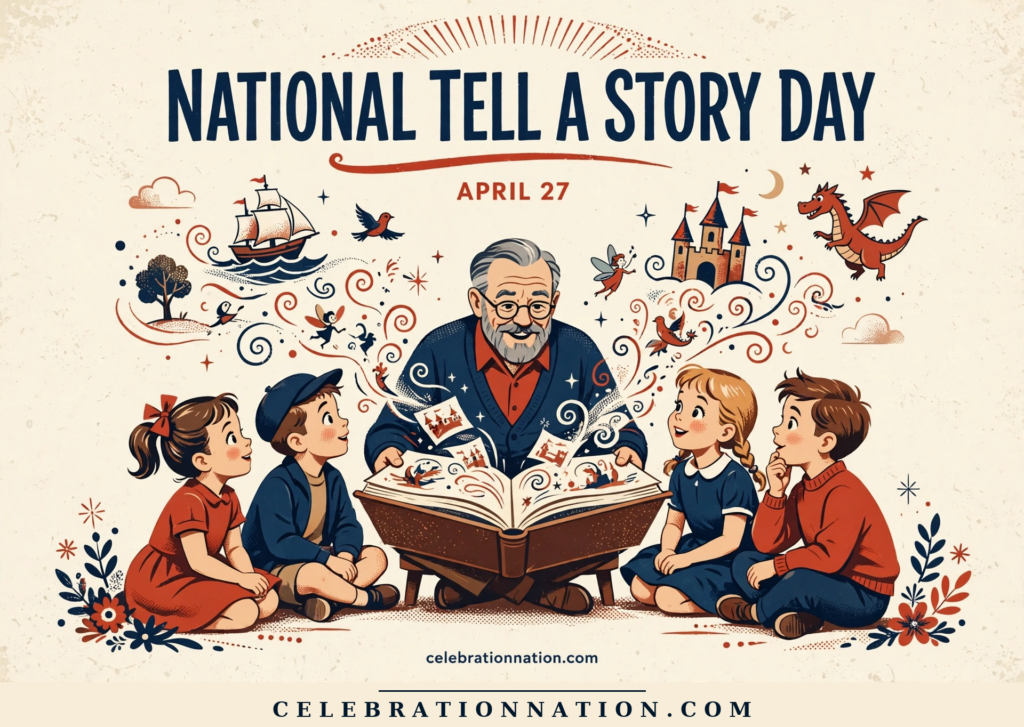
National Tell a Story Day
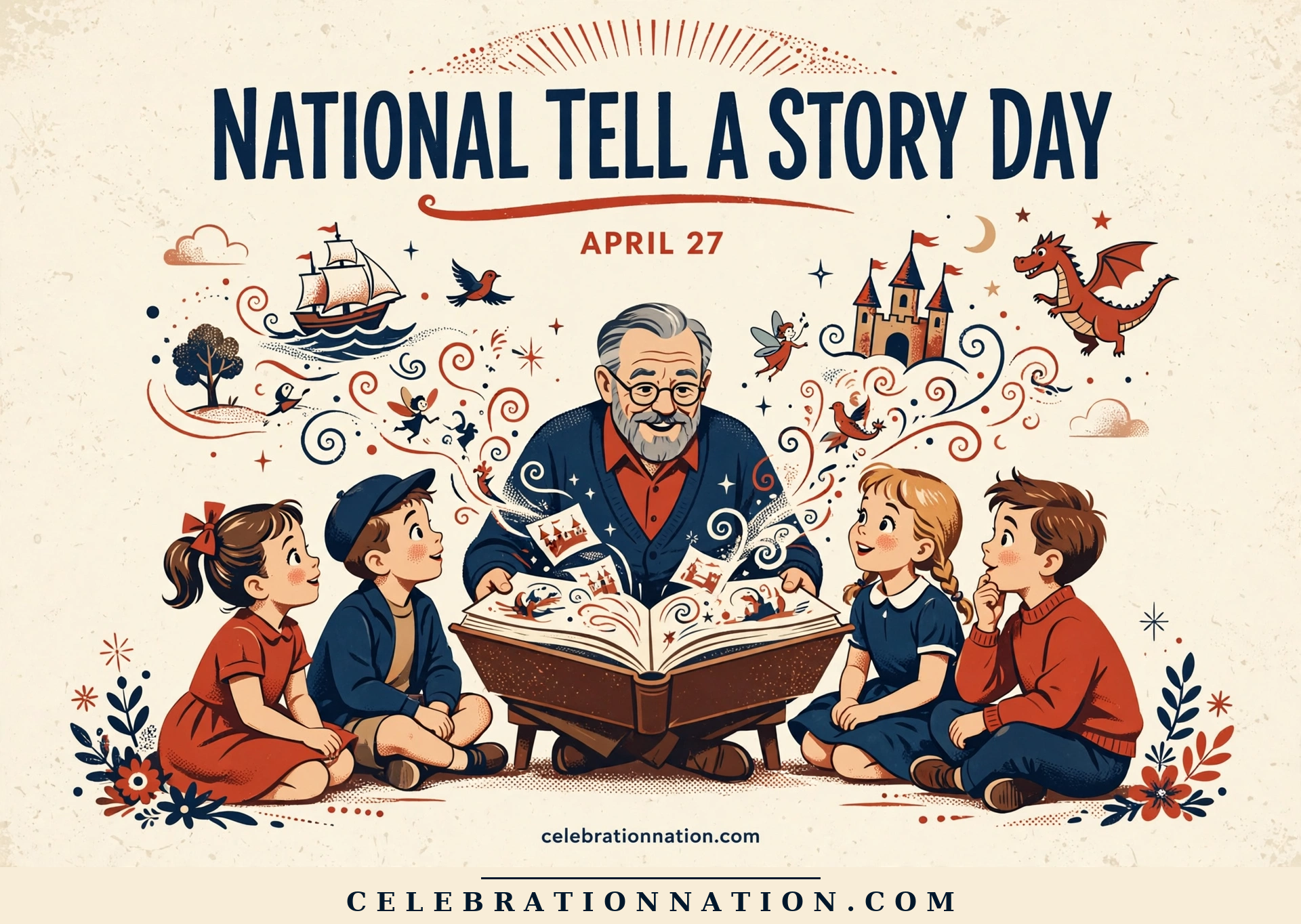
Around a campfire. In a kitchen. At bedtime. In a bar. The oldest form of human communication, and still the best. National Tell a Story Day on April 27 is a reminder to stop scrolling and start speaking.
- Vibe
- Voice & Memory
- Also on Apr 27
- World Tapir Day · Gummi Bear Day · Prime Rib Day
- Hashtag
- #NationalTellAStoryDay
Ways to celebrate
Open your mouth; skip the phone:
- 🗣️ Tell one true story today. To a kid, a partner, a coworker, a friend. Out loud. Not on text.
- 📱 Listen to The Moth. Live storytelling podcast. Hundreds of great stories. Excellent introduction to the form.
- 🎙️ Attend a live event. Moth StorySLAMs happen in every major U.S. city. Anyone can put their name in the hat.
- 📚 Read one classic. A story that shaped culture. Homer, Hans Christian Andersen, Zora Neale Hurston.
- 👵 Record an elder. Story Corps's free app lets you record a 40-minute conversation preserved in the Library of Congress.
Make it your kind of celebration
Family
Bedtime story from memory, not a book. Your own childhood, a funny relative, a family legend. Kids love hearing about life before them.
Kids
Kids are natural storytellers. Let them tell one at dinner. Don't correct. Listen like it's the most important story you've ever heard.
Couples
Share one story each about your childhood you've never told the other. Guaranteed intimacy.
Office
Meetings often get derailed because leaders don't know stories. Start a meeting with a one-minute story related to the work. Better meetings.
School
Storytelling Day is perfect for a writing-not-required creative lesson. Pair kids up; each tells a story; other listens. Real practice in both skills.
Community
Community story circle at library, coffeeshop, senior center. Rotate tellers; low pressure; huge impact. Many towns have monthly versions.
Just me
Record a voice memo telling one story about your life. Send it to a family member. Future you will be grateful.
Plan ahead
National Tell a Story Day is observed on April 27 every year. Here is where it lands for the next ten years, handy for planners, marketers and party people.
Fast facts
The story
Humans have been telling stories for as long as we've been humans. Before writing, before cities, before agriculture. Stories are how we became us.
Read the full story
Archaeologists have identified storytelling sequences in cave paintings dating to 50,000+ years ago. The paintings at Lascaux (17,000 BCE) and Chauvet (30,000+ BCE) show animal hunts, seasonal migrations, ritual scenes. These are not isolated pictures, they are narratives, meant to be read as sequences, meant to be retold.
The oldest surviving written story is the Epic of Gilgamesh, Sumerian, roughly 2100 BCE. Greek oral tradition produced the Iliad and Odyssey by the 8th century BCE, performed from memory for centuries before being written down. Every world culture has a deep oral tradition: African griots who memorize centuries of lineage, Native American story-keepers, Celtic bards, Hebrew prophets, Persian storytellers in coffeehouses who could narrate the entire Shahnameh (60,000+ verses) from memory.
Modern research confirms storytelling's cognitive importance. Stories activate more of the brain than any other form of communication, not just language centers but also sensory, motor, and emotional regions. Listeners' brainwaves synchronize with speakers' during live storytelling. Children who hear stories regularly develop richer vocabularies, better reading comprehension, and stronger empathy.
National Tell a Story Day, April 27 in the U.S. and parts of the UK, was founded informally in the 1990s. Its purpose is simple: remind us that the ancient art still works. A phone scrolls; a story lands. A text disappears; a story is remembered. The human need to hear other humans tell stories hasn't changed in 50,000 years. Today's the day to participate.
Four elements of any story that lands:
Six traditions that keep storytelling alive in the U.S.:
Did you know?
Ira Glass coined "two-line story structure."
This American Life stories typically follow the "sequence of events" + "bigger meaning" structure. Narrative action + reflection. Many podcasts now use Glass's framework.
The Moth has held 50,000+ live stories.
Across all of its formats, StorySLAMs, MainStage, Radio Hour. Over 60% of tellers are first-time storytellers. The art is accessible; the practice, not rare.
African griots can recite 400+ years of history.
West African oral historians memorize their community's full lineage and history back centuries. Still practicing today; the most extreme continuous oral tradition on earth.
Stories change your brain chemistry.
Listening to stories releases oxytocin (trust hormone), cortisol (attention hormone), and dopamine (pleasure hormone). Stories are literally chemically moving.
Keep the party going
See the calendar
Celebrate every day, all year
Official gear from the people who track 1,700+ celebrations.
Browse the shop 2027 National Day Wall CalendarGet the 2026 edition free. 1,700+ observances.
Never miss a reason to celebrate.
One quick morning email with today's celebrations, ideas and posters. Free, unsubscribe anytime.
🎉 You're on the list! Watch your inbox for The Daily Confetti.