




National Titanic Remembrance Day
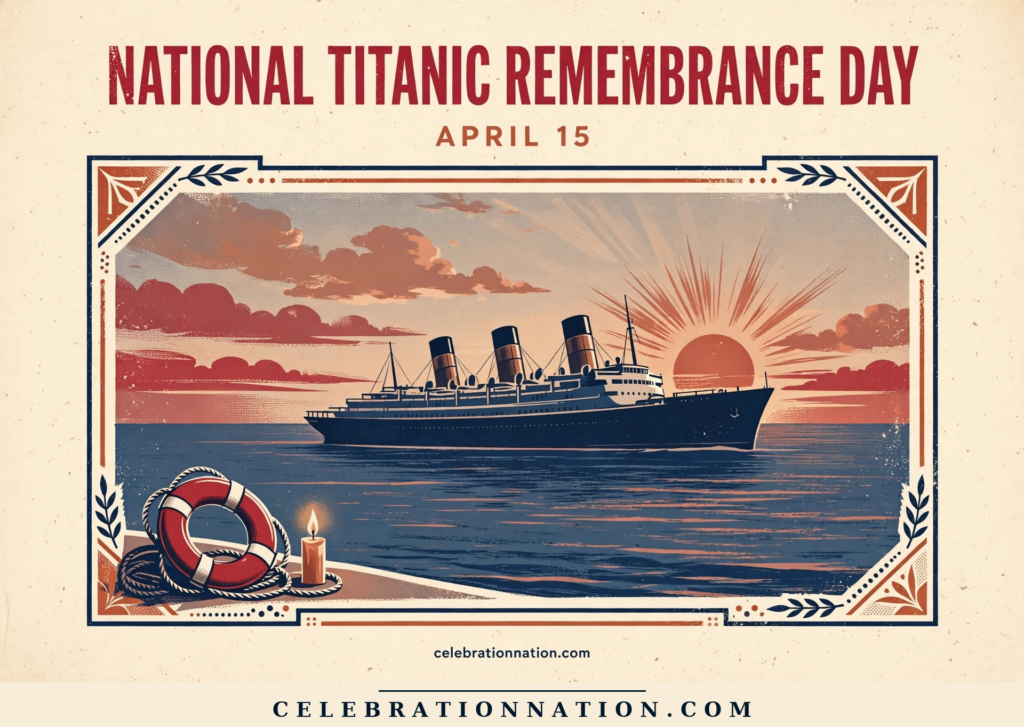
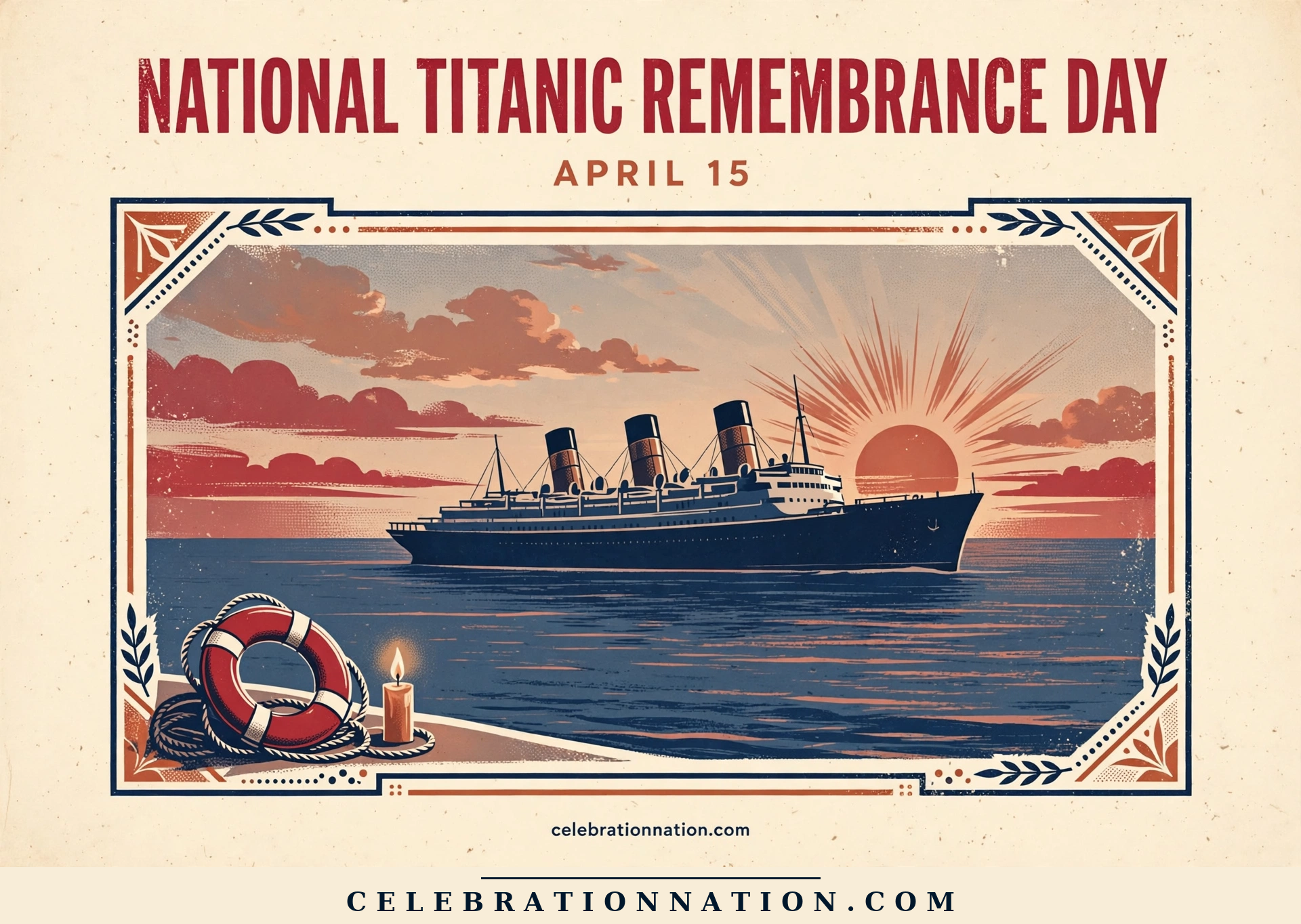
National Titanic Remembrance Day on April 15 marks the anniversary of the sinking of RMS Titanic in the early morning hours of April 15, 1912 — when the 'unsinkable' ship struck an iceberg in the North Atlantic and took 1,517 souls to their deaths. A day to remember the victims, honor the survivors, and reflect on one of the defining maritime disasters of the modern era.
- Vibe
- Solemn & Reflective
- Also on Apr 15
- Glazed Spiral Ham Day · Laundry Day · Rubber Eraser Day
- Hashtag
- #NationalTitanicRemembranceDay
Ways to celebrate
Remember, learn, reflect:
- 🚢 Visit a Titanic museum. Titanic: The Artifact Exhibition (Las Vegas), Titanic Museum Attraction (Pigeon Forge TN, Branson MO), or Titanic Belfast (Northern Ireland) for international travelers.
- 📚 Read Walter Lord's 'A Night to Remember.' The 1955 definitive historical account — built from interviews with ~60 surviving passengers. Still considered the best book written about the disaster.
- 🎬 Watch a Titanic film. 'A Night to Remember' (1958) is the historically accurate version; 'Titanic' (1997) is James Cameron's Oscar-winning dramatization. Both have their merits.
- 🕯️ Observe a moment of silence. At 2:20 AM Atlantic time (April 15), the hour the ship sank. Some maritime communities still mark the moment.
- 🌊 Visit a memorial. The Titanic Memorial in Washington DC (commissioned 1931, by Women's Titanic Memorial Committee). Halifax Fairview Lawn Cemetery has 121 Titanic graves.
Make it your kind of celebration
Family
Age-appropriate Titanic documentary night. Younger kids: 'Titanic: Adventure Out of Time' kid-friendly content. Older kids: 'A Night to Remember' historical film.
Kids
The Scholastic 'I Survived the Sinking of the Titanic' book (Lauren Tarshis, 2010) is age-appropriate historical fiction. Gateway reading for history-interested kids.
Couples
'A Night to Remember' (1958) + 'Titanic' (1997) back-to-back. Both are excellent; the 1958 film is historically rigorous, the 1997 film is emotionally gripping.
Office
Historical-reflection moment at a morning stand-up. Simple acknowledgment of the anniversary; reminds people to think about engineering ethics, safety, and responsibility.
School
Classic history/STEM cross-curricular lesson. Maritime engineering, iceberg science, class differences in 1912 society — a uniquely teachable disaster.
Community
Local historical society often has Titanic-related exhibits or talks in April. Many American small towns had residents who perished or survived.
Just me
Walter Lord's 'A Night to Remember' + a quiet evening. Meditative; extraordinarily well-written; one of the great American narrative histories.
Plan ahead
National Titanic Remembrance Day is observed on April 15 every year. Here is where it lands for the next ten years, handy for planners, marketers and party people.
Fast facts
The story
RMS Titanic was the largest moveable object in the world when it left Southampton on April 10, 1912, 882 feet long, 46,000 tons, four 62-foot funnels, swimming pool, Turkish bath, gymnasium, á la carte restaurant, post office. Built by Harland & Wolff in Belfast; owned by the White Star Line. Designed to be the pinnacle of Edwardian luxury. The crossing was Captain Edward Smith's retirement voyage, one last triumph before retirement.
Read the full story
At 11:40 PM on April 14, 1912, lookouts Frederick Fleet and Reginald Lee spotted an iceberg directly ahead. Captain Smith was not on the bridge; Officer William Murdoch ordered the ship to turn and reverse engines. The ship struck the iceberg, a glancing blow, below the waterline, that opened six of the forward compartments to the sea. The ship was designed to survive flooding in four. At 2:20 AM on April 15, Titanic broke apart and sank, 400 miles southeast of Newfoundland, 12,500 feet below the surface.
Of 2,224 people aboard, 706 survived. The class-based survival rates were devastating: first-class women survived at 97%; first-class men at 32%; third-class men at just 16%. Only 20 lifeboats were aboard, capacity ~1,178 people, less than half the 2,224 aboard. Many lifeboats launched half-full due to confusion and class segregation. The Carpathia arrived at 4:10 AM and picked up the survivors in freezing darkness. The SS Californian, closer, had shut down its wireless for the night.
The disaster transformed maritime law. The 1914 International Convention for the Safety of Life at Sea (SOLAS) required enough lifeboats for everyone aboard, mandatory lifeboat drills, 24-hour wireless watches, and an international ice patrol, still operating, still based in New London, Connecticut. Senate hearings in America led by Michigan Senator William Alden Smith produced over 1,000 pages of testimony transcripts. The wreck was lost for 73 years, until oceanographer Robert Ballard's 1985 Argo expedition located it. Dozens of expeditions since; the bow is slowly collapsing; the stern has largely disintegrated. The site was designated a UNESCO-protected maritime memorial in 2012.
What historians still debate 114 years later:
Six American connections to the disaster:
Did you know?
The ship's final position was miscalculated.
The distress call coordinates gave Titanic's sinking location. When Ballard's 1985 Argo expedition arrived at those coordinates, they found nothing. The wreck was eventually located 13 miles southeast, the original coordinates were based on dead-reckoning, slightly wrong, which is why search expeditions failed for 73 years.
Molly Brown wasn't called 'Unsinkable' until 1960.
Margaret Brown became the 'Unsinkable Molly Brown' in popular culture through Meredith Willson's 1960 Broadway musical (and the 1964 Debbie Reynolds film adaptation). Her contemporaries called her 'Maggie.' Pure Broadway mythmaking.
There was a 1912 film about Titanic, 29 days after the sinking.
The silent film 'Saved From the Titanic' premiered May 14, 1912. Starred actress Dorothy Gibson, an actual Titanic survivor, re-wearing the dress she'd worn that night. Only known print was destroyed in a 1914 film vault fire. One of the eeriest footnotes in film history.
There were only 3 Titanic survivors still living in 1997.
When James Cameron's 'Titanic' was released in 1997, only 3 of the 706 survivors were still alive, all of them 85+ years old, all only children at the time of sinking. The last survivor, Millvina Dean, died in 2009 at age 97.
Keep the party going
See the calendar


Celebrate every day, all year
Official gear from the people who track 1,700+ celebrations.
Browse the shop 2027 Wall + Desk Calendar BundleCelebrate every day at home and at work.
Never miss a reason to celebrate.
One quick morning email with today's celebrations, ideas and posters. Free, unsubscribe anytime.
🎉 You're on the list! Watch your inbox for The Daily Confetti.