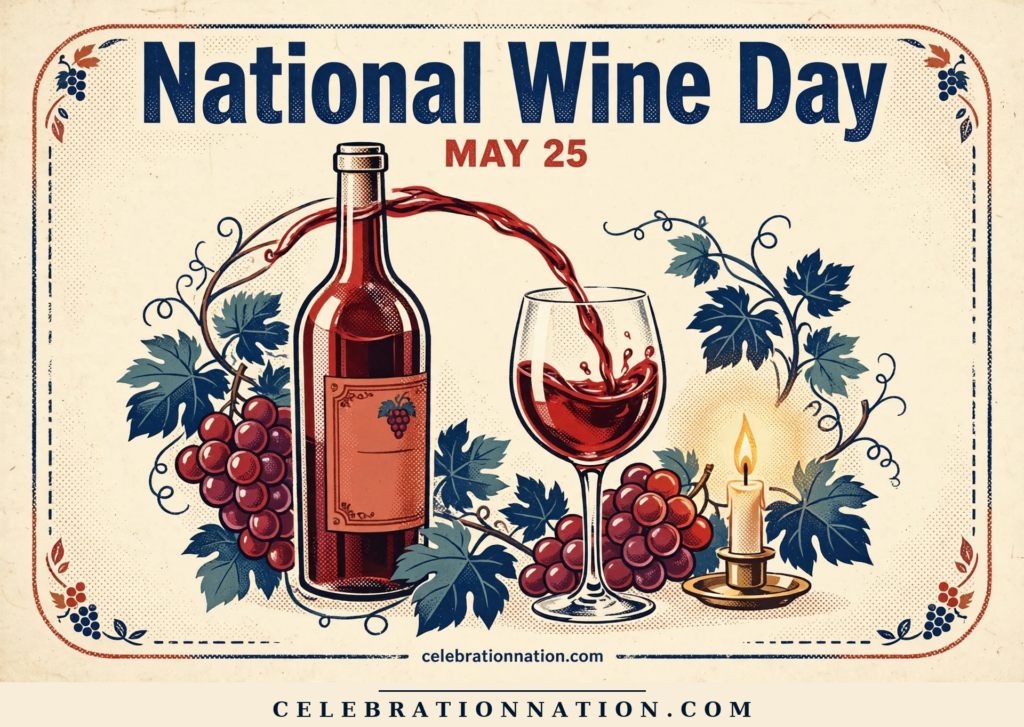
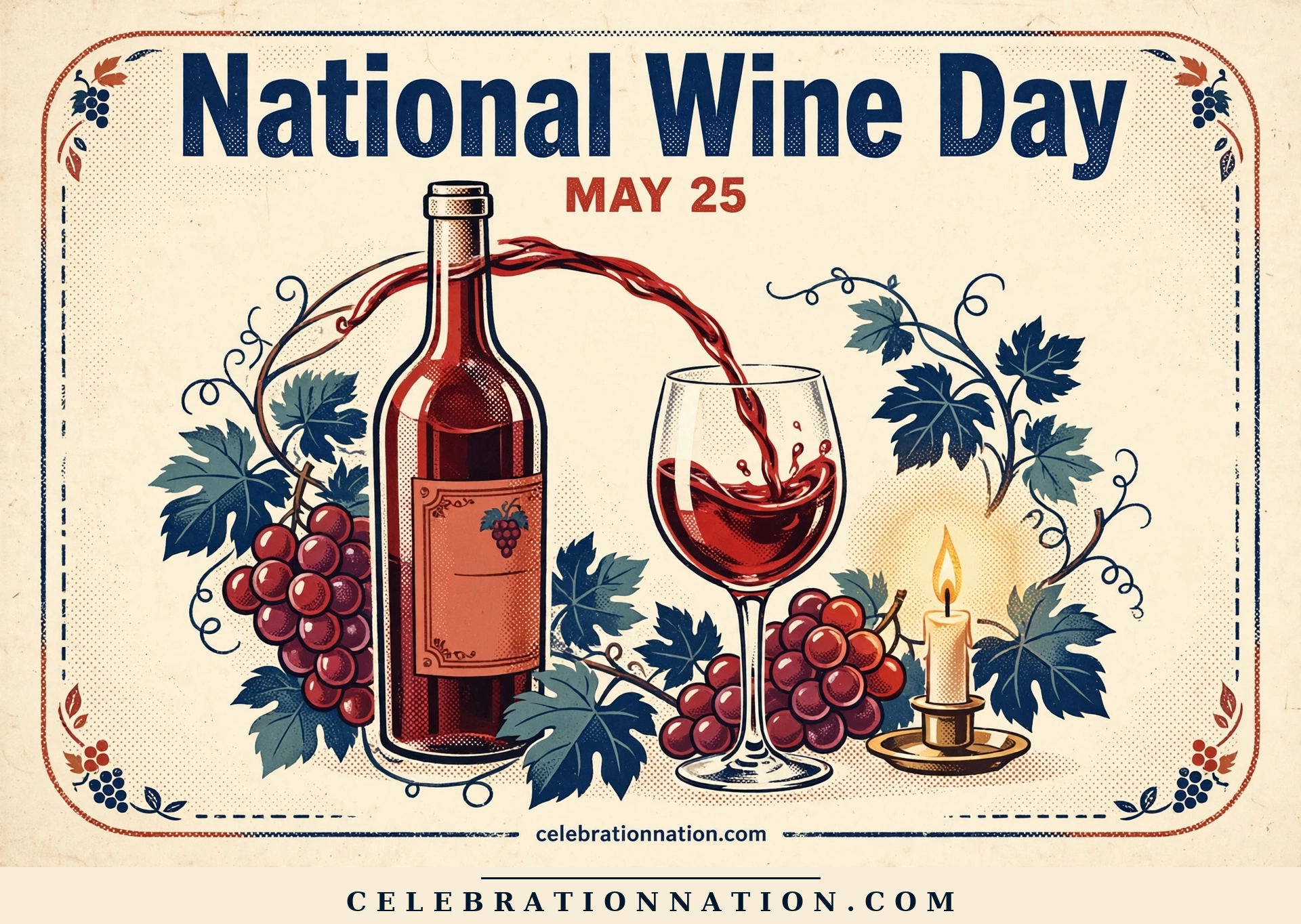
National Wine Day
One of humanity's oldest beverages, one of its most complicated pleasures. National Wine Day on May 25 is an excuse to uncork something decent, pour it for someone you like, and learn one new thing about what's in the glass.
- Roots
- The founder of this observance is unknown.
- Vibe
- Poured & Paused
- Also on May 25
- Geek Pride Day · International Plastic Free Day · Memorial Day
- Hashtag
- #NationalWineDay
Ways to celebrate
Find a decent bottle, pour with intention:
- 🍷 Try something new. A region or grape you've never had. Cabernet Franc instead of Cabernet Sauvignon. Chenin Blanc instead of Sauvignon Blanc.
- 🏪 Go to a real wine shop. Not a grocery store. Real wine shops have staff who will recommend $15-25 bottles that punch way above their price.
- 🍽️ Pair thoughtfully. Rich food = rich wine. Light food = light wine. Fat needs acid. That's 80% of pairing.
- 🥂 Decant it. Even a cheap red benefits from 30 minutes of air. Pour it in a pitcher; let it breathe.
- 👥 Share the bottle. Wine is a sharing beverage. Call a friend, split a bottle, eat something simple.
Make it your kind of celebration
Family
Older kids can do a "wine tasting" with grape juice, sparkling water, and different flavors. The mechanics of tasting — swirl, smell, sip — translate perfectly.
Kids
Teach kids that wine is an adult drink — not forbidden, not special, just adult. The cultures with the healthiest wine relationships (France, Italy) don't forbid it or glamorize it.
Couples
The classic couples pairing: cheese board, bottle of something new, candles. Saturday night; no phones. Surprisingly reliable.
Office
Wine-tasting team event at a local winery. Many host corporate events; better than a bar, more memorable.
School
Not for K-12. For college: wine education classes are unexpectedly useful. Teaches palate, focus, and hospitality skills that transfer to any career.
Community
A bottle share. Everyone brings one bottle from a new region to a potluck. Everyone tastes everything. Most fun wine night you can have.
Just me
A glass of something good. A book. 30 minutes. No phone. Wine was designed for this.
Plan ahead
National Wine Day is observed on May 25 every year. Here is where it lands for the next ten years, handy for planners, marketers and party people.
Fast facts
The story
Wine is older than most civilizations. Humans have been fermenting grapes since before writing.
Read the full story
The oldest evidence of winemaking comes from the modern-day Republic of Georgia not the American state, dated to around 6,000 BCE. Archaeologists found clay jars ("qvevri") with chemical traces of wine residue, 8,000 years old. Wine spread from there through the ancient world: Mesopotamia, Egypt, Greece, Rome. By the time Jesus turned water into wine, wine had already been a religious and social beverage for over 5,000 years.
Europe's wine regions crystallized during the Middle Ages. French monasteries, particularly the Cistercians and Benedictines, developed the techniques and classified the soil types (terroir) that still define French wine. Burgundy's Clos de Vougeot vineyard, established by Cistercians in 1110 CE, is still producing wine today. Bordeaux's classification system was formalized in 1855 and has changed remarkably little.
American wine is younger and still finding itself. California has made wine since Spanish missionaries arrived in the 1770s, but modern American wine really begins in the 1960s-70s. The 1976 "Judgment of Paris" a blind tasting in which California wines beat French ones, put American wine on the world map overnight. Today, California is one of the world's major wine-producing regions. Oregon, Washington, New York, and Virginia are serious secondary regions; every U.S. state now produces some wine.
National Wine Day on May 25 is a recent addition to the American calendar, promoted by wine industry groups since the early 2000s. It has no single founder. The idea is simple: one day to pay attention. One day to try something new. One day to notice that the glass in front of you is the end product of 8,000 years of human experimentation.
Four steps that turn a casual drink into paying attention:
Six U.S. regions producing world-class wine. Worth seeking out:
Did you know?
Wine was the only safe drink for centuries.
Before sanitation, water was often contaminated. Wine, beer, and cider were the only reliably safe beverages in much of Europe. Medieval peasants drank them constantly, and lived.
The 1976 Judgment of Paris changed everything.
Steven Spurrier, an English wine shop owner, organized a blind tasting in Paris. California Chardonnays and Cabernets beat Bordeaux and Burgundy. Ended French wine's centuries-long assumed supremacy overnight.
A bottle contains ~750ml for good reason.
The size of a glassblower's single breath. Industry standard since the 1800s. Produces about 5 glasses of wine. Universally accepted across all wine-producing countries.
The oldest bottle of wine still drinkable: 1,700 years.
The Speyer wine bottle, dating to ~325 CE, was discovered in a Roman sarcophagus in Germany. Still liquid, though sealed by olive oil and wax. Never opened to preserve it.
Keep the party going
See the calendar
Celebrate every day, all year
Official gear from the people who track 1,700+ celebrations.
Browse the shop National Wine Day stemless glasses (set of 2)Shatterproof 16 oz glasses for your next toast.
Never miss a reason to celebrate.
One quick morning email with today's celebrations, ideas and posters. Free, unsubscribe anytime.
🎉 You're on the list! Watch your inbox for The Daily Confetti.