
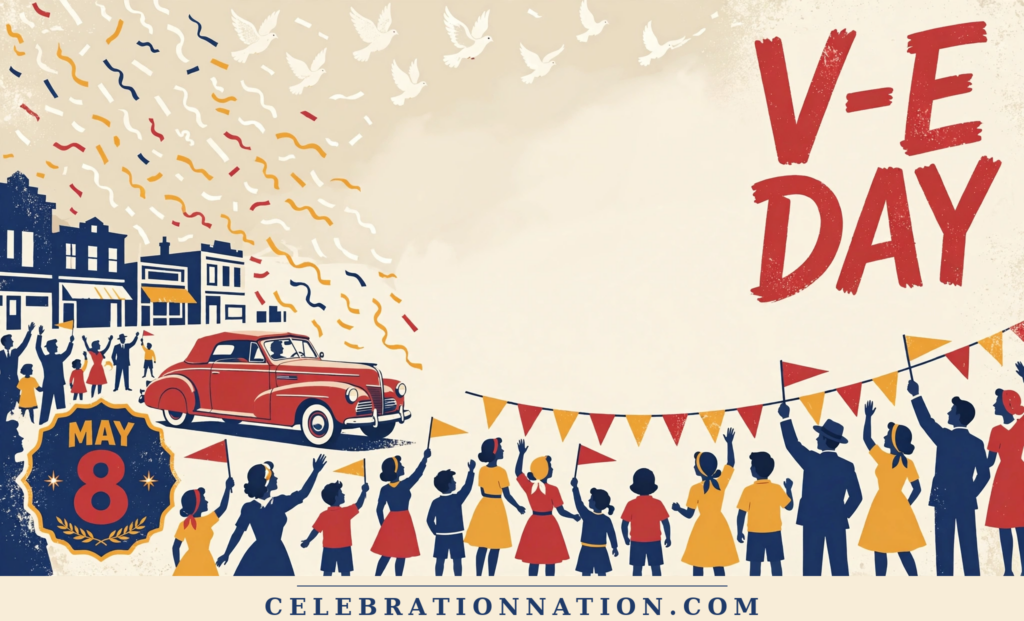
V-E Day
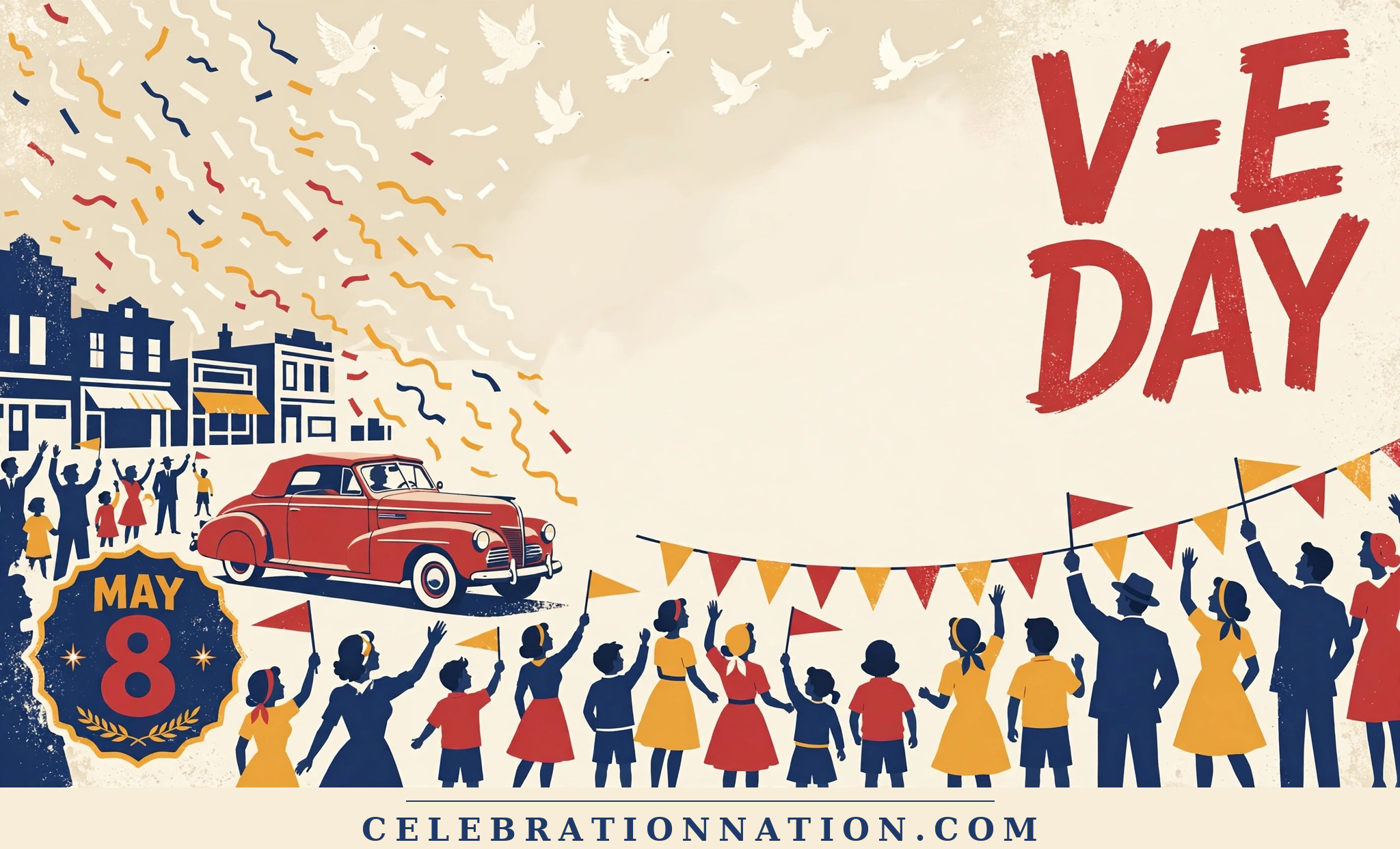
V-E Day (Victory in Europe Day) on May 8 marks the unconditional surrender of Nazi Germany in 1945 — the end of Europe's deadliest conflict and a date celebrated worldwide as the symbolic end of one of history's darkest chapters. While not a federal US holiday, V-E Day is observed across NATO countries with parades, moments of silence, and a deep remembrance of the 50+ million who died.
- Vibe
- Solemn Remembrance
- Hashtag
- #VEDay
Ways to celebrate
Remember and honor:
- 🕊️ Moment of silence. At 11 AM on May 8 (per UK tradition), observe a silent minute for the war dead. Remembrance is the central V-E Day practice.
- 🎬 Watch 'Band of Brothers' or 'The Pacific.' HBO miniseries on WWII; widely considered definitive. Churchill's speeches on YouTube.
- 🏛️ Visit a WWII memorial. National WWII Memorial (Washington DC), National Holocaust Museum, USS Arizona Memorial, any veterans' memorial park.
- 📖 Read a WWII history. Antony Beevor's 'The Second World War' or Anthony Doerr's novel 'All the Light We Cannot See.' Both outstanding.
- 🎖️ Thank a veteran. If you know a WWII vet (fewer each year) or someone who served in any war, call them.
Fast facts
The story
V-E Day commemorates May 8, 1945, the formal unconditional surrender of Nazi Germany to the Allied forces. The surrender was actually signed at 2:41 AM on May 7 in Reims, France, by General Alfred Jodl on behalf of the German High Command. The ratification occurred in Berlin on May 8. Because of time-zone differences, the Soviet Union observed the surrender on May 9, which is why Russia celebrates Victory Day on May 9, not May 8. But for the Western Allies, the US, UK, France, Canada, May 8 became V-E Day.
Read the full story
The war that ended on V-E Day had killed an estimated 40-50 million people in Europe alone (another 20-30 million died in the Pacific theater before Japan surrendered on September 2, 1945). The Holocaust, the systematic murder of six million Jews plus millions of Roma, disabled, and political prisoners, had been one of the gravest human catastrophes in history. The war had displaced hundreds of millions; destroyed most of Europe's major cities; ended colonial empires; created the United Nations. Its end was an event of cosmic significance.
V-E Day celebrations across Allied nations were enormous. In London, Winston Churchill addressed crowds from a Whitehall balcony: "In all our long history, we have never seen a greater day than this." King George VI made a BBC broadcast. Millions filled Trafalgar Square, Piccadilly Circus, and streets across Britain. In New York's Times Square, 500,000+ people celebrated. The famous Alfred Eisenstaedt photograph of a sailor kissing a nurse, published in Life magazine, captures the emotional explosion. In Paris, the liberated city celebrated with the flag of France flying from the Eiffel Tower.
V-E Day observation today is mixed across the Allied nations. The UK observes it with royal moments of silence, war-memorial ceremonies, and heritage commemoration. Russia's Victory Day (May 9) features the world's largest military parade in Moscow's Red Square. France observes 'Fête de la Victoire 1945.' The US does not observe V-E Day as a federal holiday, WWII veterans' memorial is marked by Memorial Day (last Monday of May) and Veterans Day (November 11). But the date's significance is universal: eight decades ago, one of humanity's darkest chapters ended. May 8 is the day we remember.
Images burned into 20th-century memory:
How different countries observe May 8:
Did you know?
The Holocaust killed 6 million Jews + 5 million others.
The Nazi systematic genocide killed approximately 6 million Jews plus another 5 million, Roma, disabled people, LGBTQ+ individuals, political prisoners, Slavic civilians. Total: ~11 million deliberate deaths. A cataclysm of scale human history had never seen.
The US never declared war on Germany, Germany declared on us.
After Pearl Harbor (December 7, 1941), the US declared war on Japan. Hitler then declared war on the United States on December 11, 1941. The US 'war on Germany' was a response to that declaration.
Churchill's 'Iron Curtain' speech came 10 months later.
On March 5, 1946, 10 months after V-E Day, Churchill gave his famous 'Iron Curtain' speech in Fulton, Missouri. It marked the cultural beginning of the Cold War. V-E Day's victory was already becoming complicated.
Eisenhower became US president 8 years later.
Supreme Allied Commander Dwight D. Eisenhower accepted the German surrender on behalf of the Allies in Reims. He became US President (1953-1961). The man who accepted the German surrender became one of the most consequential US leaders of the 20th century.
Coming up next
See the calendar
Celebrate every day, all year
Official gear from the people who track 1,700+ celebrations.
Browse the shop 2027 National Day Wall CalendarGet the 2026 edition free. 1,700+ observances.Shop now
Never miss a reason to celebrate.
One quick morning email with today's celebrations, ideas and posters. Free, unsubscribe anytime.
🎉 You're on the list! Watch your inbox for The Daily Confetti.