


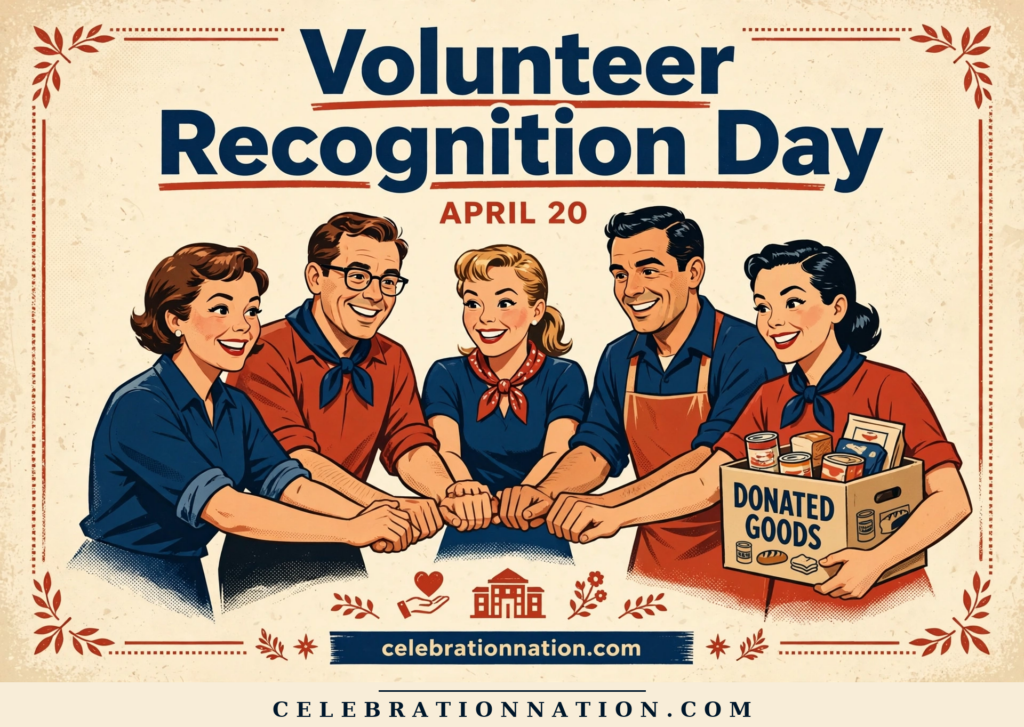
Volunteer Recognition Day
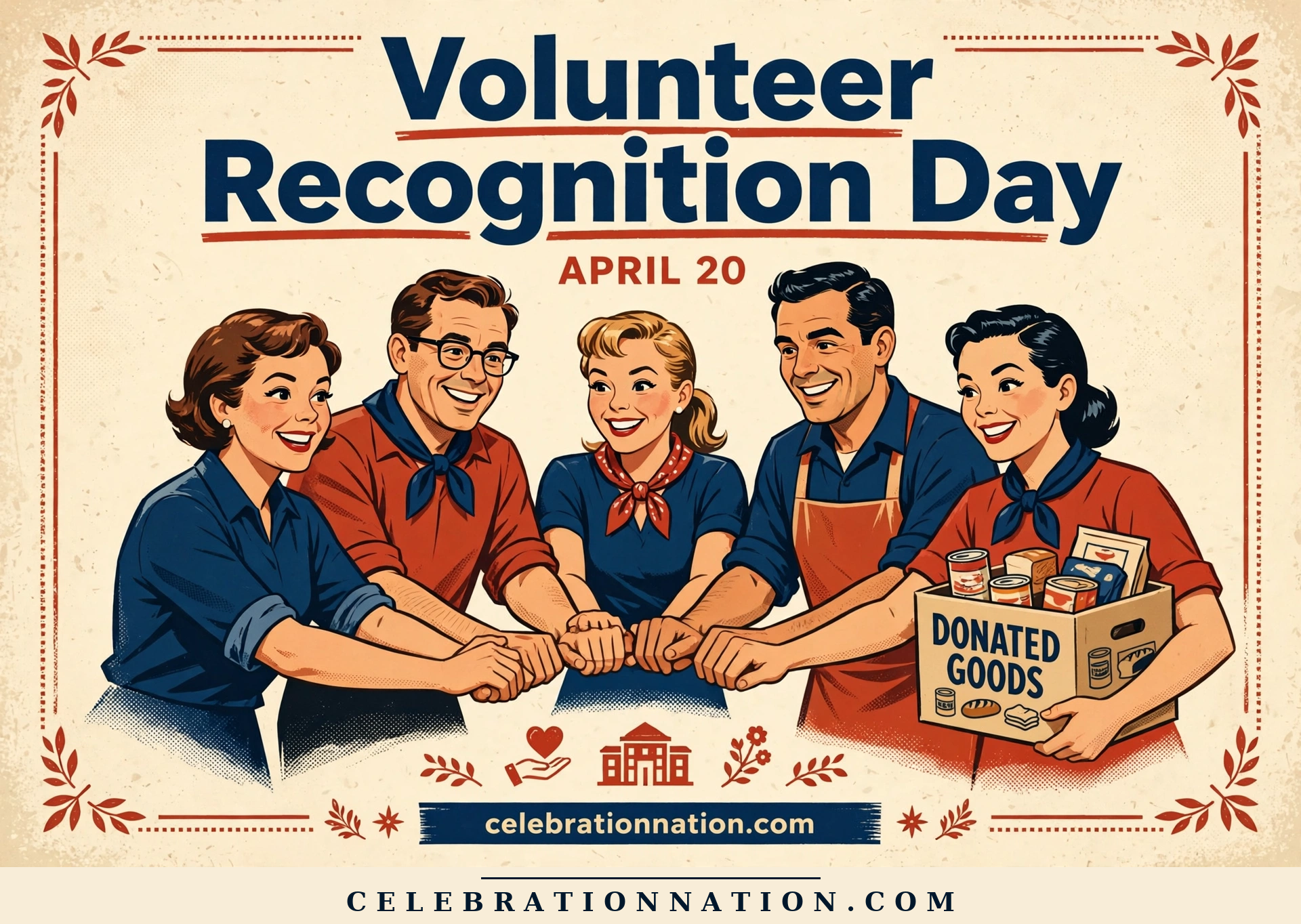
Volunteer Recognition Day on April 20 honors the 60 million Americans who give their time — collectively 7 billion hours a year — to the nonprofits, schools, food banks, sports leagues, animal shelters, hospitals, and civic organizations that literally run the country. Paid work gets the press. Volunteers get things done.
- Vibe
- Gratitude & Purpose
- Also on Apr 20
- Chinese Language Day · 420 Day · Cheddar Fries Day
- Hashtag
- #VolunteerRecognitionDay
Ways to celebrate
Recognize. Thank. Or become one:
- 🙏 Thank your volunteers. By name, specifically, for what they actually did. A handwritten note beats a generic email. A public mention beats a private one.
- 🏆 Nominate someone for a formal award. Many nonprofits, city councils, and states give annual Volunteer of the Year awards. Nominating someone = free, but transformative for the volunteer.
- 🤝 Sign up yourself. VolunteerMatch.org, AmeriCorps.gov, or your local United Way lists hundreds of opportunities. Start with 2 hours. Most volunteers keep going.
- 🍕 Feed them. Pizza for a volunteer night. A catered lunch at their monthly meeting. Food is love.
- 🎓 Sponsor training. Many great volunteer roles require certification (CPR, lifeguarding, coaching). Paying for training = a gift that multiplies.
Make it your kind of celebration
Family
Family volunteer day — food bank shift, park cleanup, shelter dog walk. Volunteering together teaches kids more than a dozen lectures about civic responsibility.
Kids
Youth-friendly volunteering: pet shelter visits, greeting-card drives for veterans, park cleanups. Age 7+ can contribute meaningfully.
Couples
Couple-volunteering is wildly underrated. Habitat for Humanity, animal shelter, community garden — shared time for a shared purpose.
Office
Corporate volunteer day: VTO (volunteer time off) policies are becoming standard. 8 paid hours a year to volunteer is now expected by employees under 30.
School
Recognize student volunteers at assembly. Many high-impact scholarships now require 50-100+ hours of community service — validation matters.
Community
Organize a public Volunteer Recognition event. Certificates, food, short speeches, handshakes. Costs $200; means everything to the volunteers named.
Just me
Pick ONE person who does thankless volunteer work in your orbit. Write them a handwritten note. That's enough.
Plan ahead
Volunteer Recognition Day is observed on April 20 every year. Here is where it lands for the next ten years, handy for planners, marketers and party people.
Fast facts
The story
Americans volunteer more than any other nation on Earth. 60 million Americans, about 25% of adults, formally volunteer each year. Informal neighbor-to-neighbor help pushes the number past 75%. This is extraordinary. In most European countries, formal volunteer rates are under 15%. In the US, volunteering is a cultural norm.
Read the full story
The tradition is old. Alexis de Tocqueville, touring America in 1831, was astonished by the density of 'voluntary associations', churches, charity groups, mutual aid societies, civic clubs. He concluded that these voluntary associations were the foundation of American democracy. Two centuries later, that's still true.
National volunteer recognition has roots in the 1970s. President Nixon proclaimed the first National Volunteer Week in 1974, a full week in April dedicated to recognizing the country's volunteers. Every president since has proclaimed it. Volunteer Recognition Day (April 20) falls within National Volunteer Week and is the single most-intense day of recognition events.
Modern American volunteering has shifted. Religious-congregation volunteering is slowly declining. Informal and digital volunteering is rising. Episodic volunteering (one-day events) is up; long-term weekly commitments are down. But the core reality persists: tens of millions of Americans still show up, clock zero hours for their paid jobs, and keep schools, shelters, food pantries, sports leagues, and nonprofits running. The country would be unrecognizable without them.
Four categories that account for 80% of American volunteer hours:
Six iconic American organizations that depend entirely on volunteers:
Did you know?
The average American volunteer gives 50 hours per year.
From 2019 Corporation for National and Community Service data. That's about 1 hour a week. Taken across 60 million Americans, it adds up to ~7 billion volunteer-hours annually.
Utah is the most-volunteering state.
51% of Utah adults formally volunteer annually, far ahead of the national 25%. Often attributed to the Latter-day Saints tradition of congregational service, which heavily values time-donation.
George H.W. Bush called them '1,000 Points of Light.'
Bush's 1988 inaugural address. The 'Points of Light' Foundation (still active today) grew from the speech; it's become one of the leading American volunteer-recognition organizations.
Volunteer work is worth $32/hour.
Independent Sector, the main sector research org, updates this value annually based on wage data. At $32/hour, the ~7 billion annual volunteer hours represent $224 billion of donated labor, bigger than many countries' entire economies.
Keep the party going
See the calendar
Celebrate every day, all year
Official gear from the people who track 1,700+ celebrations.
Browse the shop 2027 National Day Wall CalendarGet the 2026 edition free. 1,700+ observances.
Never miss a reason to celebrate.
One quick morning email with today's celebrations, ideas and posters. Free, unsubscribe anytime.
🎉 You're on the list! Watch your inbox for The Daily Confetti.