





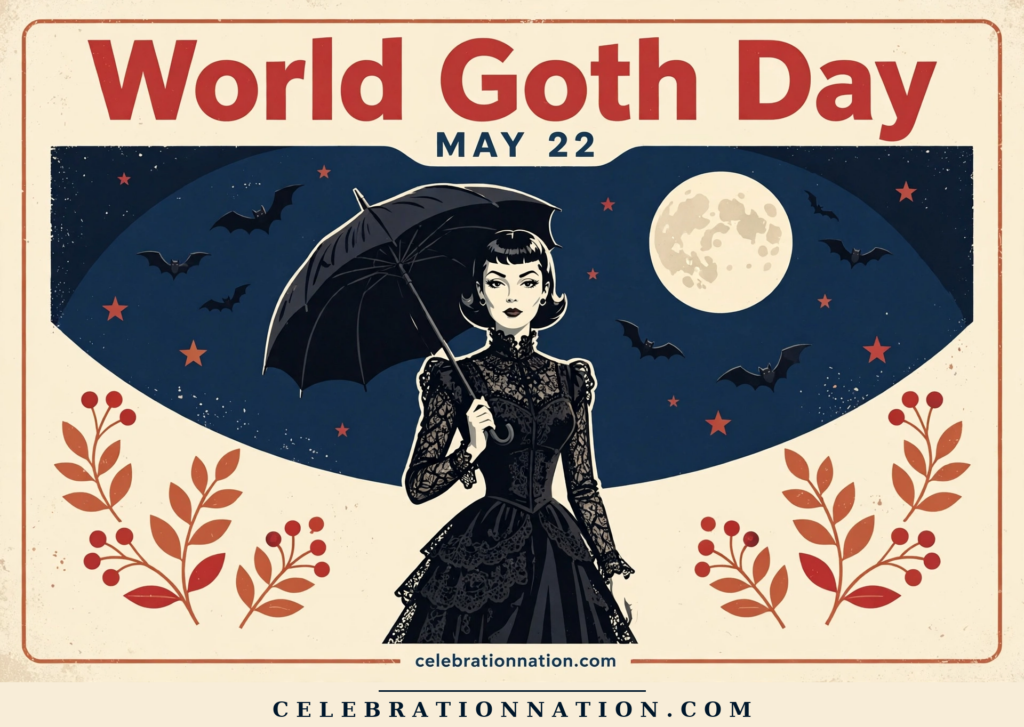
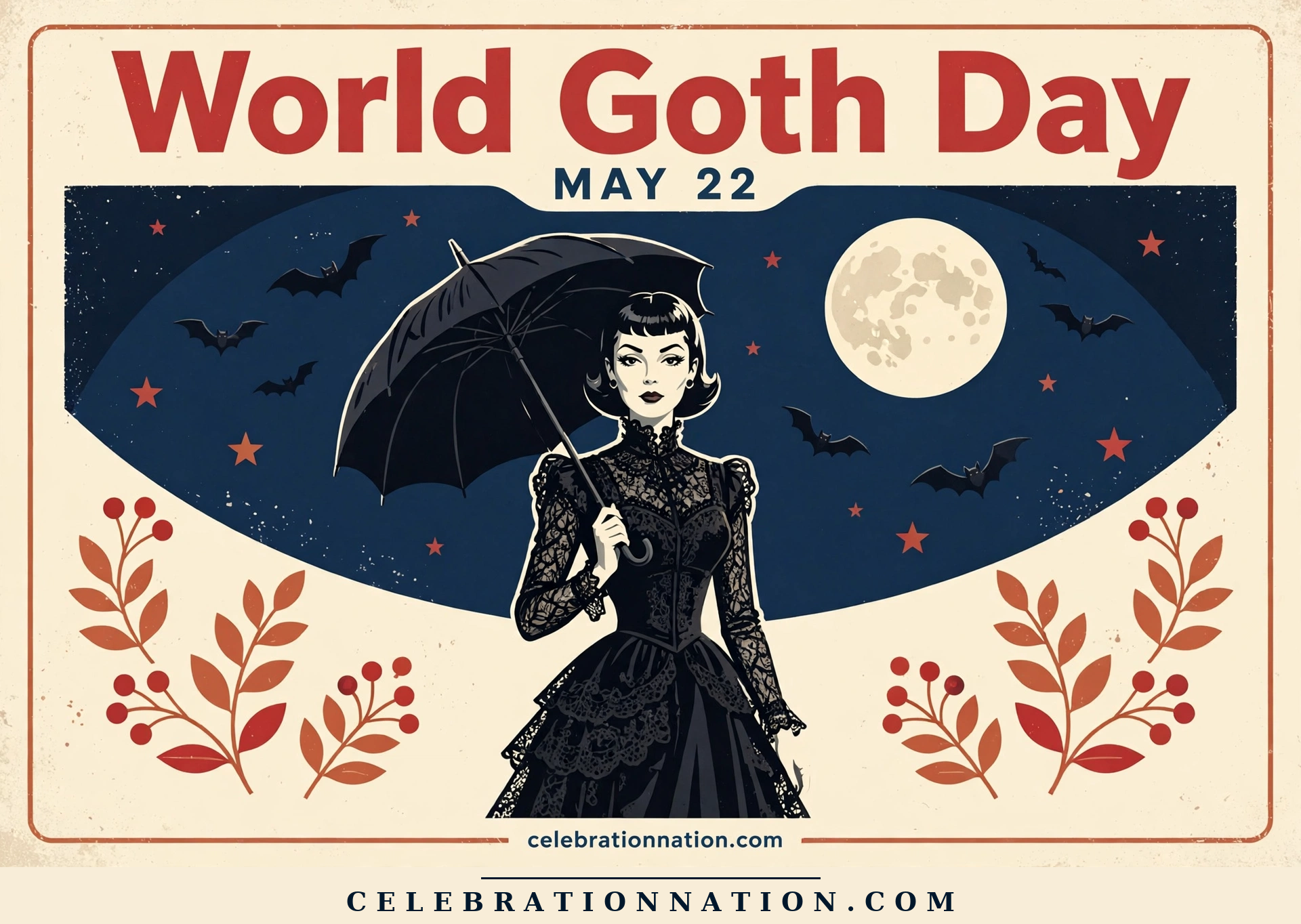
World Goth Day
World Goth Day on May 22 celebrates the cultural subculture that emerged from late-1970s British post-punk — a music scene, a fashion, a literature, and a worldview built around darkness, beauty, melancholy, and theatricality. From Bauhaus's 1979 'Bela Lugosi's Dead' to modern Bloodwitch and Molchat Doma, goth has persisted 45+ years as one of Earth's most enduring subcultures.
- Vibe
- Dark & Romantic
- Also on May 22
- International Day for Biological Diversity · Buy a Musical Instrument Day · Craft Distillery Day
- Hashtag
- #WorldGothDay
Ways to celebrate
Listen, dress, brood:
- 🎵 Make a goth playlist. Start with Bauhaus's 'Bela Lugosi's Dead.' Add Siouxsie, The Cure, Joy Division. Essential foundation.
- 👗 Wear black. Black lipstick optional. Goth fashion is about aesthetic, not costume. Own it.
- 📖 Read Gothic literature. Mary Shelley's 'Frankenstein,' Bram Stoker's 'Dracula,' Edgar Allan Poe, Anne Rice. The original goth aesthetic.
- 🎬 Watch 'The Crow' (1994) or 'Interview with the Vampire' (1994). Peak 90s goth cinema.
- 🌹 Attend a goth night. Most major cities have monthly goth/dark wave DJ nights. Leipzig's Wave-Gotik-Treffen (late May) is the global pilgrimage.
Make it your kind of celebration
Family
Younger family members often explore goth in their teenage years — a genuine subculture, not just a phase. Engage thoughtfully.
Kids
Goth-curious kids can be introduced to age-appropriate work — Tim Burton films, Edward Gorey illustrations, Lemony Snicket books.
Couples
Couples-goth night at a local dark wave club. Dress up. Dance to The Cure. It's genuinely fun.
Office
Not a traditional office observance. But if your office has a goth, acknowledge their day. Extend compassion.
School
Goth subculture is a legitimate study in sociology and music history. It's been an academic topic since the 1990s.
Community
Most major cities have monthly goth DJ nights. Memorial Day weekend coincides — many cities hold special events.
Just me
Put on The Cure's 'Disintegration.' Light a candle. Read 'Frankenstein.' Solitude is goth's natural state.
Plan ahead
World Goth Day is observed on May 22 every year. Here is where it lands for the next ten years, handy for planners, marketers and party people.
Fast facts
The story
Goth subculture emerged from British post-punk in 1979-1980. The most-cited origin point is Bauhaus's 9-minute song 'Bela Lugosi's Dead' (August 1979), a slow, atmospheric, literally-about-a-vampire track that defined gothic rock's sound. Bands like Siouxsie and the Banshees (whose 1978 'The Scream' album had gothic elements), Joy Division, The Cure (1979 'Three Imaginary Boys'), and Sisters of Mercy (1980-1981) crystallized the genre. By 1981, gothic rock was a distinct genre; by 1985, it was a global subculture.
Read the full story
The 'gothic' in gothic rock referenced Gothic literature, the 18th-and-19th-century tradition of Mary Shelley, Edgar Allan Poe, Bram Stoker, and Emily Brontë. Gothic literature dealt with darkness, supernatural, Romantic themes of death and beauty. Gothic rock borrowed those themes; gothic fashion borrowed Victorian-era black mourning clothes. The connection to medieval 'Gothic' architecture, cathedrals, pointed arches, dark stained glass, was aesthetic rather than direct, but powerful.
Goth fashion crystallized in the 1980s. Key elements: black clothing (often Victorian-inspired or romantic), pale skin makeup, black lipstick, heavy eyeliner, black hair (often dyed), silver jewelry (often with skull or cross motifs), Doc Martens or platform boots. The Batcave, London (1982-85), was the iconic goth nightclub, attended by Siouxsie, Robert Smith, and Bauhaus's Peter Murphy. By the 1990s, goth had diversified into subgenres: deathrock (American), darkwave (German), ethereal wave (atmospheric), gothic metal, and more.
World Goth Day was established in 2009 by a DJ at BBC Radio 6 Music, Cruel Britannia's Martin Oldgoth, as a celebration of the subculture. It's since become globally observed. Germany's Wave-Gotik-Treffen (WGT) in Leipzig, running since 1992, is the world's largest goth festival, drawing 20,000+ attendees annually in late May. Whitby Gothic Weekend (Whitby, UK) is the British equivalent. The American version is more diffuse, many cities have monthly goth nights but no single national festival. Goth persists, a genuine cultural continuity across nearly five decades, into every generation's teenage dark-romantic impulse.
Essential listening for any goth initiation:
Where the dark wave rolls:
Did you know?
Siouxsie Sioux defined goth makeup.
Susan Janet Ballion (Siouxsie Sioux) became goth's style icon, pale face, heavy black eye makeup, dark lipstick, backcombed black hair. Every goth makeup tutorial on YouTube references her 1980s looks.
Robert Smith's hair is trademarkable.
The Cure's Robert Smith has a specific trademarked hairstyle, backcombed, messy, distinctive. His red lipstick and hair are instantly recognizable. A rare case of a subculture icon crystallizing into a visual brand.
The Cure's 'Friday I'm in Love' is technically goth.
A goth band wrote one of the most cheerful pop songs of the 1990s. Proves goth isn't required to be somber; the best goth music is often emotionally nuanced. A reminder: goth is an aesthetic, not a personality.
Goth was named by journalists, not goths.
Early members of the subculture didn't call themselves 'goth.' Music journalists Hugh Fielder and Dave Thompson coined the term around 1980. Goths adopted the label eventually. A case of the outside-in naming.
Keep the party going
See the calendar


Celebrate every day, all year
Official gear from the people who track 1,700+ celebrations.
Browse the shop 2027 Wall + Desk Calendar BundleCelebrate every day at home and at work.
Never miss a reason to celebrate.
One quick morning email with today's celebrations, ideas and posters. Free, unsubscribe anytime.
🎉 You're on the list! Watch your inbox for The Daily Confetti.