





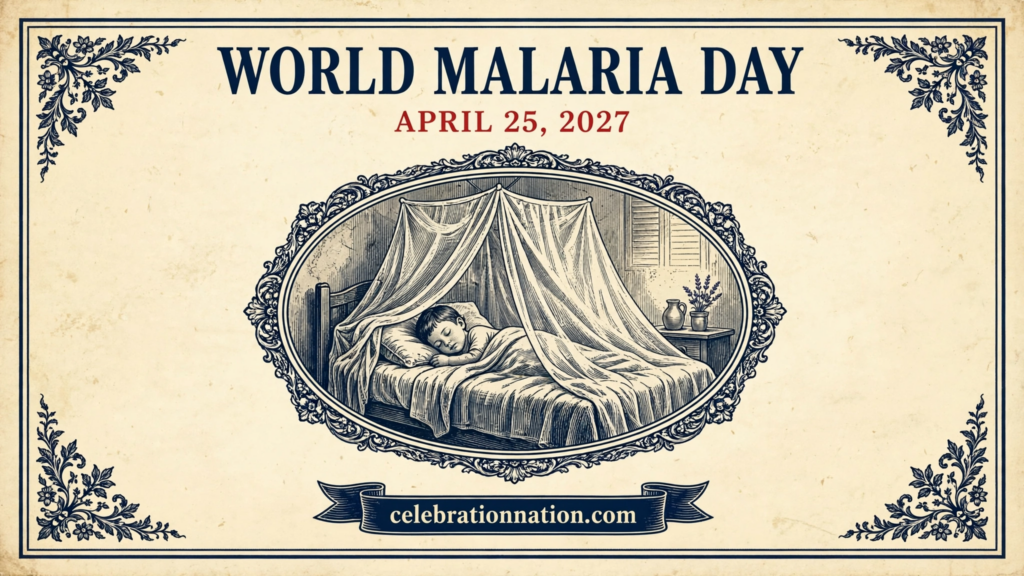
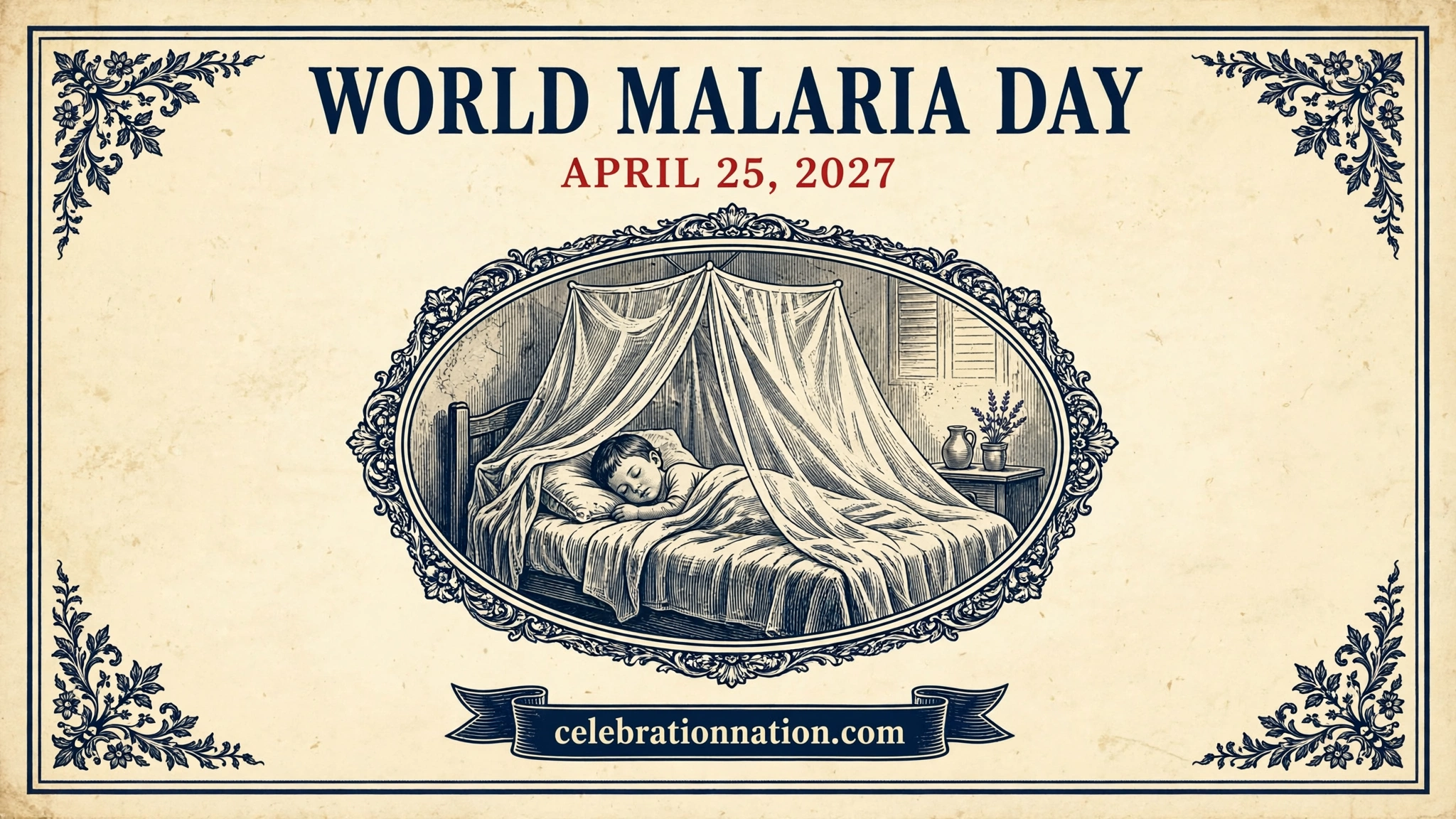
World Malaria Day
Every year on April 25, the world stands with the families malaria touches. World Malaria Day is the World Health Organization's annual call to finish the fight against a preventable and treatable disease that still claims hundreds of thousands of lives each year, most of them young children in Africa. It is part memorial, part milestone, and part mobilization, a day to measure how far the fight has come and to recommit to ending it. Behind every statistic is a family, and behind every family, a community refusing to give up. This is a day for clear eyes and full hearts: the losses are real, and so is the path to ending them. Take a breath, learn the facts, and join the millions working toward zero.
- Also on Apr 25
- World Penguin Day · Parental Alienation Day · World Veterinary Day
- Hashtag
- #WorldMalariaDay
WORLD MALARIA DAY
Every year on April 25, the world stands with the families malaria touches. World Malaria Day is the World Health Organization’s annual call to finish the fight against a preventable and treatable disease that still claims hundreds of thousands of lives each year, most of them young children in Africa. It is part memorial, part milestone, and part mobilization, a day to measure how far the fight has come and to recommit to ending it. Behind every statistic is a family, and behind every family, a community refusing to give up. This is a day for clear eyes and full hearts: the losses are real, and so is the path to ending them. Take a breath, learn the facts, and join the millions working toward zero.
The day was instituted by WHO Member States during the World Health Assembly in 2007, giving the global malaria effort a fixed annual moment of reckoning. Each April 25 since, governments, health workers, researchers, donors, and affected communities have taken stock together: the progress made, the ground lost, the funding gaps, and the innovations on the horizon. In a fight measured in decades, the day provides the yearly pulse check the world needs. A fixed date on the calendar keeps the world’s attention from drifting, year after year, no matter what else competes for it. Anniversaries focus the mind, and this fight needs focused minds.
The numbers explain the urgency. In 2023, there were an estimated 263 million malaria cases across 83 countries, and 597,000 deaths, according to the WHO’s 2024 World Malaria Report. The WHO African Region carries 94 percent of cases and 95 percent of deaths, and the disease still claims roughly one life every minute. Children under five and pregnant women face the greatest danger, because without prompt diagnosis and treatment, malaria can turn severe with terrifying speed. Each death represents a preventable tragedy, which is what makes the numbers so hard to sit with. A disease this preventable should not still be taking a life every minute. Behind every number is a name, a family, and a village that will never be the same.
There is real hope in the record. After the global community recommitted to malaria control in the late 1990s, an estimated 2.2 billion cases and 12.7 million deaths were prevented over the following two decades, one of the great quiet triumphs of modern public health. But after years of steady declines, progress has stalled. Extreme weather, conflict, humanitarian emergencies, and economic pressure are disrupting control efforts, and tens of millions of people now face limited access to the prevention, diagnosis, and treatment they need. The hard-won gains of recent decades are genuinely at risk. Those prevented cases are children who grew up, mothers who survived pregnancy, and villages that stayed whole, which is exactly what is at stake. Those are not abstract numbers; they are birthdays, graduations, and harvests. Losing momentum now would waste one of public health’s greatest victories.
Yet the tools to end malaria exist, and they keep improving: insecticide-treated bed nets, rapid diagnostic tests, effective artemisinin-based medicines, and new vaccines, joined by a global strategy, adopted in 2015 and updated in 2021, that aims to cut malaria incidence and deaths by at least 90 percent compared to 2015 and to eliminate the disease in at least 35 more countries by 2030. The 2025 campaign, “Malaria Ends With Us: Reinvest, Reimagine, Reignite,” led by WHO alongside the RBM Partnership to End Malaria, asked every level of society, from global policy to community action, to rejoin the fight. On April 25, 2027, that invitation still stands, and the destination remains the same: zero malaria. Elimination is no longer a fantasy; country after country is proving it can be done. The end of malaria is a matter of will and funding, not science fiction.
THE STORY BEHIND WORLD MALARIA DAY
🦗 A Tiny Mosquito, A Heavy Toll
Malaria is caused by parasites spread through the bites of infected mosquitoes. Without prompt diagnosis and treatment, it can progress to severe illness quickly, which is why children under five face the greatest danger. It is a disease of poverty and proximity, thriving where health systems are thinnest. Bed nets, the simplest defense, remain one of the most cost-effective health interventions ever devised. Hanging a net is a small act with an enormous return. In many villages, net distribution days are community celebrations in their own right.
📅 A Day Decreed in 2007
WHO Member States instituted World Malaria Day during the 2007 World Health Assembly. Every April 25 since, the world has paused to measure the fight against malaria, to honor the health workers on its front lines, and to recommit to winning it. The Assembly’s decision gave advocates, donors, and journalists a yearly hook for a story that never stops mattering. Rituals of remembrance keep urgent causes from fading into background noise.
📊 The Fight in Numbers
In 2023: 263 million cases, 597,000 deaths, with the African Region bearing 94 percent of cases and 95 percent of deaths. Since 2000, global efforts have prevented 2.2 billion cases and 12.7 million deaths. The progress is real, and so is the stall, which is why the day matters more, not less. Behind the stall are real pressures: conflict, climate shocks, and funding shortfalls that demand answers, not shrugs. Naming the obstacles honestly is how the movement plans to clear them.
🎯 The 2030 Goal
WHO’s global malaria strategy aims to reduce malaria cases and deaths by at least 90 percent versus 2015 levels, to eliminate malaria in at least 35 more countries by 2030, and to prevent re-establishment where it has been beaten. Countries are still joining the push: Egypt became the third country in its region to be certified malaria-free in 2024. Zero malaria is the stated destination, and the map keeps proving it is reachable. Every newly certified country lights the way for the next. The list of certified countries grows a little longer with each passing year.
WAYS TO CELEBRATE
📖 Learn the Signs
At home: Learn malaria’s symptoms, fever, chills, and headache, and why fast diagnosis and treatment matter so much. Understanding the disease is the first step to respecting the fight against it, and to recognizing how much the world’s health workers carry. Share what you learn; most people have no idea how close the world is to winning. Knowledge is contagious in the best possible way.
🤝 Fund a Net
In the community: A single insecticide-treated bed net protects a whole family while they sleep, and it costs less than a takeout dinner. Donate to a reputable malaria program, join a fundraiser, or organize one at your school, workplace, or place of worship. Rally coworkers or classmates around a team goal and watch small gifts add up to real protection. A classroom that funds ten nets has changed ten families’ nights. Challenge another class or team to match your total.
📢 Share the Facts
With friends: Post the numbers, the progress, and the goal. Most people do not know malaria still takes roughly a life every minute, or that 2.2 billion cases have been prevented since 2000. Awareness is what turns a distant statistic into a shared cause. Pair the numbers with the hope: progress is real, and the finish line is in sight. Hope, backed by data, is the most persuasive argument there is.
Celebrate World Malaria Day
On April 25, remember the lives already lost, honor the health workers still fighting through conflict and storm to reach the next village, and add your voice to the goal the whole world shares: zero malaria, in our lifetime. Zero malaria is not a dream; it is a target the world has set for itself, and every April 25 brings it closer. Stand with the families, fund the fight, and share the story.
Plan ahead
World Malaria Day is observed on April 25 every year. Here is where it lands for the next ten years, handy for planners, marketers and party people.
Keep the party going
See the calendar



Celebrate every day, all year
Official gear from the people who track 1,700+ celebrations.
Browse the shop 2027 National Day Wall CalendarGet the 2026 edition free. 1,700+ observances.
Never miss a reason to celebrate.
One quick morning email with today's celebrations, ideas and posters. Free, unsubscribe anytime.
🎉 You're on the list! Watch your inbox for The Daily Confetti.