




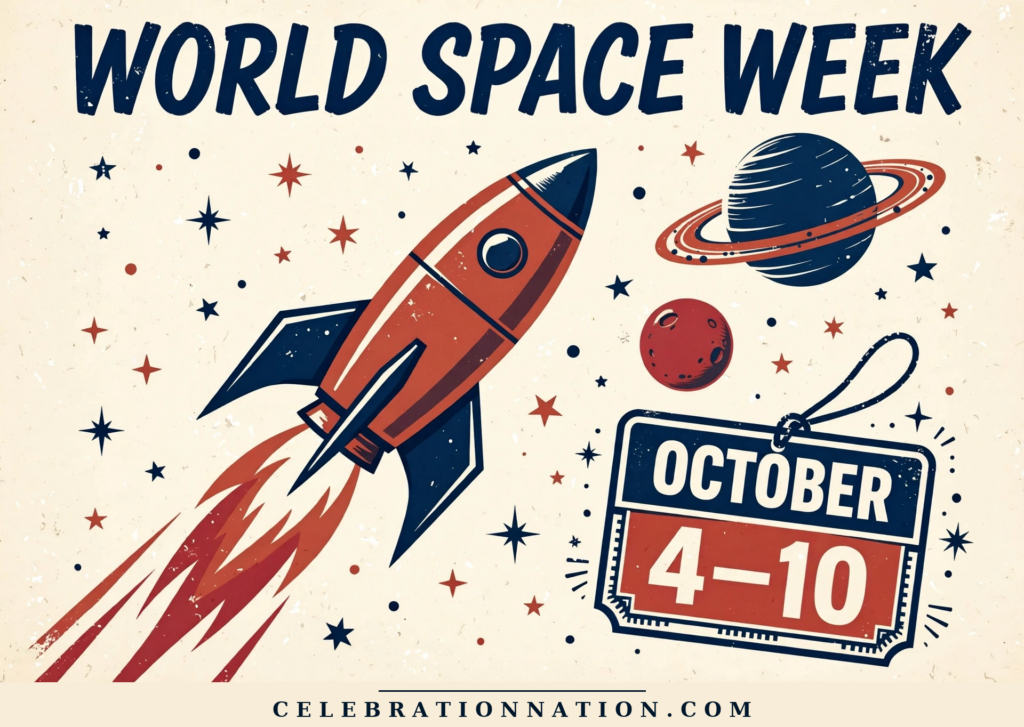
World Space Week
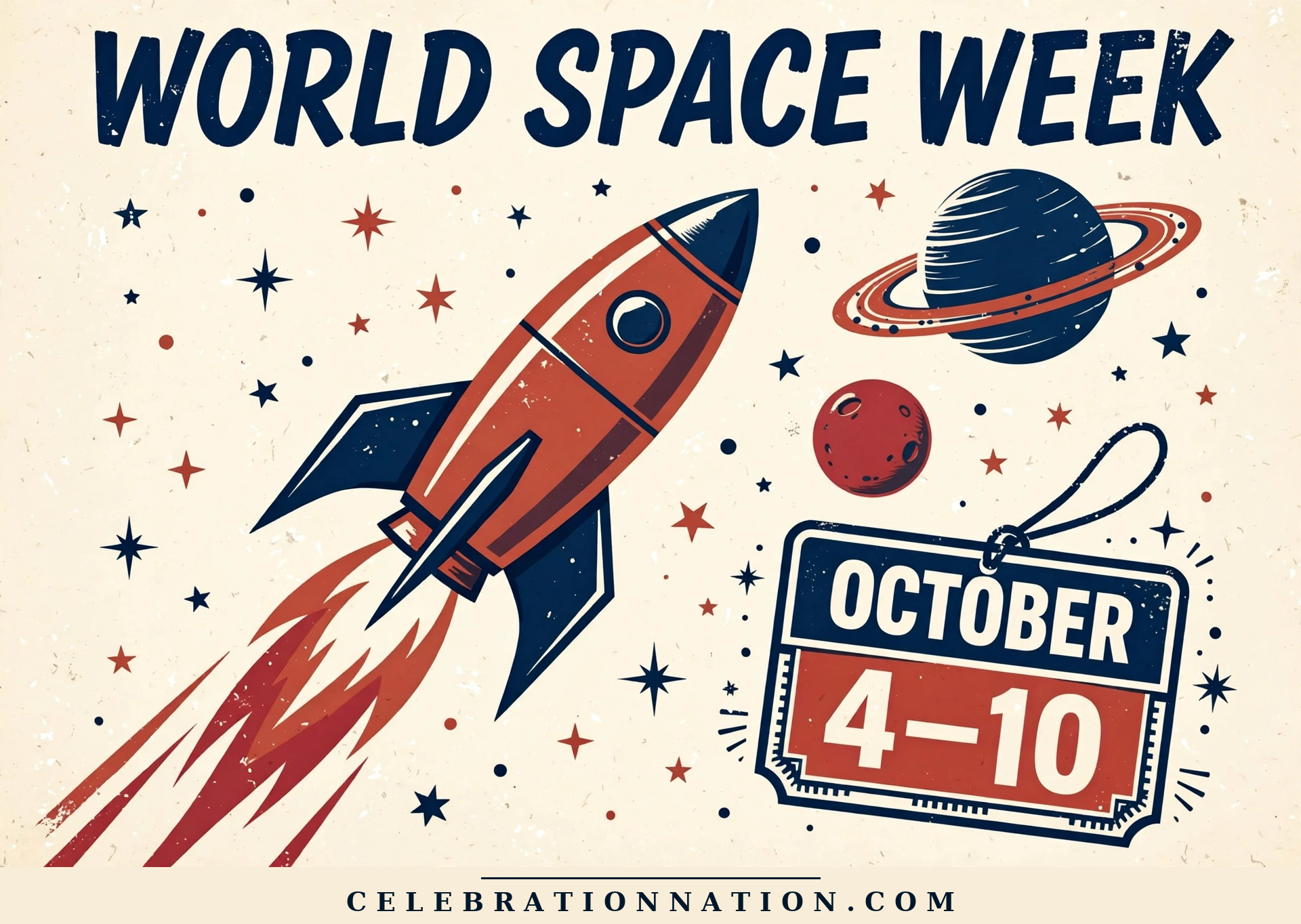
Join us in celebrating the marvels of space exploration during World Space Week.
- Roots
- Established by the United Nations in 1999
- Vibe
- Inspiring curiosity and innovation
- Hashtag
- #WorldSpaceWeek
Fast facts
The story
World Space Week is a global celebration that honors the contributions of space science and technology to humanity. The observance occurs annually from October 4 to October 10, coinciding with significant anniversaries in space history, such as the launch of Sputnik 1, the first artificial satellite, on October 4, 1957. This week serves as a platform for various educational and outreach activities aimed at inspiring the next generation of scientists and explorers.
Read the full story
Each year, World Space Week focuses on a specific theme that highlights important aspects of space exploration. For instance, in 2023, the theme is 'Space and Sustainability,' emphasizing the need for responsible practices in space exploration and the protection of our planet. Schools, universities, and organizations around the world engage by hosting lectures, workshops, and exhibitions, all designed to spark interest in space science.
In the United States, institutions like NASA and local science centers play a crucial role in promoting World Space Week. Through open houses, special exhibitions, and interactive programs, they invite the public to learn more about the universe. Participants can expect activities ranging from rocket launches to hands-on science experiments that make space science accessible and exciting for all age groups.
Internationally, World Space Week fosters collaboration between countries to share knowledge and advancements in space technology. With participation from over 90 countries, this initiative not only strengthens diplomatic ties but also fosters a sense of global community. As we look toward the stars, World Space Week reminds us of the importance of unity in facing the challenges of our time, both on Earth and beyond.
Worth knowing
Space Exploration
Explore the latest in space missions and discoveries.
Stargazing Tips
Learn how to identify constellations and planets.
Recommended Reads
Discover books that inspire curiosity about space.
Sustainability Focus
Understand the importance of preserving our planet.
Did you know?
First Artificial Satellite
Sputnik 1 was launched by the Soviet Union in 1957.
Moon Landing
Apollo 11 landed humans on the Moon in 1969.
International Space Station
Launched in 1998, it serves as a microgravity research lab.
Mars Rover
Curiosity has been exploring Mars since 2012.
Voyager Probes
Launched in 1977, they are now in interstellar space.
Hubble Space Telescope
Has provided stunning images of distant galaxies since 1990.
James Webb Telescope
Launched in 2021, it focuses on the early universe.
Around the world
Every culture celebrates a little differently.
- USUnited StatesJoin local events hosted by NASA and science centers.
- CACanadaParticipate in community stargazing nights.
- GBUnited KingdomAttend lectures at universities and observatories.
- AUAustraliaVisit the Sydney Observatory for special events.
- FRFranceExplore exhibitions at the Cité des Sciences.
- DEGermanyEngage in space workshops at local museums.
Coming up next
See the calendar


Celebrate every day, all year
Official gear from the people who track 1,700+ celebrations.
Browse the shop 2027 National Day Wall CalendarGet the 2026 edition free. 1,700+ observances.
Never miss a reason to celebrate.
One quick morning email with today's celebrations, ideas and posters. Free, unsubscribe anytime.
🎉 You're on the list! Watch your inbox for The Daily Confetti.