

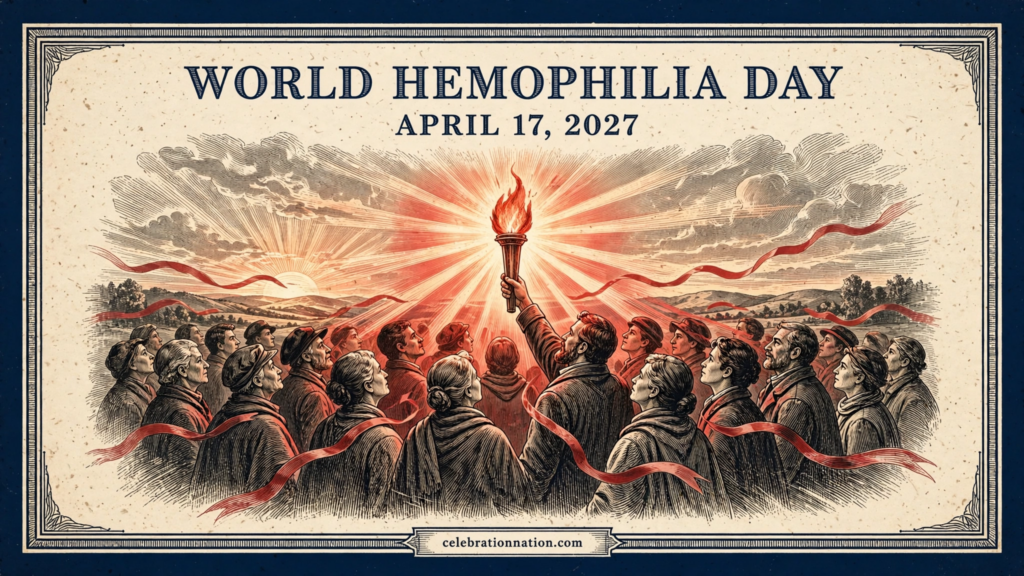
World Hemophilia Day
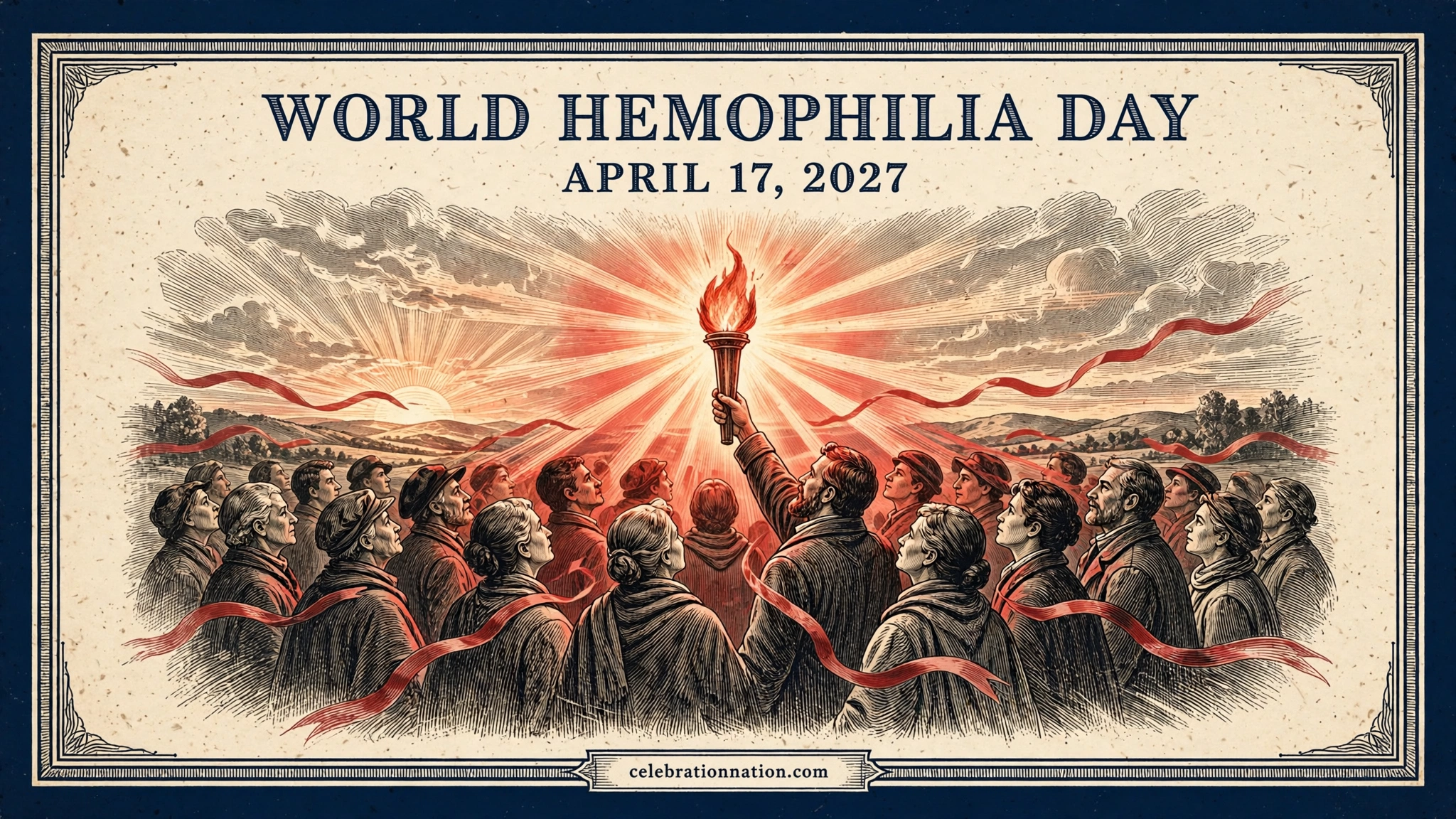
Every year on April 17, millions stand together for those who bleed differently. World Hemophilia Day is a day of awareness and quiet resolve, honoring people living with hemophilia and other inherited bleeding disorders, the families who care for them, and the advocates working toward treatment for all. In 2027, the observance falls on Saturday, April 17.
- Also on Apr 17
- Bat Appreciation Day · International Bat Appreciation Day · Cheeseball Day
- Hashtag
- #WorldHemophiliaDay
WORLD HEMOPHILIA DAY
Every year on April 17, millions stand together for those who bleed differently. World Hemophilia Day is a day of awareness and quiet resolve, honoring people living with hemophilia and other inherited bleeding disorders, the families who care for them, and the advocates working toward treatment for all. In 2027, the observance falls on Saturday, April 17.
Hemophilia is a genetic disorder in which the blood does not clot properly, so bleeding lasts longer and can begin from even a minor injury. The two main types are hemophilia A, caused by a deficiency of clotting factor VIII, and hemophilia B, caused by a deficiency of clotting factor IX. The condition is passed through families on the X chromosome, so it most often affects boys and men while women are usually carriers, though women and girls can live with bleeding disorders too. Symptoms include prolonged bleeding after injuries, frequent nosebleeds, and painful bleeding into joints and muscles that can cause lasting damage. There is no cure yet, but regular treatment with clotting factor replacement can prevent and control bleeding, allowing many people with hemophilia to live full and active lives, going to school, playing sports carefully, and chasing their dreams. Behind every treatment is a story: a child learning to ride a bike with extra padding and extra courage, a teenager explaining hemophilia to new friends, a parent becoming an expert in something they never expected to study. The medical facts matter, but the human stories are what the day is really about.
World Hemophilia Day was established in 1989 by the World Federation of Hemophilia, and April 17 was chosen to honor the birthday of the federation’s founder, Frank Schnabel. Schnabel, who himself lived with hemophilia A, founded the WFH in Montreal, Canada, in 1963, creating the first international voice for people with bleeding disorders at a time when few were listening. What began as one man’s determination grew into a global federation that now brings together 152 national member organizations and holds official recognition from the World Health Organization. The day raises awareness, attracts volunteers, and raises funds for those who cannot afford treatment, carrying Schnabel’s mission into every corner of the world. The day itself serves two purposes close to Schnabel’s heart: raising awareness of bleeding disorders and raising the funds and volunteers needed to bring treatment to those who cannot afford it. Every April 17, his birthday becomes the world’s reminder.
Hemophilia has been called the royal disease ever since Queen Victoria was identified as a carrier who passed the gene through several European royal families, a strange twist of history that made a hidden condition famous. Medical understanding advanced step by step: in 1803 Dr. John Conrad Otto of Philadelphia began formal study of the “bleeders” in one family and concluded the condition passed from mothers to sons, in 1937 the disorder was classified into types A and B based on the clotting factor affected, and from the 1960s through the 1980s clotting factor replacement therapy transformed care and life expectancy. Each breakthrough was built on the courage of patients who took part in research and treatment, and on families who refused to accept that nothing could be done, turning private struggle into public progress. Progress came slowly and then, for many, life-changingly fast. Children who once faced long hospital stays can now look forward to school days, birthdays, and ordinary scrapes managed with extraordinary medicine. Yet the memory of harder times keeps the community humble, grateful, and determined.
The work is far from finished. The World Federation of Hemophilia estimates that 75 percent of people in the world with bleeding disorders remain undiagnosed and without care, a staggering gap between what medicine can do and who it reaches. Each April 17, landmarks around the globe light up in red for the “Light It Up Red” campaign, a visible promise that no one should face a bleeding disorder alone. The day also embraces the wider community, including people with von Willebrand disease and other inherited bleeding disorders, women and girls who bleed, and every parent, sibling, and friend walking this road with love. Awareness is the first step toward the federation’s vision of treatment for all, regardless of a person’s type of bleeding disorder, gender, age, or where they live. The federation’s vision has a name, Treatment for All, and a simple measure of success: a world where no one’s address decides whether they get care. Until that day, April 17 will keep asking the world to look, to learn, and to help.
THE STORY BEHIND WORLD HEMOPHILIA DAY
🩸 A Day Born of One Man’s Birthday
In 1989 the World Federation of Hemophilia established World Hemophilia Day on April 17, the birthday of its founder Frank Schnabel. Choosing his birthday keeps his legacy at the heart of every observance, reminding the world that this global movement began with one person’s determination to be heard. It is a birthday gift to the world, given every year.
❤ Frank Schnabel’s Dream
Living with hemophilia A himself, Frank Schnabel founded the World Federation of Hemophilia in Montreal in 1963. His dream was simple and sweeping: that people with bleeding disorders everywhere would have access to diagnosis, treatment, and care. More than six decades later, 152 national member organizations in countries around the world carry that dream forward. Schnabel proved that a patient can also be a pioneer.
🕊 From Royal Courts to Modern Clinics
Called the royal disease after Queen Victoria carried the gene into Europe’s royal families, hemophilia moved from mystery to medicine through milestones like Dr. John Conrad Otto’s 1803 research, the 1937 classification of types A and B, and the rise of clotting factor replacement therapy that transformed life expectancy for generations of patients. Each milestone was a victory written in courage as much as in science.
🤝 Light It Up Red
Each April 17, landmarks across the world glow red for the “Light It Up Red” campaign. The color is a call to remember the 75 percent of people with bleeding disorders who still lack diagnosis and care, and to keep working until treatment reaches all, in every country, every community, and every family. Red is the color of awareness, and on April 17 it is also the color of hope.
WAYS TO CELEBRATE
🕯 Learn One Family’s Story
Read about a person or family living with a bleeding disorder, and share what you learn with someone you love. Understanding is the first form of support, and every story shared chips away at the isolation these families can feel when facing a rare condition. One story, truly heard, can change how a whole family is supported.
❤ Wear Red Together
Put on something red on April 17 and gather friends or family to talk about why the day matters. A simple shared color becomes a quiet statement of solidarity, echoing the red landmarks glowing around the world in the Light It Up Red campaign. Take a photo, share why you wear it, and let the red do the talking.
🤝 Support the Cause
Donate to the World Federation of Hemophilia or a national member organization, join a local awareness walk, or share the “Light It Up Red” message so more landmarks, and more hearts, join in. Funds raised help bring diagnosis and treatment within reach for those who cannot afford it. Even small gifts join a global effort that saves and improves lives.
Honor World Hemophilia Day
On April 17, we remember the courage of patients, the devotion of families, the dedication of caregivers, and the vision of Frank Schnabel. May the red lights of the world shine as a promise: treatment for all, and no one left behind, ever. In quiet rooms and glowing landmarks alike, April 17 says: you matter, you are seen, and help is coming.
Plan ahead
World Hemophilia Day is observed on April 17 every year. Here is where it lands for the next ten years, handy for planners, marketers and party people.
Keep the party going
See the calendar

Celebrate every day, all year
Official gear from the people who track 1,700+ celebrations.
Browse the shop 2027 National Day Wall CalendarGet the 2026 edition free. 1,700+ observances.
Never miss a reason to celebrate.
One quick morning email with today's celebrations, ideas and posters. Free, unsubscribe anytime.
🎉 You're on the list! Watch your inbox for The Daily Confetti.