






World Narcolepsy Day
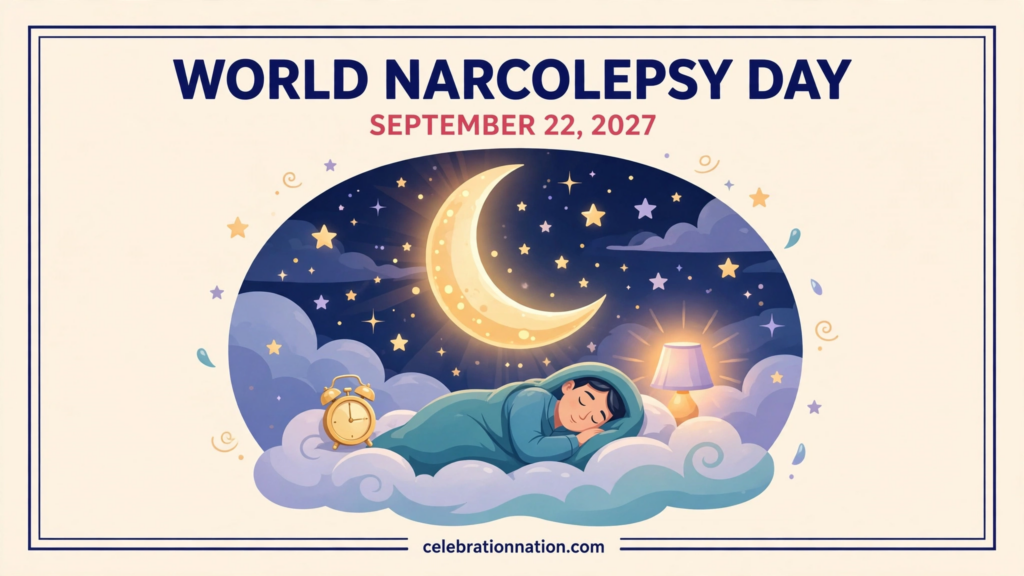
Every year on September 22, a global community shines a gentle light on an often invisible condition. World Narcolepsy Day raises awareness of narcolepsy, a chronic neurological disorder that disrupts the brain's sleep-wake cycle, and honors the millions of people who live with it. In 2027 the day falls on September 22. It is a day for understanding, for listening, and for replacing old jokes with real knowledge.
- Also on Sep 22
- World Rhino Day · Fall Begins/Autumnal Equinox · Legwear Day
- Hashtag
- #WorldNarcolepsyDay
WORLD NARCOLEPSY DAY
Every year on September 22, a global community shines a gentle light on an often invisible condition. World Narcolepsy Day raises awareness of narcolepsy, a chronic neurological disorder that disrupts the brain’s sleep-wake cycle, and honors the millions of people who live with it. In 2027 the day falls on September 22. It is a day for understanding, for listening, and for replacing old jokes with real knowledge.
Narcolepsy is a chronic neurological condition that impairs the brain’s ability to regulate the sleep-wake cycle. Its hallmarks include overwhelming daytime sleepiness, sudden episodes of muscle weakness known as cataplexy, often triggered by strong emotion such as laughter, and vivid dream-like experiences on the edges of sleep, including sleep paralysis. A related condition, idiopathic hypersomnia, brings an insatiable need for sleep that is not eased even by a full night’s rest. These are not quirks or character flaws. They are medical conditions, and they shape every part of daily life for the people who have them.
The numbers are larger than most people realize. Narcolepsy and idiopathic hypersomnia affect more than three million people worldwide, and about one in every two thousand Americans lives with narcolepsy. Yet the majority of people living with these conditions are currently undiagnosed or misdiagnosed. Low public awareness means symptoms are missed or misunderstood for years, and the average road to a correct diagnosis is long. For many, the hardest part is not the condition itself but the years spent without a name for it.
Stigma is the other burden. Popular culture has treated narcolepsy as a punchline for decades, and those portrayals have real consequences. When someone’s symptoms are read as laziness, when a student who cannot stay awake is assumed to be unmotivated, when an employee is judged for what is actually a neurological disorder, education and employment opportunities narrow and isolation deepens. Julie Flygare, the advocate who would go on to found Project Sleep, has described how people made jokes the moment she named her diagnosis, until she stopped telling anyone at all and felt profoundly alone. Her story is far from unique, and it is exactly what this day exists to change.
World Narcolepsy Day was established in 2019, when Project Sleep came together with twenty-one organizations across six continents to create a dedicated global awareness day. The inaugural observance took place on Sunday, September 22, 2019, bringing together patient-advocacy organizations, researchers, clinicians, drug developers, local communities, and individuals in a single coordinated effort. From the beginning, the mission was clear: reduce delays in diagnosis, reduce stigma, and improve outcomes for everyone living with narcolepsy.
The movement has grown every year since. By the second annual observance in 2020, twenty-six organizations around the world were co-leading the day. In 2021, twenty-nine organizations across six continents united for “Narcolepsy Around the World,” an international panel of people living with the condition sharing global perspectives on diagnosis, treatment, and support. Each year, the community grows louder and more connected, and each year more people learn that the joke they have heard for years describes a real disorder affecting real neighbors, coworkers, classmates, and friends.
Understanding is the quiet work of this day. It asks nothing flashy: learn what narcolepsy actually is, believe people when they describe their symptoms, and share accurate information instead of the old punchlines. For the millions living with narcolepsy, most of them still undiagnosed, that understanding can be the difference between years of confusion and a timely path to care. A day of awareness will not cure a neurological disorder, but it can shorten the road to diagnosis, and for someone still searching for answers, that road is everything.
There is genuine reason for hope. As Dr. Emmanuel Mignot, director of the Stanford Center for Sleep Sciences and Medicine, has noted, scientific understanding of narcolepsy is advancing rapidly, with new treatment options on the horizon, making this a critical time to elevate international awareness so people can receive proper diagnosis and treatment sooner. Each World Narcolepsy Day brings that future a little closer by connecting patients with researchers, clinicians with advocates, and isolated individuals with a community that understands exactly what they are going through.
The path to diagnosis usually begins with being believed. For Julie Flygare, it took a sleep specialist and a formal sleep study to finally put a name to the buckling knees, the sleep paralysis, and the exhaustion no amount of rest could fix. For countless others, that path starts when someone, a friend, a teacher, a doctor, recognizes the signs and takes them seriously instead of reaching for a joke. That is the quiet power of awareness: it turns a lonely, confusing experience into a treatable medical condition with a name, a community, and a way forward.
THE STORY BEHIND WORLD NARCOLEPSY DAY
🌙 A Day Founded in 2019
Project Sleep partnered with twenty-one organizations across six continents to establish World Narcolepsy Day. The inaugural observance took place on Sunday, September 22, 2019, dedicated to raising critical awareness of narcolepsy on a global scale.
👩💼 The Advocate Behind It
Julie Flygare was diagnosed with narcolepsy with cataplexy in 2007 after years of mystifying symptoms. She wrote the memoir “Wide Awake and Dreaming,” and in 2013 she founded Project Sleep, a nonprofit devoted to sleep health, sleep equity, and sleep disorders.
🧠 What Narcolepsy Is
Narcolepsy is a chronic neurological condition that impairs the brain’s ability to regulate the sleep-wake cycle. A related condition, idiopathic hypersomnia, causes an insatiable need for sleep that a full night’s rest does not relieve. Both are medical disorders, not habits or flaws.
📊 The Hidden Numbers
More than three million people worldwide live with narcolepsy and idiopathic hypersomnia, and about one in two thousand Americans has narcolepsy. The majority remain undiagnosed or misdiagnosed, often for years, because public awareness is so low.
🎬 Beyond the Punchline
Decades of inaccurate portrayals have taught the public to laugh at narcolepsy, and that laughter has a cost: symptoms get misread as laziness, diagnosis is delayed, and people feel isolated. The day’s core work is replacing the joke with knowledge.
WAYS TO CELEBRATE
📖 Learn the Real Symptoms
Spend time on September 22 reading Project Sleep’s plain-language explainers on narcolepsy and idiopathic hypersomnia. Knowing the signs, excessive daytime sleepiness, cataplexy, sleep paralysis, is the first step toward shorter roads to diagnosis.
💬 Share Facts, Not Punchlines
Post accurate information about narcolepsy with #WorldNarcolepsyDay, and gently correct the old jokes when they surface among friends. One honest conversation can change how someone sees a classmate, a coworker, or themselves.
👏 Thank a Sleep Specialist
Researchers, clinicians, and sleep specialists are part of this community too. If one of them helped you or someone you love, send a note of thanks on September 22. Their work turns awareness into diagnosis and diagnosis into care.
🤝 Stand With the Community
Listen to the voices of people living with narcolepsy, in panels like “Narcolepsy Around the World” or in your own circle. Believing someone’s experience, without minimizing it, is one of the most powerful forms of support.
Honor World Narcolepsy Day
On September 22, 2027, take a quiet moment to learn, to listen, and to believe. For millions of people living with narcolepsy, understanding is not a small thing. It is the beginning of being seen.
Plan ahead
World Narcolepsy Day is observed on September 22 every year. Here is where it lands for the next ten years, handy for planners, marketers and party people.
Keep the party going
See the calendar



Celebrate every day, all year
Official gear from the people who track 1,700+ celebrations.
Browse the shop 2027 National Day Desk CalendarA new celebration every morning. Daily tear-off.
Never miss a reason to celebrate.
One quick morning email with today's celebrations, ideas and posters. Free, unsubscribe anytime.
🎉 You're on the list! Watch your inbox for The Daily Confetti.