



Twelve Days of Christmas
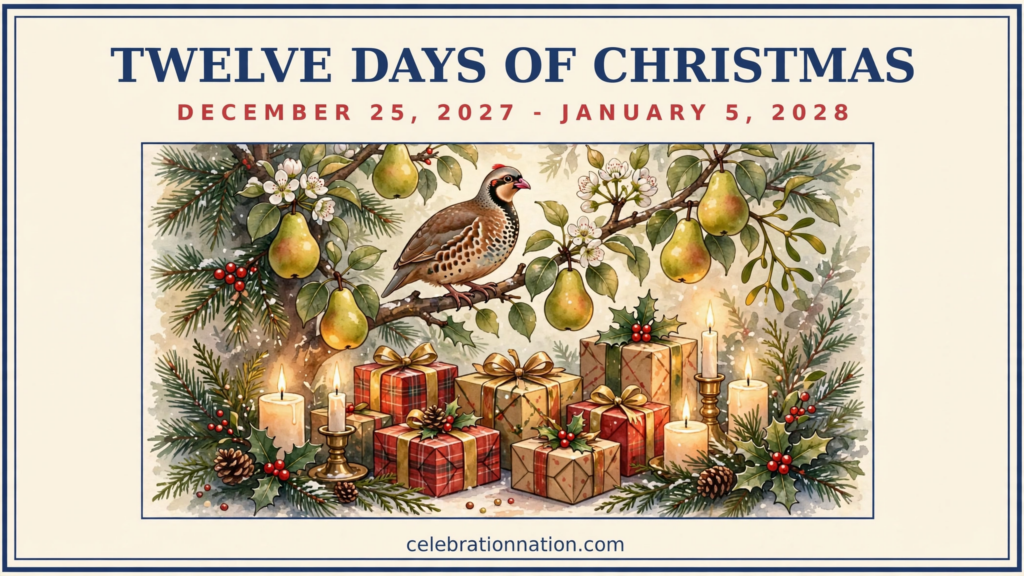
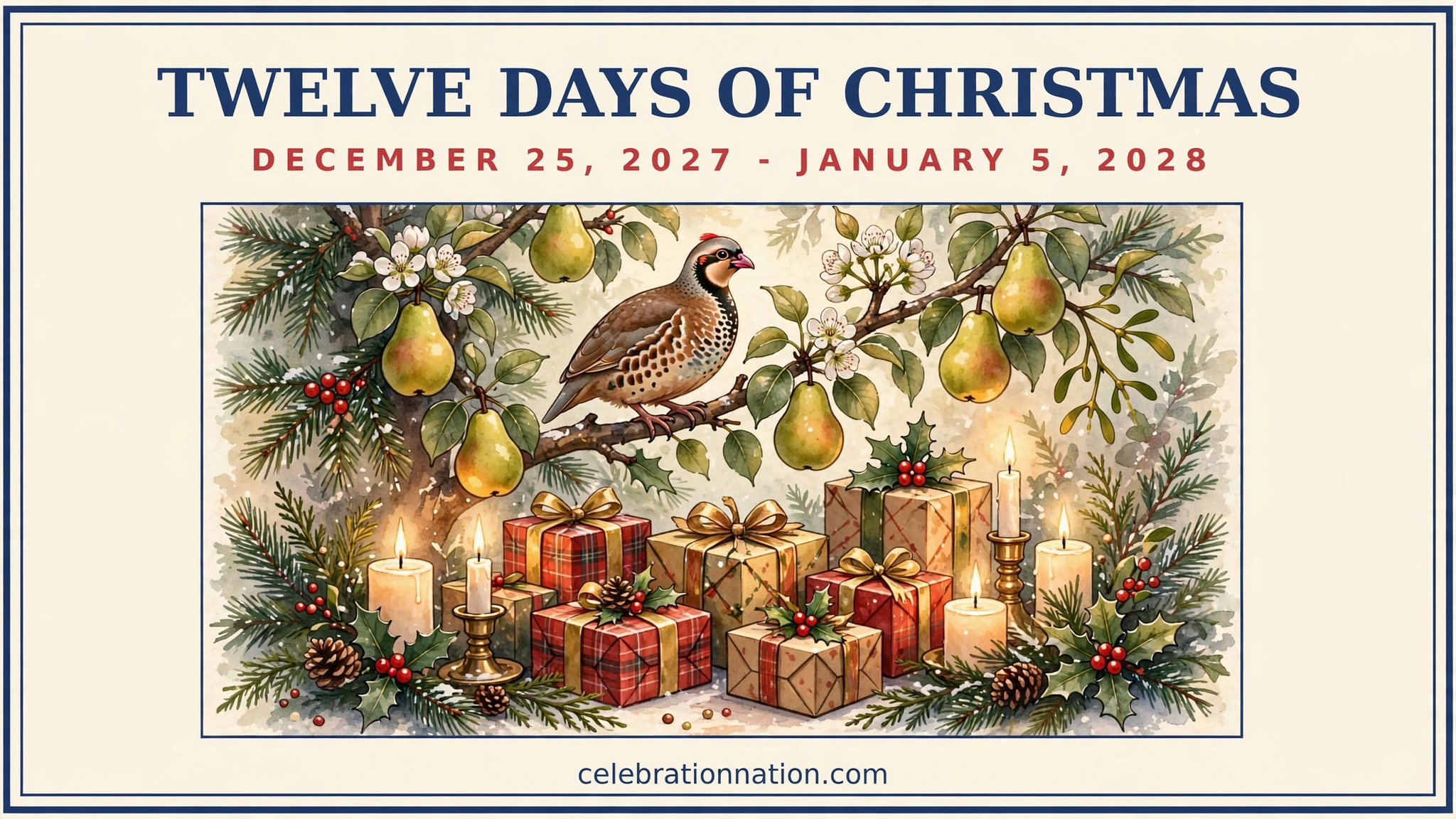
Christmas Day is not the finish line. It is the starting gate. The Twelve Days of Christmas, December 25, 2027 through January 5, 2028, mark the traditional Christmas season, known as Christmastide or Twelvetide, stretching from Christmas Day to Twelfth Night, the eve of the Epiphany. Long before the holiday became a single morning of torn wrapping paper, it was a twelve-day festival of feasting, games, and merriment. The celebration does not end at dawn. It has only just begun.
- Hashtag
- #TwelveDaysOfChristmas
TWELVE DAYS OF CHRISTMAS
Christmas Day is not the finish line. It is the starting gate. The Twelve Days of Christmas, December 25, 2027 through January 5, 2028, mark the traditional Christmas season, known as Christmastide or Twelvetide, stretching from Christmas Day to Twelfth Night, the eve of the Epiphany. Long before the holiday became a single morning of torn wrapping paper, it was a twelve-day festival of feasting, games, and merriment. The celebration does not end at dawn. It has only just begun.
The twelve days begin on Christmas Day, December 25, and run through January 5, Twelfth Night, the eve of the Epiphany on January 6. The extended Christmas season has been recognized since the 6th century, though churches and traditions have varied the details over the centuries. In our era the commercial season often ends on Christmas Eve, but the old calendar insists the merriment has twelve full days to unfold, and it rewards those who take it slowly.
The season gave its name to one of the most famous carols ever written. The Twelve Days of Christmas, the cumulative song of increasingly grand gifts from a true love, was first published in England in 1780 in a children’s book called Mirth Without Mischief, where it appeared as a Twelfth Night memories-and-forfeits game: a leader recited a verse, each player repeated it, the leader added another, and whoever stumbled paid a penalty such as a kiss or a sweet. Scholars believe the chant may be French in origin, and the melody we sing today was arranged by Frederic Austin in 1909, turning a parlor game into a beloved sing-along.
Everyone knows the gifts: a partridge in a pear tree, two turtle doves, three French hens, four calling birds, five golden rings, six geese a-laying, seven swans a-swimming, eight maids a-milking, nine ladies dancing, ten lords a-leaping, eleven pipers piping, and twelve drummers drumming. Each verse repeats all the gifts before it in ascending order, which is exactly what made the song such a fiendish memory game for Victorian children. Writing in 1842, the folklorist Halliwell noted that each child in succession repeats the gifts of the day, and forfeits for each mistake.
Within the twelve days fall smaller feasts of their own. December 26 is St. Stephen’s Day, known as Boxing Day in parts of the Commonwealth, and December 28 is Childermas, the Feast of the Holy Innocents. Each day of Christmastide carried its own customs, its own foods, and its own reasons to gather, layering celebration upon celebration. The season was a calendar of delights, not a single event.
Twelfth Night itself was the crown of the season. The Oxford English Dictionary defines it as the evening of January 5, preceding Twelfth Day, formerly the last day of the Christmas festivities and observed as a time of merrymaking. A century after the carol’s publication, the folklorist Lady Gomme described how the memories game was still played every Twelfth Night before the eating of mince pies and twelfth cake, a rich and decorated centerpiece of the feast. To end the season properly, you feasted.
Traditions for the twelve days vary beautifully around the world. Some families give small gifts on each of the twelve nights, others save everything for Twelfth Night, and many simply keep the tree lit, the candles burning, and the table welcoming a little longer. The point was never extravagance for its own sake. It was savoring: refusing to rush the sweetest season of the year, and letting joy accumulate the way the verses of the carol do.
The carol has attracted its share of mythology. A popular theory claims the twelve gifts are a secret Catholic catechism, with the partridge representing Christ and the ten lords a-leaping standing in for the Ten Commandments, supposedly composed during centuries of religious persecution in England. It is a charming idea, but scholars note it emerged in the 1990s and lacks historical evidence: the symbols do not line up consistently, and the doctrines were not uniquely Catholic. The likelier truth is simpler and sweeter. It was a game, played for laughs on Twelfth Night.
The carol had cousins, too. A related English cumulative song called A New Dial, with a similar piling-up structure, dates back to at least 1625, suggesting the format delighted singers long before 1780. The Twelve Days of Christmas carries Roud Folk Song Index number 68, placing it in the great catalog of traditional songs. Across centuries and continents, the appeal is the same: a list that grows, a memory that strains, and a room full of people laughing when it snaps.
There is also a quiet invitation in the twelve days: to rest. After the sprint of December, Christmastide offers a slower rhythm, an evening walk past lit windows, a second reading of a favorite book, a meal with no agenda. The old calendar understood something we are relearning, that celebration needs room to breathe. Twelve days is not excess. It is permission.
Here is a bit of carol arithmetic to impress your friends: if you add up every gift as the verses accumulate, the true love gives 364 presents in total, one for nearly every day of the year. The partridge in a pear tree appears twelve times, the turtle doves eleven, and so on down the line, which means the full performance delivers 184 birds alone. It is the kind of gloriously excessive math that could only come from a Christmas game, and it makes the final verse feel like the feast it is.
The season ends, as it began, with a feast. January 6 is the Epiphany, the traditional celebration of the arrival of the Magi, and in many traditions it is the day the decorations finally come down and the last of the Christmas foods are shared. Some families mark it with king cake, others with a final candlelit dinner, and many simply take a quiet moment to be grateful the season lasted as long as it did. Twelve days of savoring deserve a proper farewell.
From December 25, 2027 to January 5, 2028, consider keeping Christmas a little longer. Sing the carol all the way through without peeking at the lyrics, leave the lights up, share a meal on an ordinary January evening, and let the season end the way it was meant to: gently, and with cake.
THE STORY BEHIND TWELVE DAYS OF CHRISTMAS
📆 Published in 1780
The carol first appeared in the children’s book Mirth Without Mischief as a Twelfth Night memory game.
🔬 The 1909 Melody
Frederic Austin arranged the familiar tune in 1909, turning a parlor game into a beloved sing-along.
👥 A Game of Memory
Players recited the growing verses in turn, paying a forfeit, a kiss or a sweet, for each mistake.
❤️ Twelfth Night
January 5 is Twelfth Night, the eve of Epiphany and the traditional end of the festivities.
📢 Ancient Roots
The extended Christmas season has been recognized since the 6th century.
WAYS TO CELEBRATE
🏫 Sing It All the Way Through
Gather friends and sing all twelve verses from memory. The first one to stumble owes the group dessert.
👣 Keep the Lights Up
Leave your decorations up through January 5 and enjoy one unhurried evening of candles and carols.
💬 Bake a Twelfth Night Cake
Bake or buy a festive cake to share on January 5 and close the season the traditional way.
Celebrate Twelve Days of Christmas
From December 25, 2027 to January 5, 2028, let Christmas linger. Sing every verse, keep the candles lit, and savor the twelve days the way generations before us did. Share your Twelfth Night table with #TwelveDaysOfChristmas. The season is longer than a morning, and twice as sweet for it. Keep one candle burning a little longer each night, and let Twelfth Night be the merriest of all. When the Epiphany arrives, you will have celebrated Christmas the way it was always meant to be celebrated: fully, and without rushing a single day.
Keep the party going
See the calendar
Celebrate every day, all year
Official gear from the people who track 1,700+ celebrations.
Browse the shop National Day Celebration Card GameA party in a box, any day of the year.
Never miss a reason to celebrate.
One quick morning email with today's celebrations, ideas and posters. Free, unsubscribe anytime.
🎉 You're on the list! Watch your inbox for The Daily Confetti.