
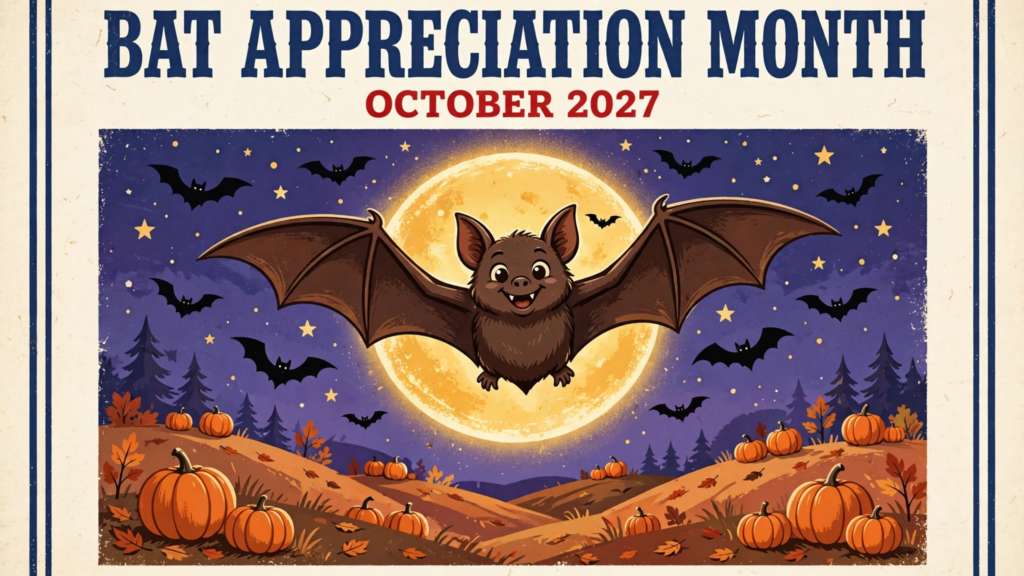
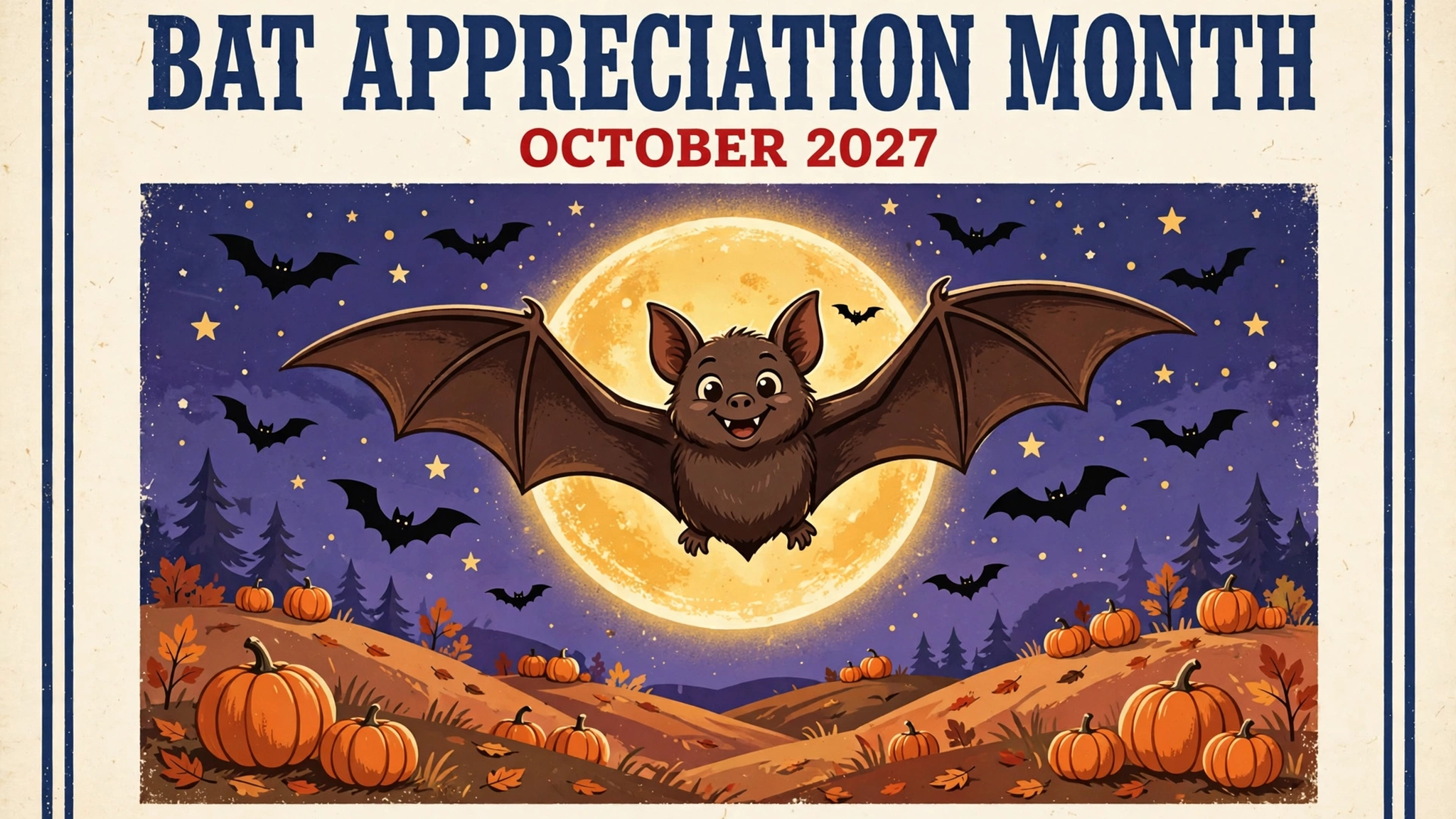
Bat Appreciation Month
Every year in October, bats get a whole month to steal the spotlight, and honestly, they have earned every minute of it. Bat Appreciation Month turns the calendar's spookiest season into a celebration of the only mammals on Earth that can truly fly. In 2027, October brings thirty-one days of winged wonder, capped by Bat Week from October 24 through October 31, which ends on Halloween itself. It is a playful, wild-hearted observance that asks you to trade fear for fascination, one flapping bat at a time.
- Hashtag
- #BatAppreciationMonth
BAT APPRECIATION MONTH
Every year in October, bats get a whole month to steal the spotlight, and honestly, they have earned every minute of it. Bat Appreciation Month turns the calendar’s spookiest season into a celebration of the only mammals on Earth that can truly fly. In 2027, October brings thirty-one days of winged wonder, capped by Bat Week from October 24 through October 31, which ends on Halloween itself. It is a playful, wild-hearted observance that asks you to trade fear for fascination, one flapping bat at a time.
Let us start with the obvious: bats have an image problem. For centuries they have been cast as the villains of Halloween, tangled up with tales of vampires, witches, and haunted houses. Bat Appreciation Month exists to flip that script. These creatures are not spooky sidekicks; they are ecological superheroes working the night shift while the rest of us sleep. Colonies of insect-eating bats provide pest-control services worth an estimated 3.7 billion to 53 billion dollars a year to American agriculture. That is an astonishing amount of free labor from animals that often weigh less than a candy bar.
What makes bats so extraordinary is how much they accomplish with so little. They are the only mammals capable of true, powered flight, and their wings are actually modified hands, with elongated fingers stretching a thin, flexible membrane. More than 1,400 species fill nearly every corner of the globe, from the tiny bumblebee bat, one of the smallest mammals on Earth, to flying foxes with wingspans stretching several feet. Most navigate the dark with echolocation, sending out high-pitched calls and reading the returning echoes like a sound map of the night. Their colonies can number in the millions, and their social lives are surprisingly rich for creatures we rarely see up close.
The month’s roots run deep in conservation history. As bat populations began to decline in the 1960s and 1970s, scientists raised the alarm, and in 1982 biologist Merlin Tuttle founded Bat Conservation International, an organization devoted to protecting bats through conservation, education, and research. Conservationists later created dedicated bat awareness periods, and October was the natural choice: the month of Halloween, when bats dominate the cultural imagination, became the perfect stage for changing minds. Bat Appreciation Week, observed each year from October 24 through October 31, sits at the heart of the month, and in 2018 it earned federal recognition when USDA Secretary Sonny Perdue formally proclaimed October 24 through 31 as National Bat Week, with the governors of West Virginia, Pennsylvania, Montana, and South Carolina issuing similar proclamations.
Bats deserve the fanfare for reasons that go far beyond pest control. More than 1,400 species of bats are known worldwide, making them one of the most diverse groups of mammals on the planet. They pollinate or disperse the seeds of more than 1,000 plant species, including bananas, mangoes, and the agave used to make tequila. Some bats live astonishingly long lives; the oldest known bat was captured at age 41. And their guano makes excellent fertilizer. For animals so small, bats carry an outsized share of the world’s ecological heavy lifting.
That is also why the month carries an urgent message. In 2006, a fungus called Pseudogymnoascus destructans was discovered in a single New York cave, and it causes a disease known as white-nose syndrome. North American bats had no immunity to it, and the disease has since killed an estimated 6.7 million bats, making it the worst wildlife disease outbreak in the continent’s recorded history. Species like the northern long-eared bat have been pushed toward endangered status. Add ongoing habitat loss to the mix, and the picture is clear: the creatures doing so much quiet good for the planet need our help in return.
And here is the part that makes Bat Appreciation Month so fun: bats are full of surprises. Only three of the more than 1,400 species are vampire bats, and they prefer livestock to people, taking small sips of blood without harming their hosts. Some bats pollinate night-blooming flowers, others snatch fish from the water’s surface, and some migrate hundreds of miles each year. Every October, zoos, nature centers, and parks host bat nights, cave tours, and talks that let you meet these animals up close. The more you learn, the harder it is not to love them.
THE STORY BEHIND BAT APPRECIATION MONTH
🦎 1982: The Man Who Loved Bats
Biologist Merlin Tuttle founded Bat Conservation International in 1982 after watching bat populations decline through the 1960s and 1970s. His mission was simple and bold: end the fear and misinformation driving bats toward extinction, and fund the research needed to save them. Today he is known as the father of bat conservation.
🎃 Why October? Thank Halloween
In the 2000s, conservationists created dedicated bat awareness periods, and October was the obvious pick. Halloween puts bats front and center in popular imagery, so advocates claimed the month and turned seasonal attention into a chance to change minds. Nothing says rebrand like taking over the spookiest month of the year.
📝 2018: The Federal Seal of Approval
Bat Appreciation Week, the October 24 through 31 climax of the month, gained major recognition in 2018 when USDA Secretary Sonny Perdue formally proclaimed it National Bat Week. The governors of West Virginia, Pennsylvania, Montana, and South Carolina issued similar proclamations. Bats had officially gone mainstream.
🍌 The Night Shift That Feeds Us
Bats pollinate or disperse seeds for more than 1,000 plant species, including bananas, mangoes, and agave. Their insect-eating saves American agriculture an estimated 3.7 billion to 53 billion dollars a year in pest control. Bananas, mangoes, and tequila all have bats to thank, so raise a glass of agave nectar to the night shift.
🦠 The Fungus That Changed Everything
White-nose syndrome, discovered in a New York cave in 2006, is caused by the fungus Pseudogymnoascus destructans. It disrupts hibernation, forcing bats to burn through fat reserves before spring, and has killed an estimated 6.7 million bats across North America. It remains the worst wildlife disease outbreak in the continent’s recorded history, and fighting it is one reason this month matters.
🌙 How Bats See the Dark
Most bats navigate by echolocation, sending out high-pitched calls and listening for the echoes that bounce back. Those echoes build a detailed sound map of insects, obstacles, and open sky, letting bats hunt in total darkness with astonishing precision. It is nature’s own sonar, and it works beautifully.
WAYS TO CELEBRATE
🦎 Put Up a Bat House
Give your local bats a safe place to roost by building or hanging a bat house in your yard or on a community building. A single well-placed box can shelter dozens of insect-eating bats through the season.
🌙 Take a Twilight Bat Walk
Head out at dusk with friends or family and watch bats swoop and dive for insects. Bring a flashlight, a field guide, and a sense of wonder, and see who can spot the most aerial acrobats.
📢 Bust a Bat Myth
Share your favorite bat fact online with #BatAppreciationMonth, from their billion-dollar pest-control work to their 41-year lifespans. Every myth corrected is a small victory for bat conservation.
Celebrate Bat Appreciation Month
All October 2027, look up at the night sky and cheer for the original night owls. Learn a bat fact, hang a bat house, and let the world’s most misunderstood mammals finally get their moment in the moonlight.
Coming up next
See the calendar
Celebrate every day, all year
Official gear from the people who track 1,700+ celebrations.
Browse the shop 2027 Wall + Desk Calendar BundleCelebrate every day at home and at work.
Never miss a reason to celebrate.
One quick morning email with today's celebrations, ideas and posters. Free, unsubscribe anytime.
🎉 You're on the list! Watch your inbox for The Daily Confetti.