



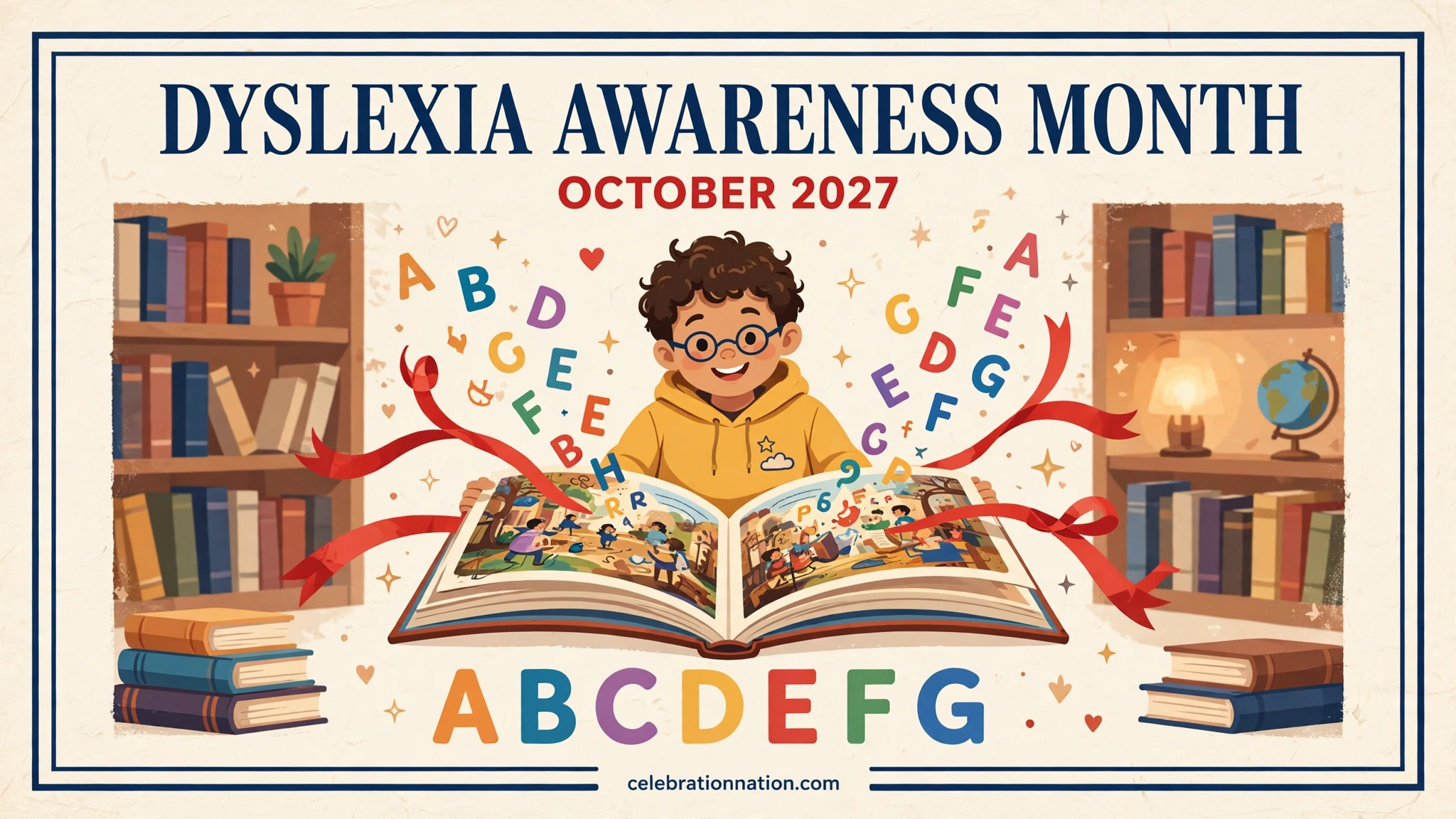
Dyslexia Awareness Month
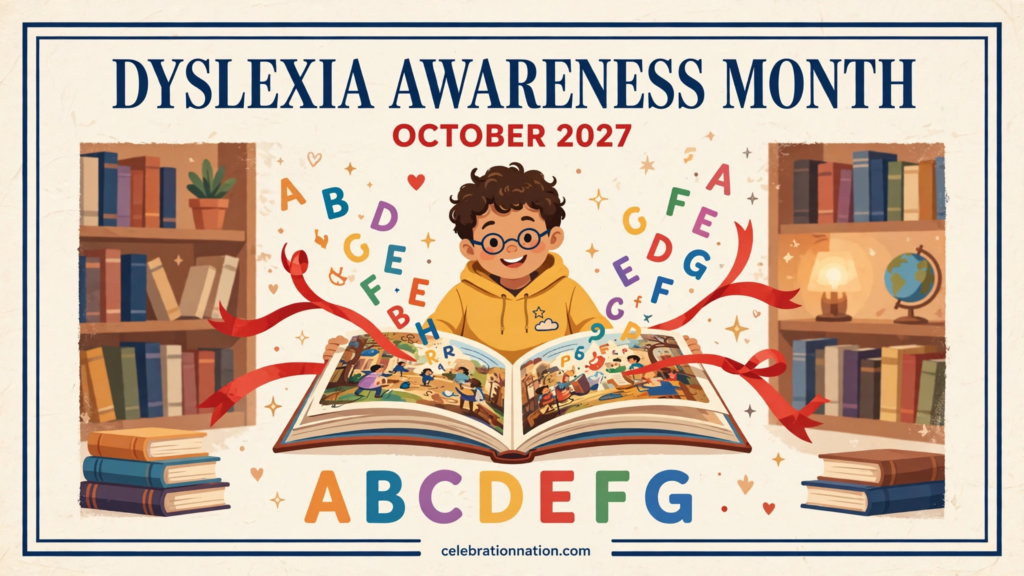
Every October, the world pauses to honor the way millions of brilliant minds read. Dyslexia Awareness Month, observed each October since 2002, shines a warm light on a learning difference that touches an estimated 15 to 20 percent of people, roughly one in five. It has no connection to intelligence, and most dyslexic thinkers have average or above-average IQs. This October, we celebrate different minds and the quiet courage it takes to learn differently.
- Hashtag
- #DyslexiaAwarenessMonth
DYSLEXIA AWARENESS MONTH
Every October, the world pauses to honor the way millions of brilliant minds read. Dyslexia Awareness Month, observed each October since 2002, shines a warm light on a learning difference that touches an estimated 15 to 20 percent of people, roughly one in five. It has no connection to intelligence, and most dyslexic thinkers have average or above-average IQs. This October, we celebrate different minds and the quiet courage it takes to learn differently.
Dyslexia is a specific learning disability that is neurobiological in origin. It is characterized by difficulties with accurate and fluent word recognition and by poor spelling and decoding abilities. These difficulties typically result from a deficit in the phonological component of language, and they are often unexpected in relation to a person’s other cognitive abilities. That last part matters enormously. A child with dyslexia can be sharp, curious, and quick in every way, and still struggle to make letters behave on a page. Understanding that gap, with kindness rather than judgment, is the heart of this month.
The observance itself is young, but its roots run deep. The International Dyslexia Association created Dyslexia Awareness Month in 2002 to raise public awareness about dyslexia and to help people living with it find the resources they need. That same year, the U.S. Senate first designated October as National Dyslexia Awareness Month, giving the observance an official home on the calendar. Since then, every October has carried the same gentle mission: promote accurate understanding, correct old misconceptions, and center the voices of people who live with dyslexia every day.
Behind the Association stands a love story of sorts. In 1948, June Orton founded an organization to continue the work of her late husband, Samuel Torrey Orton, a pioneer in understanding reading difficulties. She originally named it the Orton Society, and over the decades it grew into what is now the International Dyslexia Association, supporting individuals and professionals around the globe. From Samuel Torrey Orton’s research grew the Orton-Gillingham method, a multisensory teaching approach that remains foundational in dyslexia education to this day and has profoundly shaped how the world supports dyslexic learners.
Even the word itself tells a story. In the 1870s, doctors puzzled over patients who could see words clearly yet could not make sense of them, calling the condition “word blindness.” Then, in 1877, German ophthalmologist Rudolf Berlin coined a new term from Greek roots meaning “difficulty with words”: dyslexia. The new word shifted attention away from the eyes and toward the true relationship between the brain and written language. Nearly a century and a half later, that shift in understanding is still the work of every October.
One of the most harmful myths this month works to undo is the idea that struggling to read means struggling to think. Dyslexia cannot be treated with medication, and it is not a sign of laziness, stubbornness, or lack of effort. People with dyslexia often need therapy, innovative methods for learning, and persistent, patient care from the adults around them. When the condition goes undiagnosed, children are too often misread as slow learners or troublemakers, which could not be further from the truth. An accurate diagnosis, delivered with compassion, can change the entire direction of a young life.
So what does October actually look like? Educational institutions, advocacy groups, and families come together to organize workshops, seminars, reading events, and fundraising campaigns that support research and resources. Many people wear red, the color of dyslexia awareness, throughout the month, with October 8 observed as International Dyslexia Awareness Day. Schools highlight the strengths and talents that dyslexic students bring to the table. And across social media, individuals share personal stories that reframe dyslexia as a difference rather than a deficit, one honest story at a time.
The deeper purpose of the month is beautifully simple: early identification and evidence-based instruction. When a struggling reader is identified early and taught with methods that actually work for a dyslexic brain, the trajectory changes completely. Confidence grows. Reading becomes manageable. The child who once dreaded the classroom starts to believe in their own mind. That is why awareness matters so much. It is not about pity or labels. It is about making sure no child has to fight an invisible battle alone, and no parent has to figure it out without help.
Families have a special role to play, and October is the perfect time to start. If your child reverses letters, reads slowly despite obvious intelligence, or avoids reading altogether, those can be early warning signs worth bringing to a teacher or pediatrician. You do not need a diagnosis to begin helping: reading aloud together, playing rhyming games, and celebrating every small victory build the foundation that formal instruction will later strengthen. And if dyslexia is confirmed, know this: you are joining a large, warm, well-organized community of families who have walked this road and are eager to share what they have learned.
There is a reverence to this month that sets it apart. It asks us to slow down and remember that every mind arrives with its own wiring, its own gifts, and its own way of taking in the world. A dyslexic thinker may read more slowly and imagine more vividly, may stumble over spelling and soar at problem-solving. October invites us to honor all of that, to teach with patience, to listen with humility, and to build classrooms and workplaces where different minds are not merely accommodated but genuinely welcomed.
THE STORY BEHIND DYSLEXIA AWARENESS MONTH
🏛 The 2002 Beginning
The International Dyslexia Association created Dyslexia Awareness Month in 2002, and that same year the U.S. Senate first designated October as National Dyslexia Awareness Month.
👩 June Orton’s Promise
In 1948, June Orton founded the Orton Society to continue her late husband Samuel Torrey Orton’s pioneering work helping people with dyslexia. It later grew into the International Dyslexia Association.
📖 A Word Is Born
In 1877, German ophthalmologist Rudolf Berlin coined the word “dyslexia” from Greek roots meaning “difficulty with words,” shifting attention from the eyes to the brain’s relationship with written language.
🧠 Intelligence, Untouched
Dyslexia has no connection to intelligence. The vast majority of dyslexic people have average or above-average IQs. It is a difference in how the brain processes written language, never a measure of ability.
🎓 The Orton-Gillingham Way
The multisensory Orton-Gillingham teaching method, built on Samuel Torrey Orton’s research, remains foundational in dyslexia education and has shaped how the world supports dyslexic learners.
WAYS TO CELEBRATE
❤️ Wear Red for Dyslexia
Red is the color of dyslexia awareness in October. Wear it proudly, especially on October 8, International Dyslexia Awareness Day, and tell someone the reason you are wearing it.
🏠 Learn the Signs at Home
Read the IDA’s plain-language guide to the early signs of dyslexia so your family can recognize them, push for early screening, and ask schools for evidence-based reading instruction.
👥 Share a Story of a Different Mind
Gather friends and share stories of dyslexic artists, inventors, and entrepreneurs, then post a favorite book and celebrate the many wonderful ways a mind can read.
Celebrate Dyslexia Awareness Month
This October 2027, honor every reader who learns differently. See the strengths, share the stories, and help build a world where no brilliant mind is ever mistaken for a broken one.
Coming up next
See the calendar


Celebrate every day, all year
Official gear from the people who track 1,700+ celebrations.
Browse the shop 2027 National Day Wall CalendarGet the 2026 edition free. 1,700+ observances.
Never miss a reason to celebrate.
One quick morning email with today's celebrations, ideas and posters. Free, unsubscribe anytime.
🎉 You're on the list! Watch your inbox for The Daily Confetti.