



Law Day
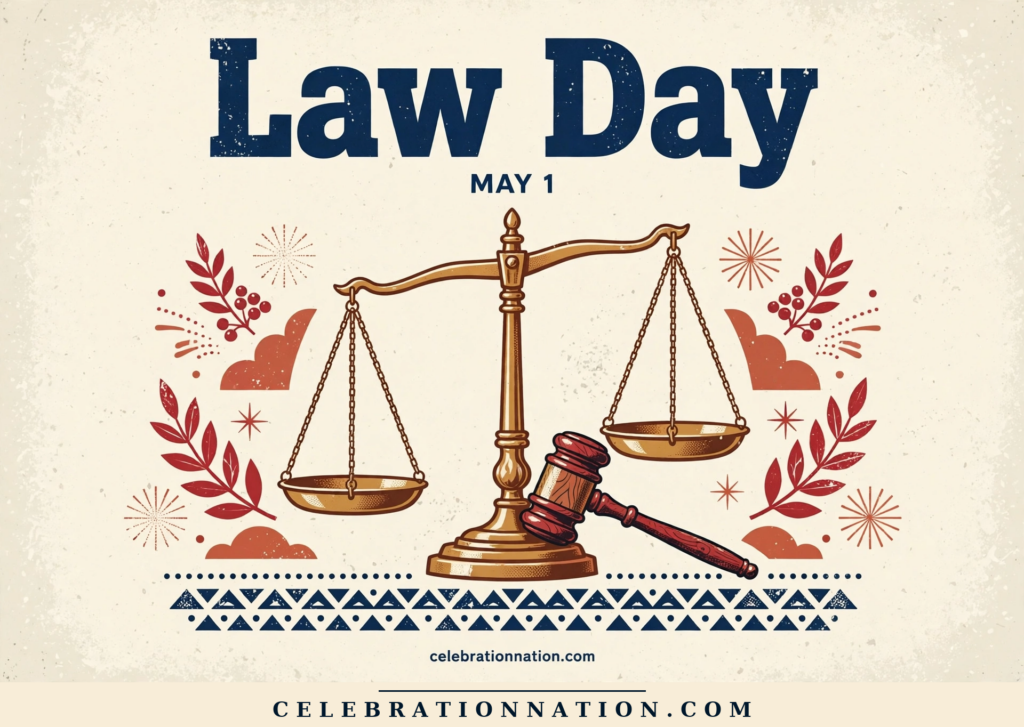
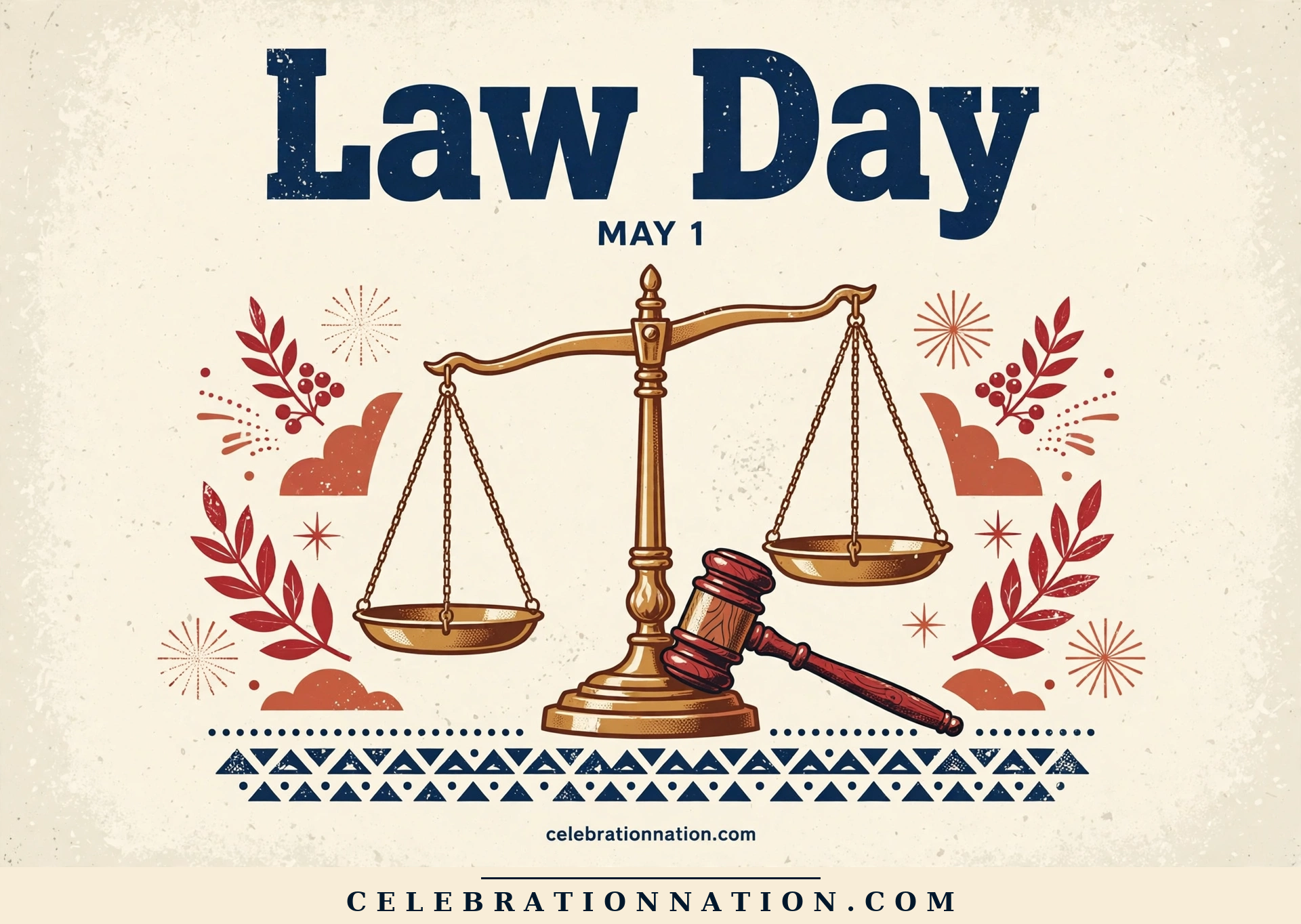
The rule of law made into a holiday. Law Day on May 1 is the American civic observance dedicated to celebrating the principle that sets us apart — that the law applies equally to everyone, including the people who write it.
- Vibe
- Civic & Upright
- Also on May 1
- Global Love Day · International Workers’ Day · May Day
- Hashtag
- #LawDay
Ways to celebrate
Engage with the actual institutions:
- 📖 Read the Constitution. Or the Bill of Rights. Or the Declaration. Less time than you'd think; more interesting than you remember.
- 🏛️ Attend a court session. Most state and federal courts are open to the public. Watching a real case is educational in ways school isn't.
- ✍️ Write to a representative. About any law, any issue. Civic engagement is the whole point of Law Day.
- 🗳️ Check your voter registration. Usa.gov. 30 seconds. Every American should verify once a year.
- 📚 Read one classic of American legal history. Gideon's Trumpet, A Civil Action, The New Jim Crow. Every one of these shaped a generation of lawyers.
Make it your kind of celebration
Family
Read the Bill of Rights together at dinner. Ten amendments, 462 words, one great conversation starter.
Kids
Kids understand fairness instinctively. Tell them what the rule of law means: "The law applies to everyone the same, including the people who make it."
Couples
Attend a city council meeting together. The most accessible, low-stakes encounter with real government you can have.
Office
Offices in legal, finance, or compliance should absolutely recognize Law Day. Even a short note from leadership about integrity and law makes a mark.
School
Mock trial is the perfect Law Day classroom activity. Every age can do a version. Students remember the ones they participate in.
Community
Most bar associations run free legal clinics on Law Day. Great community resource; many people who need legal help don't know they exist.
Just me
Read one Supreme Court opinion. A short one. Gideon v. Wainwright is 9 pages and changed American criminal law forever.
Plan ahead
Law Day is observed on May 1 every year. Here is where it lands for the next ten years, handy for planners, marketers and party people.
Fast facts
The story
Law Day was created by President Dwight Eisenhower in 1958, and the timing was deliberate. May 1 was the globally-recognized International Workers' Day with strong socialist associations, and Eisenhower wanted a distinctly American alternative.
Read the full story
In 1957, the American Bar Association's president, Charles S. Rhyne, proposed the idea to President Eisenhower: a day celebrating the American legal tradition. Eisenhower, a Cold War president deeply concerned about the international appeal of communism, saw the value immediately. May 1 was International Workers' Day, a date with strong socialist and Marxist associations, celebrated in Moscow with massive military parades through Red Square.
On February 3, 1958, Eisenhower proclaimed May 1 as Law Day, U.S.A. In his proclamation, he wrote: "In a very real sense, the world no longer has a choice between force and law. If civilization is to survive, it must choose the rule of law." In 1961, Congress formally codified Law Day by joint resolution, making it a federal civic observance (though not a federal holiday).
The American Bar Association chooses a theme for Law Day each year. Past themes have included "The Rule of Law", "Miranda: More Than Words", "Voting Rights: Challenges and Change," and "Separation of Powers." Bar associations nationwide host events, free legal clinics, mock trials in schools, speeches at courthouses, public readings of founding documents. Many law firms and legal organizations host pro bono service days.
Law Day's quiet power lies in what it asks of ordinary citizens. Not to be lawyers, to be participants. To read the documents. To know our rights. To notice when the law is applied unevenly. The founding premise of American democracy is that an informed citizenry is its own check on power. Law Day is one day a year that premise gets an official civic nudge.
Four documents every American citizen should have actually read:
Six cases that fundamentally changed American life. Worth looking up each one:
Did you know?
The Constitution is the oldest written national constitution in use.
Ratified 1788, in continuous effect since 1789. 235+ years. Most national constitutions are rewritten every few decades; America's has been amended 27 times but never replaced.
The Bill of Rights was almost not ratified.
Several framers (including Hamilton) opposed adding a bill of rights, arguing it was unnecessary and might imply unlisted rights weren't protected. The 9th Amendment was added specifically to address that concern.
There are ~1.3 million lawyers in the U.S.
More than any other country by raw number. About 1 lawyer per 250 Americans. Attorney density is highest in Washington D.C. and New York.
The Supreme Court has only 9 Justices by tradition.
The Constitution doesn't specify the number. It has ranged from 5 to 10 over history. Congress set it at 9 in 1869 and it has stayed there since, though the number is not constitutionally fixed.
Keep the party going
See the calendar


Celebrate every day, all year
Official gear from the people who track 1,700+ celebrations.
Browse the shop 2027 National Day Wall CalendarGet the 2026 edition free. 1,700+ observances.
Never miss a reason to celebrate.
One quick morning email with today's celebrations, ideas and posters. Free, unsubscribe anytime.
🎉 You're on the list! Watch your inbox for The Daily Confetti.