









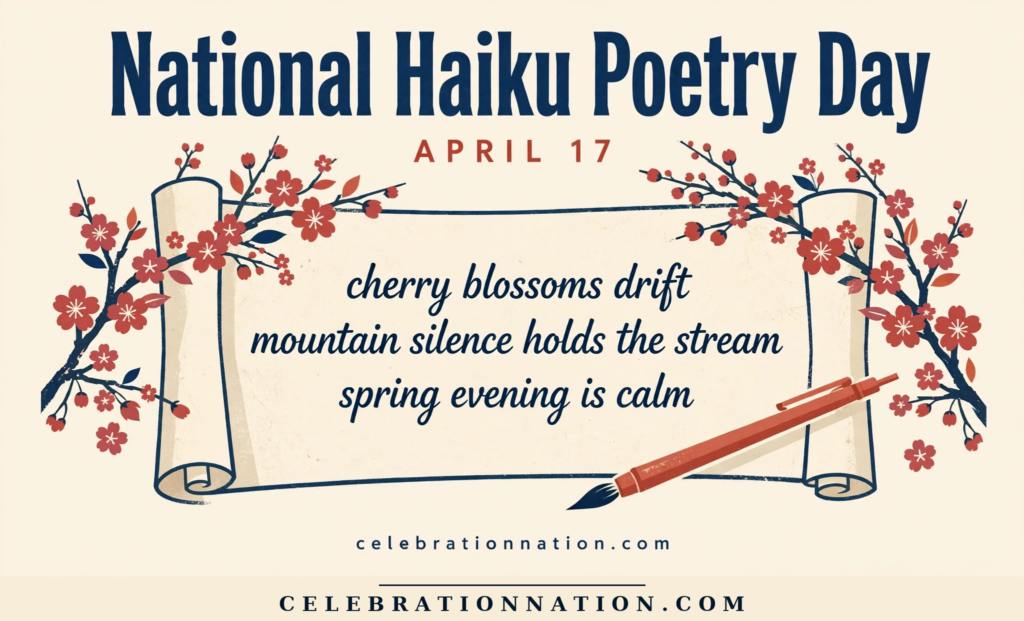
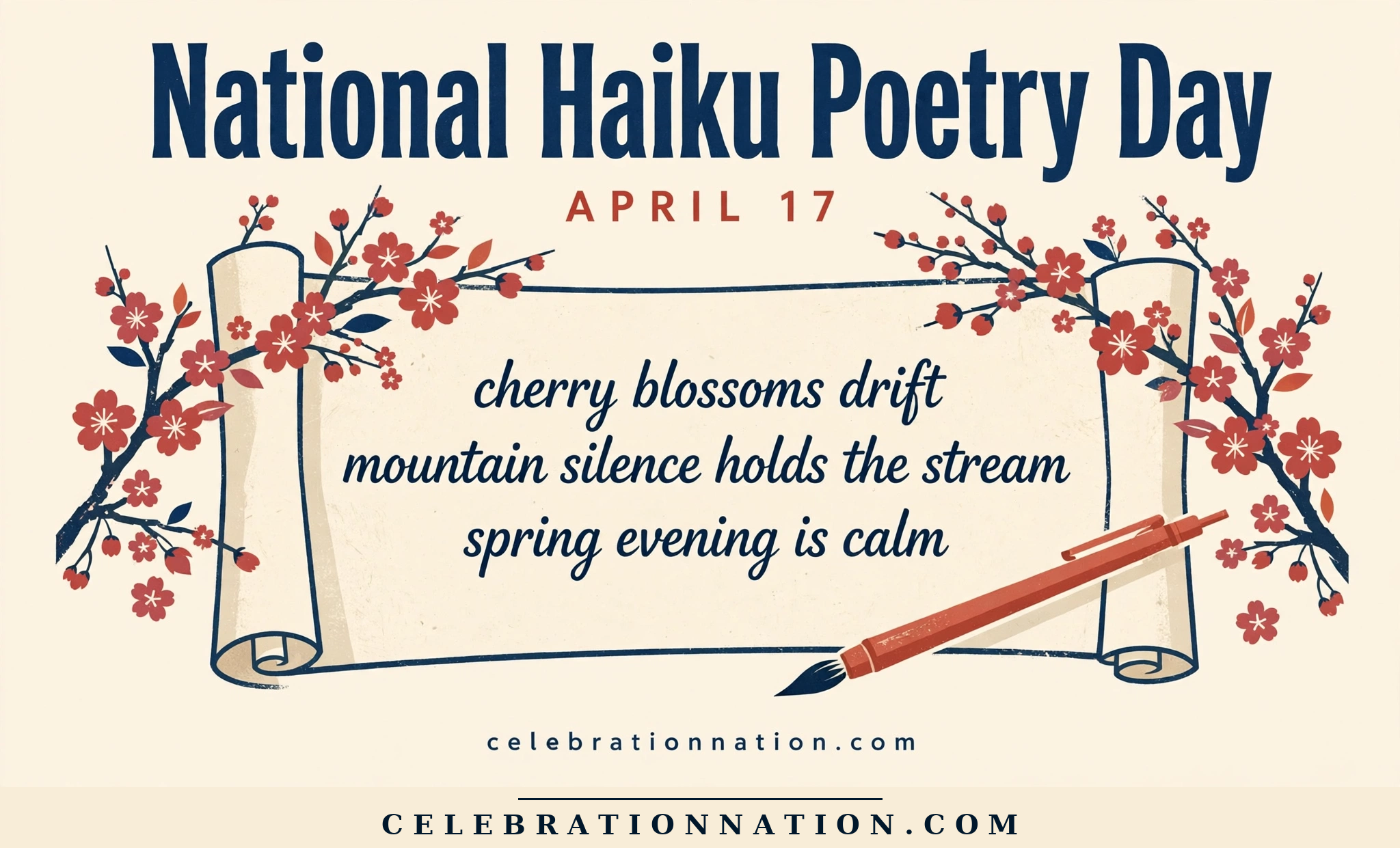
National Haiku Poetry Day
Seventeen syllables. Three lines. An image that stays with you. National Haiku Poetry Day on April 17 honors the smallest, quietest, most precise poetic form humans have ever invented.
- Roots
- 17th-cent Japan
- Vibe
- Precise
- Also on Apr 17
- World Hemophilia Day · Bat Appreciation Day · Ellis Island Family History Day
- Hashtag
- #NationalHaikuPoetryDay
Ways to celebrate
Write one; read ten; share one:
- 📝 Write your own. Pick a season, an image, a moment. Three lines. Five-seven-five syllables. Done.
- 📚 Read Bashō. The master. Matsuo Bashō's 17th-century haikus are the form's foundation.
- 🖋️ Write 10 today. The form's virtue: you can write fast. Most haikus take less time than reading them.
- 🎨 Pair with a photo. Haiku + image is a beloved modern form. Takes 5 minutes; social-media ready.
- 📮 Send one to a friend. A haiku in a text is surprisingly touching. Weirdly intimate.
Make it your kind of celebration
Family
Family haiku dinner game. Each person writes one on a napkin; read around the table; funniest one wins.
Kids
Haiku is the perfect kid-level poetry form. Clear rules, short, satisfying. Great K-6 teaching tool.
Couples
Exchange haikus at dinner. Three lines each, about the day or the other person. Charming; low-stakes.
Office
One-haiku Monday meetings: everyone opens with a haiku about their weekend. Improves morale measurably.
School
Haiku is a standard poetry unit for good reason. Kids produce real poems they're proud of. Works K-12.
Community
Library haiku contests are great community events. Low-entry barrier; rewarding to judge.
Just me
A commute-scale haiku per day. Write one at lunch, one on the walk, one before bed. Pays off after a week.
Plan ahead
National Haiku Poetry Day is observed on April 17 every year. Here is where it lands for the next ten years, handy for planners, marketers and party people.
Fast facts
The story
The haiku as we know it is 400 years old, a Japanese invention that became a world form.
Read the full story
Haiku descends from a longer Japanese poetic form called renga linked verse, where one poet wrote the opening three lines and subsequent poets added linked verses. By the 17th century, the opening three lines (hokku) had become a form of their own, detachable and complete. Matsuo Bashō (1644-1694) is considered the first great master. His haikus introduced the deep emotion, seasonal imagery, and spiritual resonance that define the form.
Bashō's most famous haiku is almost untranslatable: Furuike ya / kawazu tobikomu / mizu no oto. Common translation: "Old pond, / a frog jumps in: / sound of water." The haiku is 400 years old; it still feels contemporary. That's the form's genius, a brief moment, precisely captured, opens into something larger.
A true haiku has technical requirements beyond 5-7-5 syllables. It should include a kigo (seasonal word) that anchors it in nature. It should have a kireji ("cutting word") that creates a pause or juxtaposition between two images. It should be grounded in an observed moment, not abstract. Most American "haikus" don't meet these criteria they're 17-syllable verses. The form is more demanding than it looks.
Haiku reached America in the early 20th century, popularized by Ezra Pound's Imagist movement. The Beats (Gary Snyder, Jack Kerouac, Allen Ginsberg) wrote haikus in the 1950s-60s. Richard Wright wrote 4,000 haikus in the last year of his life. Today there are haiku societies in every major American city, haiku magazines, haiku conferences. National Haiku Poetry Day, April 17 in the U.S., was established by the Haiku Foundation in 2007. The form remains small, quiet, and disproportionately loved.
Four elements that separate a real haiku from a 17-syllable fragment:
Six poets worth reading today, from 17th-century Japan to modern America:
Did you know?
Bashō walked 1,200 miles for a book of poetry.
Between 1689 and 1691, Bashō walked across northern Japan writing his masterwork, The Narrow Road to the Deep North. It interweaves prose and haiku. Considered one of the great travel books in world literature.
Richard Wright wrote 4,000 haikus in his last year.
Wright, author of Native Son and Black Boy, wrote 4,000 haikus while dying of illness in Paris in 1960. Published posthumously as Haiku: This Other World. Extraordinary final work.
Bashō's frog poem has 1,000+ English translations.
"An old pond / a frog jumps in / sound of water." Robert Hass alone has translated it multiple times. Each translator brings something different; no definitive English version exists.
There are three U.S. haiku societies.
Haiku Society of America (1968, main), Haiku North America (conferences), The Haiku Foundation. All active; all publish journals. Haiku is a real living practice in the U.S.
Keep the party going
See the calendar



Celebrate every day, all year
Official gear from the people who track 1,700+ celebrations.
Browse the shop 2027 National Day Desk CalendarA new celebration every morning. Daily tear-off.
Never miss a reason to celebrate.
One quick morning email with today's celebrations, ideas and posters. Free, unsubscribe anytime.
🎉 You're on the list! Watch your inbox for The Daily Confetti.