
National Macaroon Day
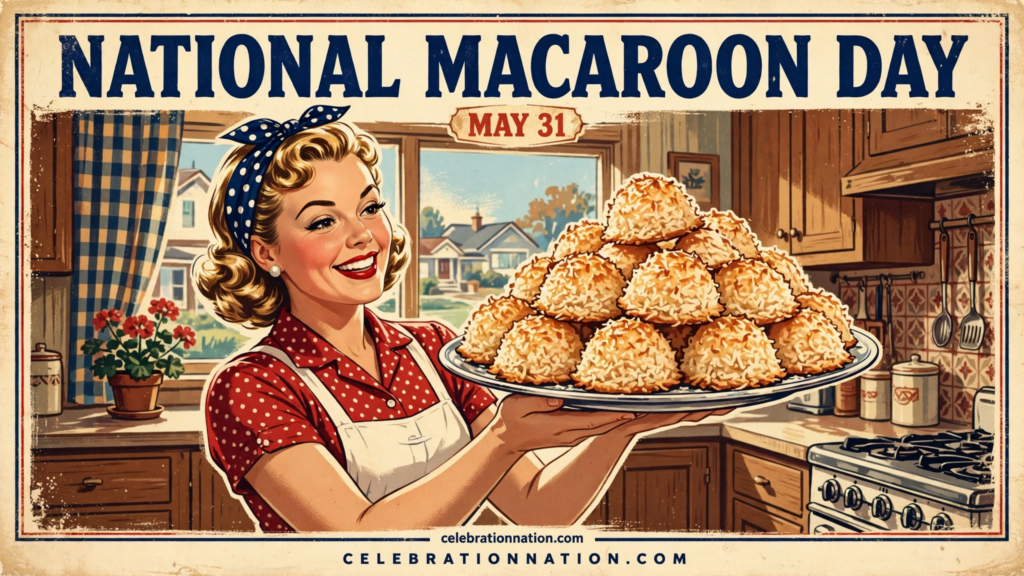
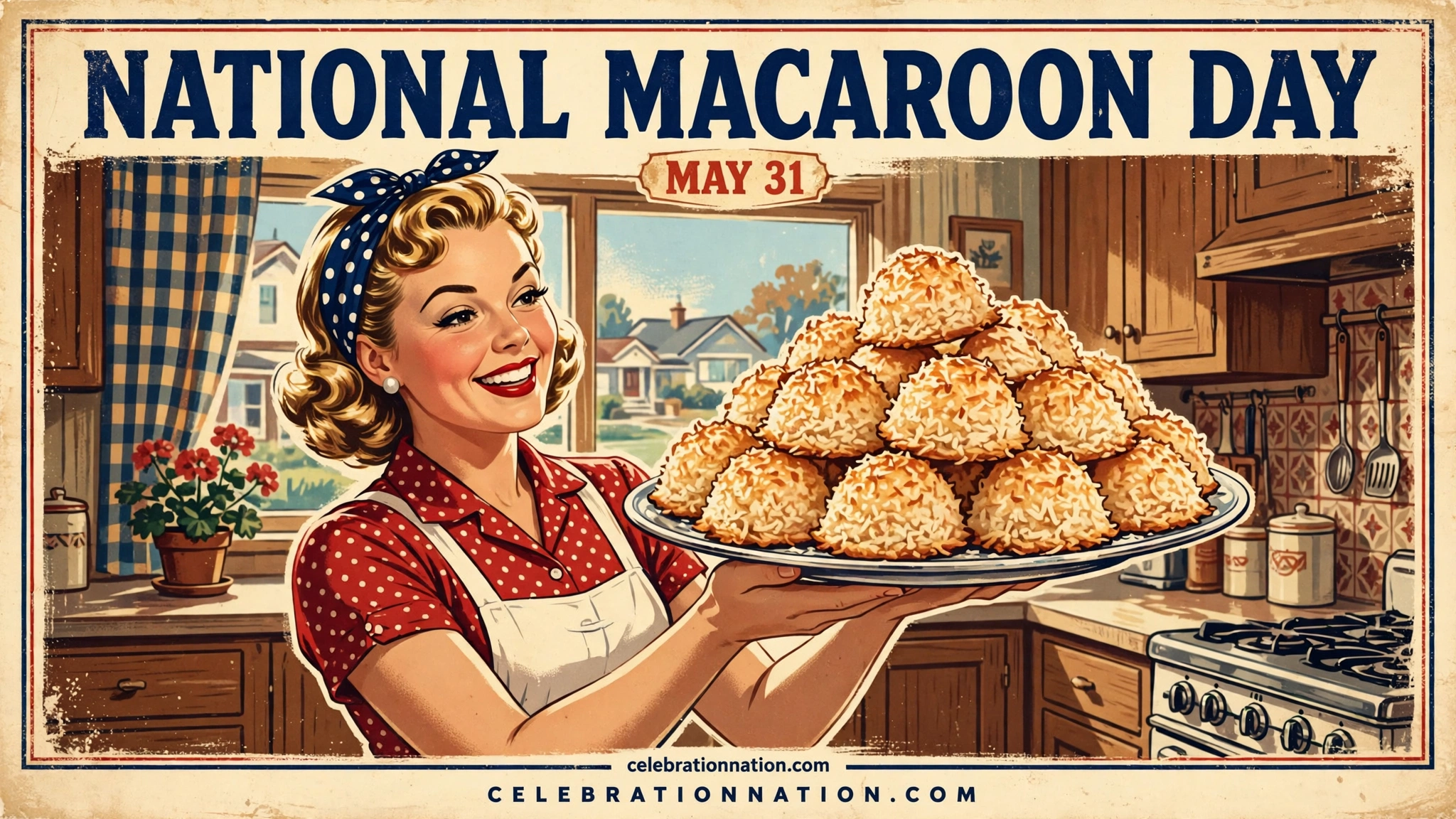
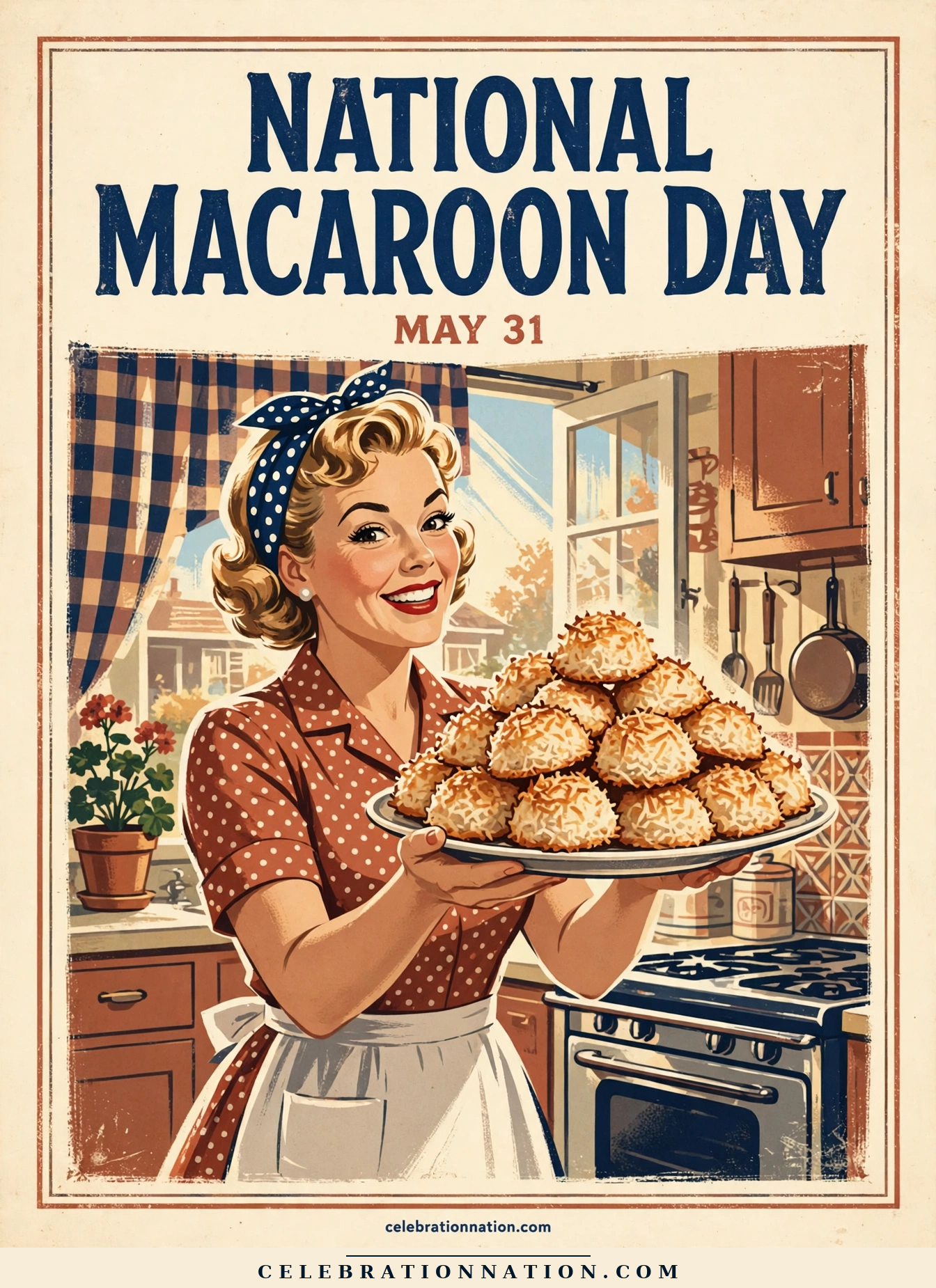
National Macaroon Day on May 31 celebrates the coconut cookie that's been an American dessert staple for a century — chewy coconut mounds dipped in chocolate, the universal cookie of Passover and kosher baking. Not to be confused with the French macaron (two meringue cookies sandwiching ganache), the American coconut macaroon is its own distinct cookie — simpler, richer, and deeply tied to American and Jewish-American baking tradition.
- Roots
- 9th-century Italian monasteries
- Vibe
- Simple & Chewy
- Also on May 31
- International Flight Attendant Day · Smile Day · Speak in Complete Sentences Day
- Hashtag
- #NationalMacaroonDay
Ways to celebrate
Bake, dip, savor:
- 🍪 Bake classic coconut macaroons. Egg whites, sugar, unsweetened shredded coconut, vanilla. Mix, drop, bake 15 min at 325°F. Extremely simple.
- 🍫 Dip in chocolate. Melted semi-sweet chocolate, dip half the macaroon, let set. Elevates a simple cookie.
- 🥥 Try Swiss macaroons. A variation with less coconut and more almond, sometimes enrobed in chocolate.
- 🎂 Use them as passover sweets. Passover (April 2026) features macaroons as standard dessert. Canned Manischewitz or homemade.
- 🥂 Pair with wine. Dessert wine — Moscato or late-harvest Riesling — matches macaroons beautifully.
Make it your kind of celebration
Family
Family macaroon baking — simple, fast, nearly foolproof. Kids can mix and drop cookies onto the sheet.
Kids
Kids love macaroons — chewy, coconut, sweet. Chocolate-dipped version is the kid favorite.
Couples
Couples macaroon-baking night. Simple 4-ingredient cookie; 30 minutes; romantic in its low-key-ness.
Office
Office macaroons — bring a batch for the office break room. Cookie tray universally appreciated.
School
Macaroons are classic school-fundraiser cookies. Easy to mass-produce; kosher/gluten-free by default.
Community
Passover (April) means macaroons across Jewish-American bake sales, synagogue breakfasts, community dinners.
Just me
A single macaroon with coffee is perfect. Buy one from a kosher bakery if you don't want to bake.
Plan ahead
National Macaroon Day is observed on May 31 every year. Here is where it lands for the next ten years, handy for planners, marketers and party people.
Fast facts
The story
Macaroons and macarons share a common ancestor, 9th-century Italian monks in the Abbey of Monte Cassino who developed almond-flour cookies called 'maccheroni.' The word derives from Italian 'maccherone' (a fine paste). The almond cookie spread through Italian and French courts by the 1500s. In France, it evolved into the macaron (the sandwich cookie of ganache between two meringue discs). In Italy and later in American Jewish tradition, it evolved into the macaroon, larger, coconut-based, and chewy.
Read the full story
The American coconut macaroon emerged in the 1800s, when Caribbean coconut trade made coconut a common American pantry item. Shredded coconut replaced almond flour in many macaroon recipes, creating a distinct American style. By the 1900s, coconut macaroons were standard in American bakeries. They were particularly important to American Jewish bakers because macaroons are naturally flourless (just coconut, egg whites, sugar), making them suitable for Passover, the Jewish spring holiday that prohibits leavened grains.
Manischewitz, the iconic American Jewish food company, introduced canned macaroons in the 1920s. Canned Manischewitz macaroons became the universal American Passover cookie, shelf-stable, reliably tasty, sold in every American supermarket during Passover season. The company's expansion into diverse macaroon flavors (chocolate-chip, almond, chocolate-dipped) kept it a cultural staple for 100+ years.
Modern American macaroon culture includes boutique bakeries selling handmade versions, kosher bakeries in Orthodox Jewish neighborhoods, and the continued Manischewitz industrial production. Chocolate-dipped macaroons (dipping the cookie half in melted chocolate) became a defining modern variation in the 1980s. The French macaron (trendy since 2005 due to bakeries like Ladurée and Pierre Hermé) has caused naming confusion, many Americans now conflate the two desserts. National Macaroon Day on May 31 specifically honors the American coconut macaroon, a humble, enduring classic.
Regional and stylistic differences:
Regional interpretations of the cookie:
Did you know?
Macaroons are gluten-free by default.
Traditional macaroons have no wheat flour, just coconut, egg whites, sugar, vanilla. This made them important for Passover (no leavened grains), and makes them appealing to modern gluten-free eaters.
Macarons (French) and macaroons (American) are often confused.
French 'macaron' (two meringue discs with ganache between) is different from American 'macaroon' (coconut cookie). The naming confusion is a constant American bakery frustration.
Manischewitz sold 2M+ cans per year at peak.
Manischewitz canned macaroons, the classic Passover staple, sold 2 million+ cans annually in the 1970s-80s. Still widely sold; brand remains iconic in American Jewish food culture.
Coconut macaroon recipe is extraordinarily old.
The modern American coconut macaroon recipe appears in 19th-century American cookbooks essentially unchanged. Amelia Simmons's 'American Cookery' (1796), the first American cookbook, includes a related almond-based version.
Keep the party going
See the calendar

Celebrate every day, all year
Official gear from the people who track 1,700+ celebrations.
Browse the shop 2027 National Day Wall CalendarGet the 2026 edition free. 1,700+ observances.
Never miss a reason to celebrate.
One quick morning email with today's celebrations, ideas and posters. Free, unsubscribe anytime.
🎉 You're on the list! Watch your inbox for The Daily Confetti.