


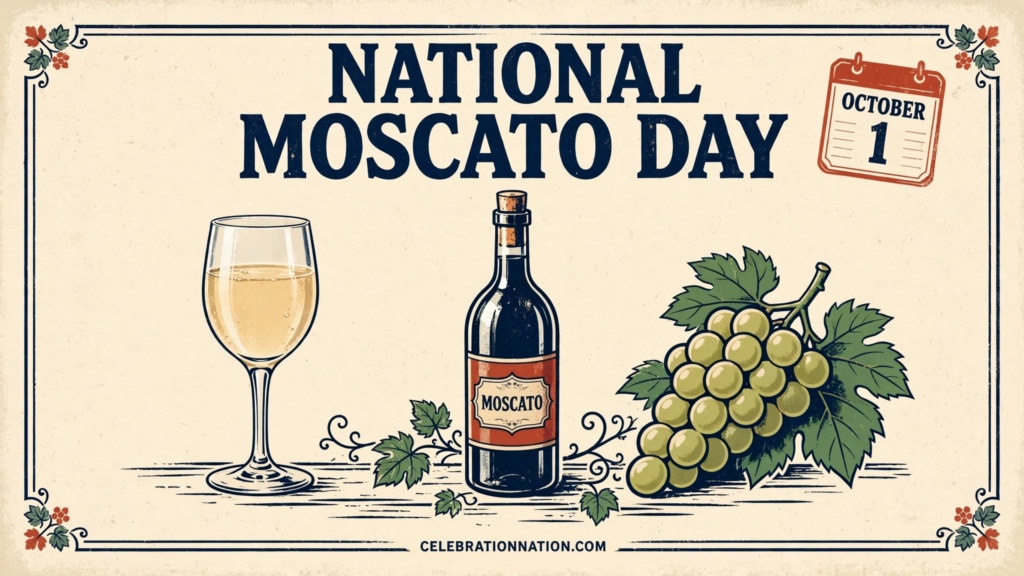
National Moscato Day
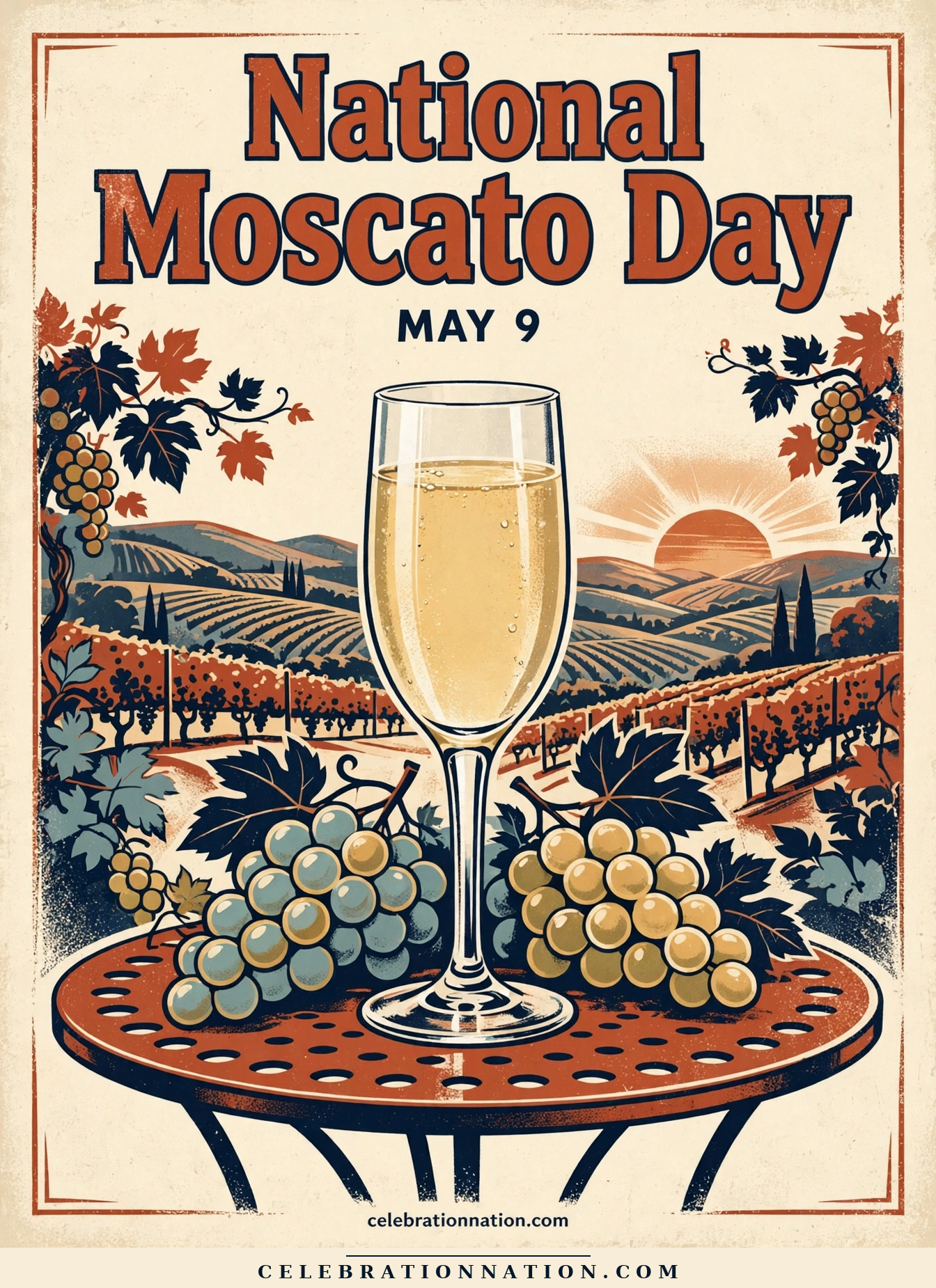
National Moscato Day on May 9 honors the light, floral, faintly sweet, slightly sparkling wine that's become the most surprising American wine success story of the 21st century. Moscato sales in the US grew 600% between 2005 and 2015, driven by affordability, approachability, and hip-hop endorsements. A day to appreciate the grape that reintroduced Americans to Italian wine.
- Vibe
- Light & Celebratory
- Also on May 9
- Birth Mother’s Day · Wanna Have a Catch Day · Stamp Out Hunger Food Drive Day
- Hashtag
- #NationalMoscatoDay
Ways to celebrate
Pour, sip, share:
- 🍷 Try authentic Moscato d'Asti. Vietti, Saracco, Marenco — the small-producer Piedmont versions are worlds better than supermarket Moscato. $15-25 per bottle; transformative.
- 🍓 Pair with strawberries and cream. The classic Italian pairing — simple, perfect. Or peaches in summer; grilled stone fruit works beautifully.
- 🧀 Try with blue cheese. Moscato + Gorgonzola is one of Italy's great counter-intuitive pairings. Sweet wine + salty cheese = magical.
- 📚 Read Karen MacNeil's 'The Wine Bible.' The most approachable American wine reference; Moscato chapter is excellent.
- 🎵 Host a wine night. Moscato + board games + friends. Low-alcohol means long conversations.
Make it your kind of celebration
Family
Adult-only beverage — but great for multi-generational family dinners. Italian grandmothers approve.
Kids
Not for kids. But making a 'virgin Moscato' with sparkling lemonade, mint, and strawberries gives kids a festive drink for the same party.
Couples
Wine-and-cheese night at home: Moscato d'Asti, blue cheese, fresh fruit, good bread. Date-night perfection.
Office
Office holiday party or celebration event. Moscato is universally pleasant; low-alcohol means fewer awkward moments.
School
Obviously not for students — but in adult education settings, Moscato is a great intro-to-wine-tasting grape. Approachable, non-intimidating.
Community
Wine-tasting at a community event with a 'Italian Moscato vs. American Moscato' theme. Educational and fun.
Just me
A glass of Moscato d'Asti + a good book + a Friday evening. Low-alcohol, light, easy.
Plan ahead
National Moscato Day is observed on May 9 every year. Here is where it lands for the next ten years, handy for planners, marketers and party people.
Fast facts
The story
Muscat is ancient. DNA analysis of the Muscat Blanc à Petits Grains grape suggests it was cultivated in the eastern Mediterranean 3,000+ years ago, one of the oldest wine grapes in continuous cultivation. The grape spread through the Roman world; by the Middle Ages, it was widespread across Italy, France, Greece, and Spain. 'Moscato' is the Italian name; 'Muscat' the French; 'Moscatel' the Spanish. All the same grape family, rendered regionally.
Read the full story
The specifically Italian Moscato d'Asti, from the Asti region of Piedmont in northwestern Italy, emerged as a distinct style in the 1800s. Unlike most wines, it's only lightly fermented: sugar is left unfermented (5-6% alcohol instead of 12-14%), and the wine is naturally 'frizzante' (lightly sparkling). Traditional Italian families drink it at Easter and Christmas morning breakfast, with panettone or fresh fruit. A gentle celebratory wine, not a main-course partner.
For most of American wine history, Moscato was a minor category. Italian-American families knew it. A few Italian restaurants carried it. But in the mid-2000s, something shifted. In the late 2000s and early 2010s, US Moscato sales surged at one point the fastest-growing varietal wine in the country. A combination of factors drove it: affordable price ($5-12 for entry-level bottles), approachable sweetness (a contrast to dry wines that intimidate new drinkers), and, significantly, hip-hop endorsements. Drake's "Do It Now" (2009), Nicki Minaj, and Lil Kim all name-checked Moscato in hit singles; the cultural momentum was real.
Today's Moscato landscape is wide. Authentic Moscato d'Asti from small Piedmont producers (Saracco, Vietti, Marenco, La Spinetta) is exceptional, nuanced, balanced, delicate. Large-scale commercial Moscato (Barefoot, Bartles & Jaymes) dominates grocery stores and is designed for casual drinking. Asti Spumante (a fully sparkling version) is popular at celebrations. Pink Moscato (made by blending Muscat with red wine or red Muscat grapes) is a distinctly American invention. Moscato has democratized American wine, it's often the first wine Americans try. And for many, it's the wine they come back to.
Very different wines; all called 'Moscato':
Six regional Muscat/Moscato traditions:
Did you know?
Hip-hop drove the American boom.
Drake's 'Do It Now' (2009), Nicki Minaj, Lil Kim, and Kanye West all name-checked Moscato in hit songs. Industry analysts have credited hip-hop culture with a significant share of the sales boom. The cultural moment was real and measurable.
Moscato is the slowest-fermented wine.
Moscato d'Asti fermentation is deliberately halted by chilling before all the sugar has converted to alcohol, typically when the wine reaches 5-6% alcohol. The resulting wine retains the grape's natural sugar. A specific technique called 'partial fermentation' or 'arrested fermentation.'
Some American 'Moscato' isn't Muscat.
A handful of American 'Moscato'-labeled wines contain Moscato Canelli (a related but distinct Muscat variety), and some budget producers blend Muscat with other grapes. Look for 'Moscato Bianco' or 'Muscat Blanc à Petits Grains' on authentic labels.
Italian families drink it on Easter morning.
The classic Italian Easter breakfast in Piedmont includes Moscato d'Asti with colomba (Easter sweet bread). The tradition of light, morning sparkling wine on Easter is centuries-old and still practiced in Italian families worldwide.
Keep the party going
See the calendar
Celebrate every day, all year
Official gear from the people who track 1,700+ celebrations.
Browse the shop National Day Celebration Card GameA party in a box, any day of the year.
Never miss a reason to celebrate.
One quick morning email with today's celebrations, ideas and posters. Free, unsubscribe anytime.
🎉 You're on the list! Watch your inbox for The Daily Confetti.