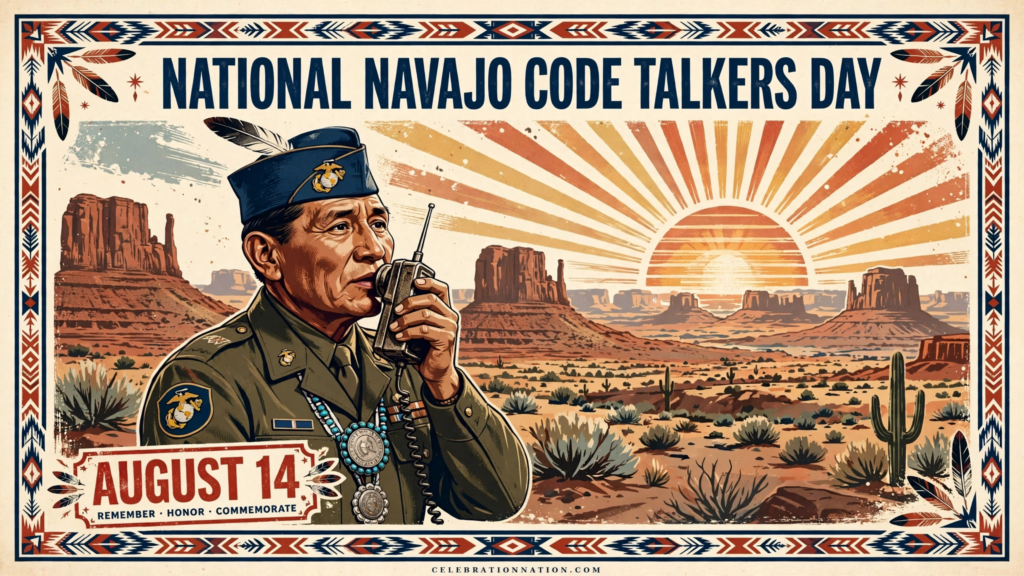
National Navajo Code Talkers Day
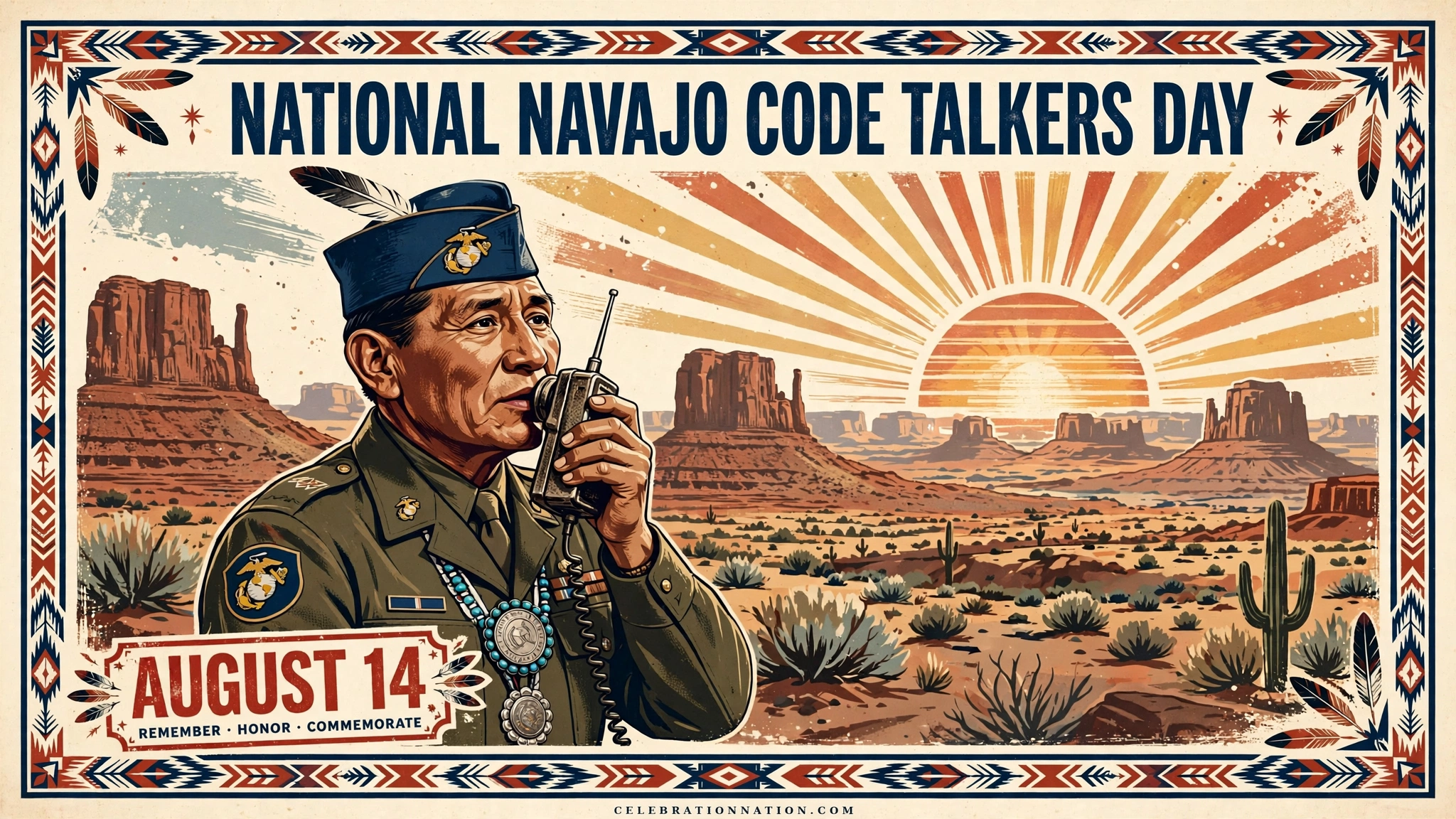
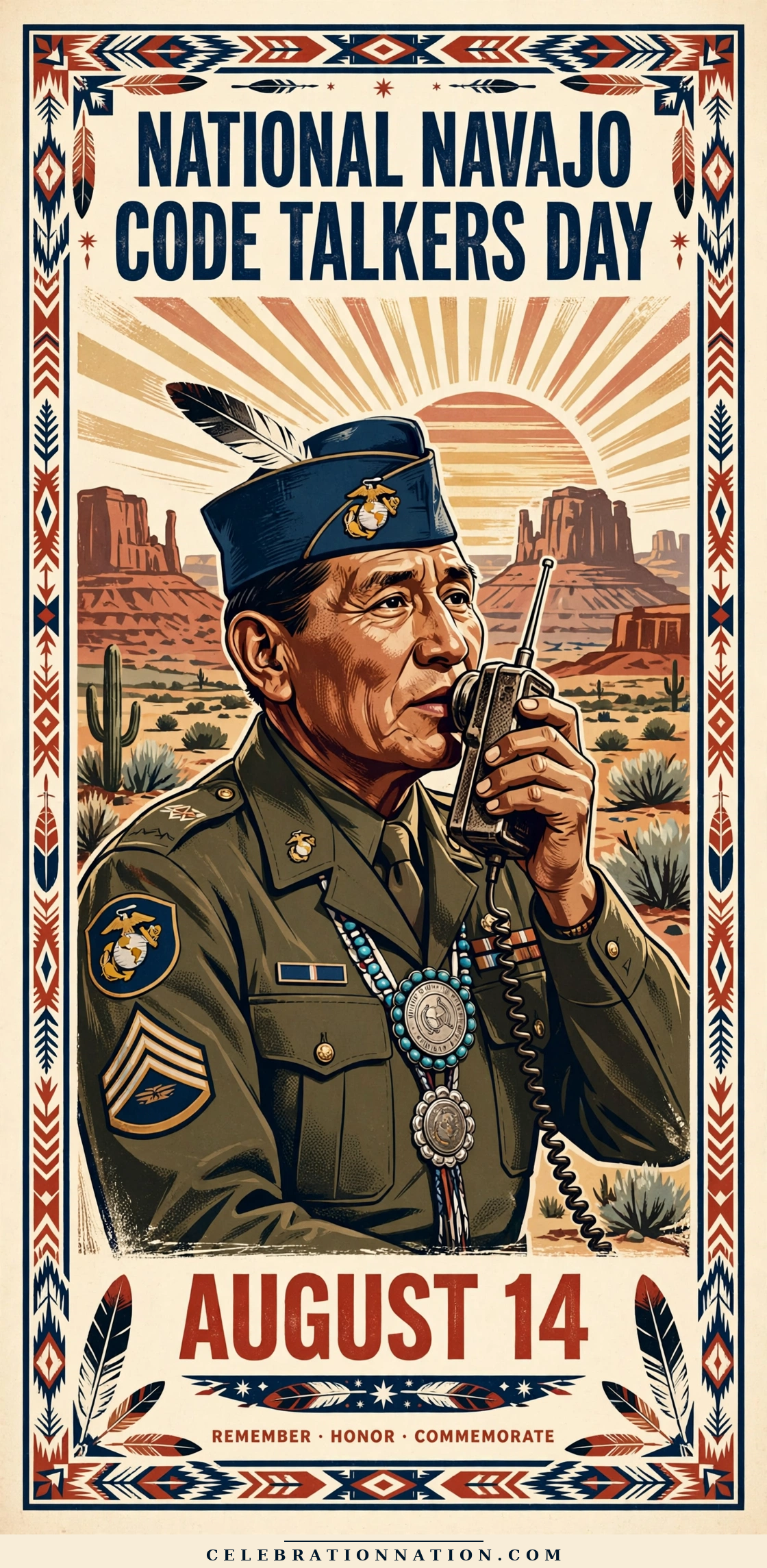
National Navajo Code Talkers Day acknowledges the extraordinary contributions of the Diné Marines whose unbreakable code was instrumental in Allied victories during World War II.
- Roots
- Presidential Proclamation
- Vibe
- Reverent, inspiring, educational
- Also on Aug 14
- Creamsicle Day · World Lizard Day
- Hashtag
- #NationalNavajoCodeTalkersDay
3 ways to celebrate
Learn their story
Read about the Code Talkers and their service.
Watch a documentary
Stream a film about them and discuss it.
Share the tribute
Post about their legacy in the newsletter.
Plan ahead
National Navajo Code Talkers Day is observed on August 14 every year. Here is where it lands for the next ten years, handy for planners, marketers and party people.
Fast facts
The story
In the crucible of World War II, as the United States faced an enemy adept at deciphering military communications, a unique solution emerged from an unexpected source: the Navajo language. In 1942, the U.S. Marine Corps began recruiting young Navajo men, known as Diné, to develop and transmit an unbreakable code. The Japanese, having broken every other code, found themselves utterly baffled by the complex, unwritten, and tonal nuances of the Navajo language. These initial 29 recruits, who trained at Camp Elliott, California, laid the foundation for a communication system that would prove pivotal in the Pacific Theater, embodying an extraordinary fusion of cultural heritage and military necessity.
Read the full story
The code itself was a marvel of linguistic innovation. It did not merely translate English words into Navajo; instead, it assigned Navajo words to represent military terms and English alphabet letters. For instance, the Navajo word for 'iron fish' (besh-lo) meant submarine, and 'hummingbird' (da-he-tih-hi) stood for fighter plane. This intricate system, combined with the fact that the Navajo language was largely unknown outside the Navajo Nation and had no written alphabet, created a cipher that was utterly incomprehensible to Japanese intelligence. Its speed and accuracy in transmitting critical messages, often faster than encryption machines, gave Allied forces a crucial tactical advantage.
Throughout the Pacific campaigns, from the grueling battles of Guadalcanal and Tarawa to the strategic assaults on Peleliu and Iwo Jima, the Navajo Code Talkers served on the front lines, often under intense enemy fire. Their communications were vital for coordinating troop movements, relaying strategic intelligence, and calling in artillery strikes. During the Battle of Iwo Jima, six Code Talkers worked continuously for 48 hours, transmitting over 800 messages without error, a testament to their unwavering precision and endurance. Major Howard Connor, a signal officer for the 5th Marine Division, famously stated, 'Were it not for the Navajos, the Marines would never have taken Iwo Jima,' underscoring their indispensable role.
Despite their extraordinary contributions, the heroism of the Navajo Code Talkers remained a classified secret for decades after the war, due to the potential for the code's future use. It was not until 1968 that their mission was declassified, and full public recognition began to emerge. In 1982, President Ronald Reagan declared August 14 as National Navajo Code Talkers Day, and in 2001, President George W. Bush awarded the Congressional Gold Medal to the original 29 Code Talkers. Their story stands as a powerful testament to the strength found in cultural identity, the enduring spirit of service, and a unique chapter in American history that continues to inspire and educate.
Did you know?
Code Origins
The original 29 Navajo Code Talkers developed the core of the code at Camp Elliott, California, in 1942, establishing the foundation for all future communications.
Code Language
The code consisted of over 200 terms, using Navajo words to represent English letters or military terms, such as 'gí-di' (goat) for 'G' and 'chay-da-gahi' (turtle) for 'tank'.
Recruitment Drive
The Marine Corps initially sought only 30 Navajo men for the program, but the demand for their unique skills quickly grew to over 400.
Iwo Jima's Lifeline
During the first two days of the Battle of Iwo Jima, six Navajo Code Talkers successfully transmitted over 800 messages without error, highlighting their critical efficiency.
Secrecy Maintained
Even after the war, the Code Talkers were instructed not to speak about their wartime service, and the code remained classified until 1968, preserving its strategic value.
Presidential Honor
In 2001, President George W. Bush presented the Congressional Gold Medal to the original 29 Navajo Code Talkers, finally bestowing the highest civilian honor.
Last Surviving Original
Chester Nez, the last of the original 29 Navajo Code Talkers, passed away in 2014 at the age of 93, marking the end of an era for the pioneering group.
Around the world
Every culture celebrates a little differently.
- USHomeland HeroesThe Code Talkers were primarily from the Navajo Nation, spanning parts of Arizona, New Mexico, and Utah, bringing their unique language to national service.
- JPUnbreakable AdversaryThe Code Talkers' efforts were directed against Imperial Japan, whose cryptographers famously failed to decipher the Navajo messages.
- PHLiberation CampaignsCode Talkers played a vital role in campaigns, including the liberation of the Philippines, ensuring secure communications for Allied forces.
- GUStrategic Island BattlesSignificant battles took place on Guam where the Code Talkers' rapid and secure communications were critical for Marine movements and strategy.
- IMCrucial CommunicationsThe Battle of Iwo Jima saw the Code Talkers transmit hundreds of messages without error, proving indispensable for the Allied victory.
- AUAllied Staging GroundsWhile not a direct combat zone for Code Talkers, Australia served as an important Allied base and staging area for many Pacific operations.
Keep the party going
See the calendar
Celebrate every day, all year
Official gear from the people who track 1,700+ celebrations.
Browse the shop 2027 National Day Desk CalendarA new celebration every morning. Daily tear-off.
Never miss a reason to celebrate.
One quick morning email with today's celebrations, ideas and posters. Free, unsubscribe anytime.
🎉 You're on the list! Watch your inbox for The Daily Confetti.